
Utah News Dispatch
What to know about the money flowing to help the Great Salt Lake


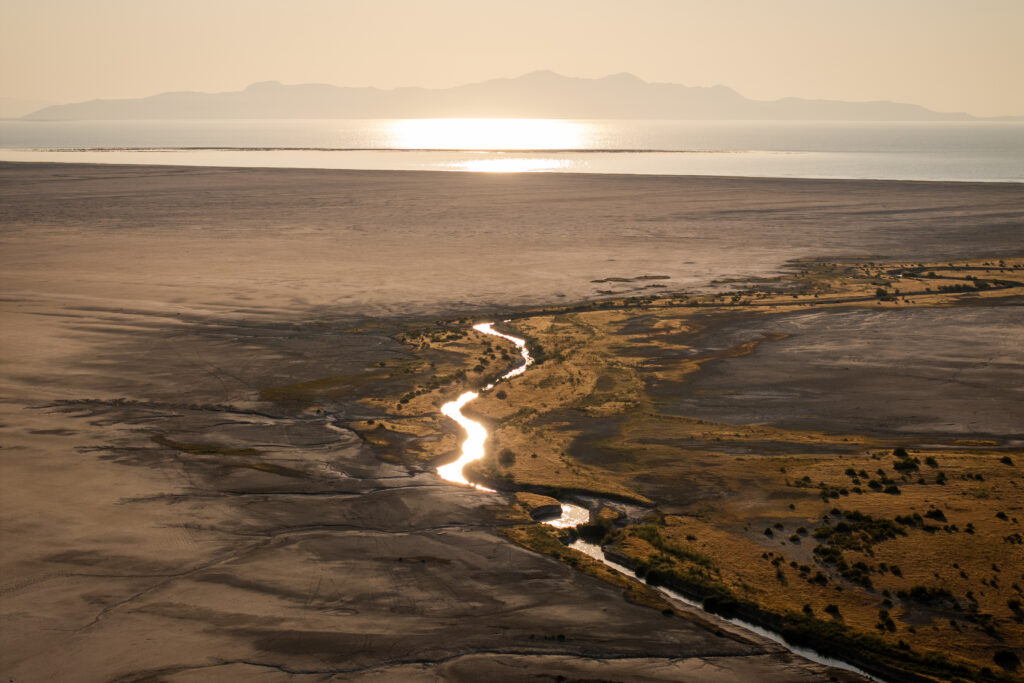


Lee Creek flows through mudflats into the Great Salt Lake near Magna on Tuesday, Aug. 5, 2025. (Photo by Spenser Heaps for Utah News Dispatch)
Key points:
- As the water in Great Salt Lake remains at an unhealthy low level, funding to help restore it is being promised from both government, nonprofit and private sources.
- President Donald Trump pledged $1 billion for the lake in his budget, though it must first pass Congress and details about Utah’s plans for the money haven’t been revealed.
- Some of Utah’s wealthiest families are pledging contributions toward $100 million to help the lake, while Ducks Unlimited is working on raising another $100 million. Those funds are meant for conservation efforts.
If Utah’s rivers and streams were running as high as commitments from powerful executives to save the Great Salt Lake, the parched state would be in much better shape.
Donations are stacking up, with families behind the Marriott hotels, Maverik gas stations and Miller sports empire propelling a fundraising push toward a $100 million goal. But the biggest number is coming from the White House. President Donald Trump is proposing $1 billion in assistance in next year’s federal budget, calling the lake a “critical economic and ecological asset.” However, the budget has to make it through a divided Congress before any of it could come to Utah.
How much money will actually flow to the cause and how exactly it will be spent are still open questions. State leaders haven’t made public the details or status of their proposal for the $1 billion, but they have identified four “buckets of investment” they’re hoping to fill.


This article is published through the Great Salt Lake Collaborative, a solutions journalism initiative that partners news, education and media organizations to help inform people about the plight of the Great Salt Lake — and what can be done to make a difference before it is too late.
Filling up ‘buckets’
One would involve engineering projects near the lake, such as redirecting water that’s been pooling in the Newfoundland Evaporation Basin since the 1980s under an old flood prevention strategy.
“Even in a year as dry as this, there’s a tremendous amount of water that’s trapped out on those salt flats,” said Great Salt Lake Commissioner Brian Steed.
The second category pertains to strengthening programs paying farmers to conserve and reimbursing them for upgrading to more efficient irrigation systems. The third: incentives for homeowners and businesses to introduce drought-friendly landscaping and encouraging the use of smart timers to automate watering. The fourth is wiping out thirsty, invasive plants along the lake and its rivers and streams.
Asked which project is the priority, Steed said they all are, describing them as interconnected.
“I think it’s important that we use it pretty holistically,” he said of the proposed financial help.
Gov. Spencer Cox announced an ambitious goal last year to restore the lake in time for the 2034 Olympics in Salt Lake City, and the fundraising push followed. Most of the lake’s surface area has vanished, raising alarm about heavy metals in dust exposed from decades of drought, climate change and people diverting water, mostly for farming. The lake ended last year at its third-lowest level on record.
‘Conflicted’ priorities
The rescue effort is bringing together a broad array of top state officials, business leaders and conservation groups. Everyone agrees the lake needs all the help it can get, but some advocates are wary of the ripple effects.
One potential pitfall, said Deeda Seed with the Center for Biological Diversity, is that state leaders feel the assistance gives them room to pull back on Utah’s own contributions.
“We’re in a political environment where people do like to kind of kick the can down the road, and we can’t do that with this anymore, because the crisis is here,” she said.
SUBSCRIBE: GET THE MORNING HEADLINES DELIVERED TO YOUR INBOX
And while Trump’s budget proposal gives to the lake, it also takes from existing water conservation efforts. If Congress approves it, the plan would defund certain programs administered by the U.S. Bureau of Reclamation, including grants for local ecosystem restoration, climate studies and projects the document describes as “frivolous,” such as installing artificial turf at schools and parks.
“What the budget document shows is the priorities of the administration, and they’re conflicted in this instance, clearly,” Seed said.
After Trump met with Gov. Spencer Cox and promised in February to help restore the lake, top Republican state lawmakers floated ideas on how to spend a massive cash infusion. They referenced potential pipelines delivering water from out of state or desalination plants turning ocean water into fresh water.
Those solutions are beholden to permitting and construction timelines. The conservation group Grow the Flow wants results within faster, closer reach.
“We are already approaching a record low by this fall, and we need solutions that can support the lake today, not years or decades down the line,” said Jake Dreyfous, the group’s managing director. The more readily available methods include leasing water from farmers and others, and removing noxious weeds, Dreyfous said.

Big goals and late-night calls
Joel Ferry, executive director of the Utah Department of Natural Resources, shed light on the key role of the private sector in the state’s strategy last week at a news conference. Ferry recalled talking by phone to Josh Romney, the businessman and son of former Utah Sen. Mitt Romney, at 10 and 11 p.m. in January, when the state sought to quietly buy a defunct $30 million magnesium plant on the shores of the lake. Romney elaborated on the conversations in a recent interview.
“So that was a period where it was easier for Joel to come to me and say, ‘Hey, I’m going to make this commitment. I don’t have the financial backing to do it. Can you, if the state doesn’t come through, can you come through for me?’” Romney told Utah News Dispatch, saying he agreed to find a way to guarantee the payment. “So it allowed him to go out and have more comfort and getting aggressive on a bid, without necessarily having to run it through every legislator to make sure he had the votes for it.”

The Legislature ultimately set aside money for the purchase intended to keep more water in the lake.
Romney launched the $100 million philanthropic campaign last fall and hopes to hit the goal by the start of the 2027 legislative session in January. He joined Utah officials and other business leaders to celebrate a series of contributions last week — early steps toward what he estimates is a total of $3 billion needed for the lake’s comeback.
His fundraising nonprofit, Great Salt Lake Rising, plans to coordinate closely with the state and commissioner on where the investments will land, Romney said. He sees redirecting water from Newfoundland Basin, removing invasive Phragmites reeds, and encouraging conservation for homeowners and farmers as strong steps toward saving the lake from collapse.
“The potential consequences to our health, to the health of our citizens, to the environment, and then to our economy, would be devastating,” Romney said. “I think it’s hard to even overstate what a huge impact losing the lake would have.”
The nonprofit Ducks Unlimited has also pledged to bring in its own $100 million, with $10 million going toward invasive plant control, a spokesperson said, and most of its commitment supporting “land protection and ecosystem resilience projects.”