Candidates for Public Office
From Plain City to County Leadership: Jon Beesley’s Run for Weber County Commission Seat B
Jon Beasley’s campaign for Weber County Commission Seat B centers on practical leadership shaped by his eight years as Plain City mayor. He emphasizes communication between county and cities, disciplined budgeting, and support for public safety morale. Pointing to economic growth from projects like Kent’s Market and Amazon-related revenue, Beasley argues that smart development can ease tax pressure on residents. He is critical of “spend it or lose it” budgeting and county micromanagement, advocating instead for trust in departments, accountability at election time, and a leadership style grounded in accessibility, relationships, and real-world problem-solving.



In local politics, the best leadership often looks a lot like everyday problem-solving. It is showing up, answering questions, listening to neighbors, and then doing the unglamorous work that turns gaps and friction into real results.
Jon Beasley’s pitch for Weber County Commission Seat B is rooted in that kind of leadership. After serving two terms as mayor of Plain City, Beasley is now asking voters to expand his focus from one community to the county level. His central themes are straightforward: improve communication between county government and cities, protect morale in public safety, stop a “spend it or lose it” mentality, and support local partners so growth does not become a series of new pressures dumped onto city services.
Plain City, Beasley points out, is still small, around 8,700 residents. That size matters because it forces leaders to know people, not just policies. During his time in office, he said he genuinely enjoyed “getting to know people” through everything from volunteerism to neighbor conflicts. That relational approach becomes an organizing principle in how he wants to govern at the county level.
Below is a clear look at Beasley’s story, his motivations for running, and the practical policy priorities he describes, from economic development and spending discipline to public safety budget respect and morale-building.
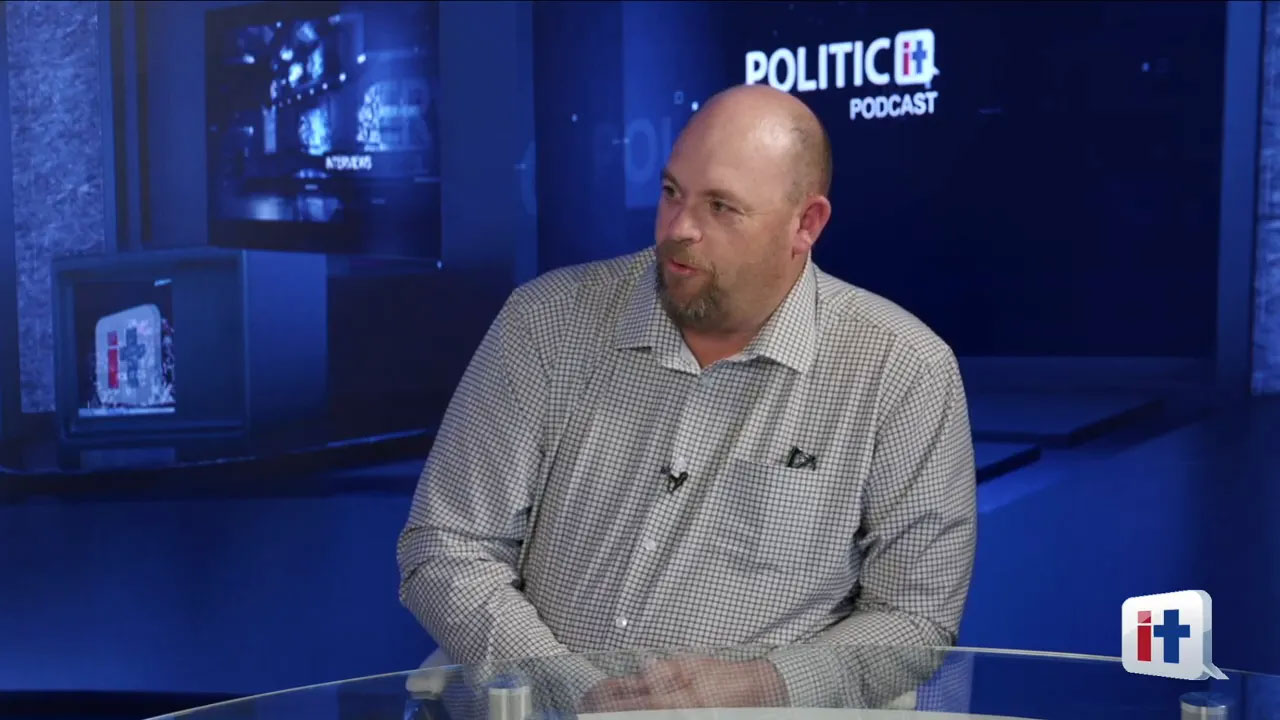
PoliticIt Radio – Built in Plain City – Jon Beasley
Mayor Experience: Building Trust in Plain City
Beasley finished his service as Plain City mayor in January after eight years. For him, the job was not only about overseeing budgets and ordinances. It was about building relationships with residents and making government feel accessible.
He describes Plain City as a place where the “getting to know” part of governance never really ends. Whether the issue is neighborhood-level conflict or community service, it is personal. And because it is personal, people expect answers, not delays.


Local economic development that helped residents
One of the most concrete examples from Beasley’s mayoral tenure is the arrival of major commercial development: Kent’s Market and later an Amazon fulfillment and delivery-related point-of-sale arrangement.
Kent’s Market was described as a “shot in the arm” for Plain City, arriving at a key time in leadership transitions. Beasley notes that Mayor Bruce Higley was in office when the project was passed and built, and Beasley began receiving the increased funds in his budget year after being elected. That timeline mattered because cities operate on different calendar cycles than counties. Plain City’s budget runs June to June, while counties run January to January.
Still, the impact was clear. Beasley describes sales tax revenue moving from roughly $300,000 per year to around a million the second year after the opening. The practical result, he argues, was that this boost helped “save our residents” by reducing pressure to pursue property tax increases.
The same theme appears with the Amazon-related sales tax effect. Beasley calls it an “adrenaline” boost to Plain City. He emphasizes that point-of-sale logistics were central to how the sales tax benefit came back to the city.
A “come full circle” moment
There is also a personal, hometown feel to Kent’s story. Beasley points out that Kent’s Market’s first store was actually in Plain City, then it expanded outward and eventually came back as the top store. That detail reinforces a broader message: economic development is not only about growth numbers. It is about building local momentum with businesses that understand the community.

Why Run for County Commission?
Beasley’s motivation is not framed as ambition for its own sake. It is presented as a response to gaps he believes exist at the county level, especially in how the county communicates with city leaders and supports contract cities.
After eight years as mayor, he said he saw repeated issues around:
- Communication gaps between the county and communities.
- Openness and accessibility compared to what city leaders experience with county leadership.
- Competition dynamics that create contention when they do not need to exist.
He also describes something that became a cultural detail during his mayoral service: he regularly answered questions on the Plain City Facebook page and left his phone number. Over time, people began tagging him constantly. But he treated that as a signal that residents do not just want public meetings. They want leaders who are reachable.
Beasley says he always left his phone number at the bottom of posts, encouraging residents to call, even if he was busy. His stated purpose was to start discussions and work toward solutions, not hide behind bureaucracy.
What caused the county-city gap?
Beasley’s explanation is blunt. He believes there is “some competition going on that doesn’t necessarily need to be going on.” He argues that the county has a responsibility to oversee certain functions, but that some actions go beyond what should be county responsibilities, which can turn collaboration into tension.
His example focuses on development and the ripple effects of growth. Cities were established to handle many community services, while counties were not set up to manage those same functions in the same way.
A concrete case is youth recreation. Beasley notes that Plain City has a “phenomenal rec director” who handles programs effectively. But he also points to expected population growth, including “a thousand homes coming in” between Plain City and Far West. In his view, those kids will need recreation programs somewhere, and the burden will land on cities.
He emphasizes that city recreation programs would face “undue pressure” and “undue strain,” especially because those city services do not always receive the property tax dollars generated by new homes in the same way.
From his perspective, contention then reduces communication. He says similar friction has appeared over the last five to six years between city leaders and county government.

Public Safety and the Sheriff: Morale, Budget Respect, and Less Micromanaging
If Beasley’s campaign is about relationships and communication, his account of public safety is about the internal health of an organization that protects residents. He says he worked closely with the sheriff and his lieutenants during his years as mayor, particularly because Plain City is a contract city.
Plain City as a contract city
Beasley explains that instead of having its own police department, Plain City contracts with the Weber County Sheriff’s Office for coverage.
He describes the collaboration as effective and highlights specific personnel. He mentions “Lieutenant Horton” as his last lieutenant, worked with for “two, three, four years,” and describes earlier lieutenants as well as positive partners.
He says the sheriff’s office has consistently performed well. But what makes his perspective distinctive is how he interprets the sheriff’s leadership style.
“It is an office” rather than a department
Beasley notes that the sheriff’s leadership is tied to the fact that the sheriff is elected. He distinguishes between a “department” and the actual elected office. For him, that distinction matters because of how budgets should be handled.
Beasley says he learned the sheriff’s approach includes building morale, not just managing tasks. He describes it as a “people builder” philosophy. He also points to training levels for deputies and the idea that the administration is serious about both professional and personal readiness.
In his view, the sheriff is tough when needed and expects a lot, but he maintains principle and treats personnel in a way that creates loyalty and respect.

His critique: micromanaging kills morale
Beasley’s critique is directed at county commissioners’ involvement in how the sheriff’s budget is handled during the year.
He acknowledges that counties oversee the sheriff’s budget. But he argues that there is “a time and a place” for that oversight. For him, the key is when intervention happens. He believes commissioners too often insert themselves early in a budget cycle, talking about “reallocations or cuts” only a few months into the cycle.
He connects that kind of ongoing adjustment to lower morale among the men and women who wear badges and do the work day to day.
Beasley describes the protective mission as the sheriff’s first responsibility: to ensure residents and property are protected. In that context, he believes commissioners should avoid destabilizing the people doing the work.
How he would handle it differently
Beasley’s proposed remedy is consistent with his broader theme of trust with accountability. He argues for sitting down with the sheriff and letting him design and execute his budget as provided.
His approach includes three key ideas:
- Let the sheriff create the budget and then give him room to execute it.
- Stop frequent in-year meddling through reallocations and cuts.
- Judge spending at election time, since the sheriff is elected and can be held accountable by voters.
In a campaign tone that signals both conviction and pragmatism, Beasley also suggests he would support the sheriff’s budget “as needed,” especially if the county and contract cities are growing and those responsibilities expand.
He contrasts this with a posture he sees in current governance, where he believes short-term adjustments mean less support for deputies and staff.

Spending Discipline: Needs Over Wants and Rewarding Prudence
Beyond communication and morale, Beasley focuses on budgeting behavior. His central argument is not simply that governments should spend less. It is that governments should spend smarter, aligned to needs, and stop punishing departments for underspending.
He supports the idea that governments already have enough
Beasley frames a goal he pursued while mayor: proving governments have “enough money” and that the issue is spending decisions, not a lack of revenue.
His philosophy can be summarized as:
- Focus on needs, not wants.
- Only consider “wants” if funding remains after needs are covered.
- Avoid the instinct to spend surplus quickly just to make sure a budget does not shrink next year.
Reward departments that spend responsibly
One of his most memorable budgeting examples involves a hypothetical public works director given a $20 million budget. If, at year end, they have $2,000 or $2 million left, Beasley argues they should not be punished by cutting their future budget.
Instead, he says leaders should thank them for responsible execution and then look for opportunities where they might improve efficiency or reallocate resources based on real gaps. For him, “spending less than allocated” is a signal of prudence, not failure.
He also describes a mindset he disliked from a previous job in plumbing supply. He recalled cities coming in with last-minute invoices simply to use up leftover budget before the end of the year. The purpose was not a legitimate project need but preventing the risk of reduced funding later.
That behavior, he argues, leads to waste. It also encourages stocking up on parts and supplies that are not actually needed, creating long-term costs.
At the county level, Beasley says he would work on fine-tuning purchasing habits and reinforcing a culture that departments are not punished for managing budgets responsibly.

Leadership Style: Teach Yourself to Listen, Then Have the Hard Conversations
Beasley’s leadership pitch is relational, but it is also practical. He says he is willing to learn, but if he believes he is acting on principles that are right, he does not want to be pushed off course by pressure or politics.
Approachability and accessibility
Beasley’s mayoral behavior is again used as evidence. He said he did not have a receptionist; he answered phone calls and called people back himself. That accessibility is part of why he thinks he stood out.
He frames this as more than style. It is a governance tool. When people believe leaders are reachable, misunderstandings get corrected earlier, and problems move toward solutions instead of staying stuck in frustration.
His personal “learning” influence
In an unexpected moment, Beasley talks about something from his childhood that shaped how he values conversations with older generations. He describes going across the street to sit with a retired neighbor who would have lawn chairs out and talk about life and how things work. Beasley credits “Harold” with teaching him, at a young age, a philosophy of respect and curiosity.
That anecdote fits into his later message that there should be more of those older, meaningful discussions in civic life. His point is simple: governance should not be only about formal meetings and technicalities. It should include human understanding.
The Race: Seat B, Two Opponents, and Beasley’s Differentiator
Beasley is running for Weber County Commission Seat B. He says there are two seats up for election, and he is running for Seat B.
He identifies two opponents:
- Sharon Bolos, the sitting county commissioner
- Michael Thomas, a gentleman he says he has only met a couple of times and describes as a city councilman in Washington Terrace
He suggests Michael Thomas and he might be somewhat similar, but Beasley believes he has more administrative experience due to his time as mayor. He says he is “unteachable” in the sense that he can learn, but he will not be shaken from principled decisions. He also emphasizes that he is willing to have hard conversations and believes they are necessary.

Beasley vs. Bolos: availability, micromanaging, and sheriff governance
Beasley’s sharpest contrast is with Sharon Bolos. He says she has direct influence because the sheriff’s department is under her portfolio currently.
He alleges that morale in the sheriff’s organization gets “dinged” when issues are brought up in a recurring way and that, in his view, it happens at the wrong times. He argues that budget reconsiderations should happen once a year, not multiple times.
Beasley also makes a bold statement about compensation. He says he would take a pay decrease, and he believes county commissioners are overcompensated. He even calls for a “20% pay decrease” immediately, suggesting he would vote for it if both votes were aligned.
His point is consistent with his earlier emphasis: if the county is growing, it is not the right moment to seek cuts that harm critical services like public safety. Responsible oversight is fine, but constant adjustment is damaging.
He also expresses support for fully funding the sheriff’s department, emphasizing that the sheriff’s department is growing, the county is growing, and contract cities are growing.
Animal Shelter Funding and Volunteer Morale
While the sheriff’s department gets a large share of attention, Beasley also highlights another area where morale and funding decisions can have real outcomes: the Weaver Animal Shelter.
Beasley describes receiving letters from volunteer workers and former employees. His claims, as he presents them, center on how funding affects basic care: feeding, walking dogs, and maintaining volunteer participation.
He says volunteers help clean kennels, walk dogs, and feed them. But he describes concerns that dogs may be getting fed less and walked less because funding for food is insufficient. He references an email message he believes he could pull up where a volunteer indicated how many days a dog did not get walked.
He connects this to a larger morale-building need. For him, animal shelter management should include both resources and follow-through that makes volunteers feel heard and supported.
He also addresses an idea discussed publicly: making the Weaver Animal Shelter its own taxable district. Beasley calls that “a terrible idea,” arguing that money already exists in the county to fund the shelter and that the taxable district model is not a good fit.
Even though the interview time runs short for additional detail, Beasley’s closing point is clear. He wants discussions about improvement with respect for pets and the people who care for them. He is not arguing that every “whim” should be accommodated, but he believes pet care deserves serious attention and proper funding.
Campaign Closing Message: Support Cities, Protect Elections, Protect Residents
Beasley’s closing pitch to voters focuses on four promises that summarize his campaign’s direction.
- Change county-level actions so cities receive real support rather than friction.
- Support the sheriff’s department and residents with respect for how budgets and morale work.
- Back other elected officials in the county, including efforts to protect elections.
- Protect property and residents by ensuring critical services are funded responsibly.
He closes by identifying himself as a Plain City resident of five generations, stating he raised his family there and served as mayor for eight years. He says the greatest accomplishment of his time as mayor was education, not in the sense of a degree, but in the sense of learning leadership through real situations and “hard knocks.”
That idea of education through experience is also reflected in his method. His campaign emphasizes the discipline of budgeting, the practical realities of service burdens during growth, the morale impact of governance decisions, and the value of accessibility and communication.
What Beasley’s Approach Suggests About County Leadership
Taken as a whole, Jon Beasley’s plan for Weber County Commission Seat B is not a collection of unrelated issues. It is a connected philosophy about how government should behave:
- Communication should reduce contention. If county leadership acts in ways that create friction, leaders will talk less, coordinate less, and solve fewer problems.
- Growth should be managed with fairness. When new residents arrive, cities should not absorb all the service pressure without support.
- Public safety requires stability. Micromanaging budgets too frequently can harm morale, and morale matters because deputies and staff are protecting people and property.
- Spending discipline should be rewarded. Responsible underspending is prudence, not an excuse to slash next year’s funding or encourage waste.
- Leadership is a relationship. Being reachable, listening, and taking action are the same thing in local government.
That blend of experience and practical priorities is why Beasley’s story resonates beyond Plain City. While county governance is larger and more complex than city leadership, his argument is that the core duties do not change: protect residents, manage budgets responsibly, and communicate in a way that makes collaboration possible.
Key Takeaways
- Plain City economic development (Kent’s Market and Amazon-related sales tax) helped increase sales tax revenue and reduced pressure for property tax increases.
- Beasley’s motivation is to address gaps in communication and support between county leadership and cities.
- He supports limiting micromanagement of the sheriff’s budget so morale stays strong and the sheriff can execute plans.
- He wants spending discipline with a “needs over wants” framework and a culture that rewards prudent management.
- He highlights animal shelter morale and funding, opposing the idea of creating a separate taxable district for the shelter.
In local elections, voters often look for competence, but they also look for character. Beasley’s case is that competence comes from the ability to manage budgets and coordinate services, while character comes from being accessible, respectful, and willing to have the hard conversations required to move public work forward.
#politicit #utahelections #utpol