
Utah News Dispatch
Utah built respected courts. Political retaliation is undermining them


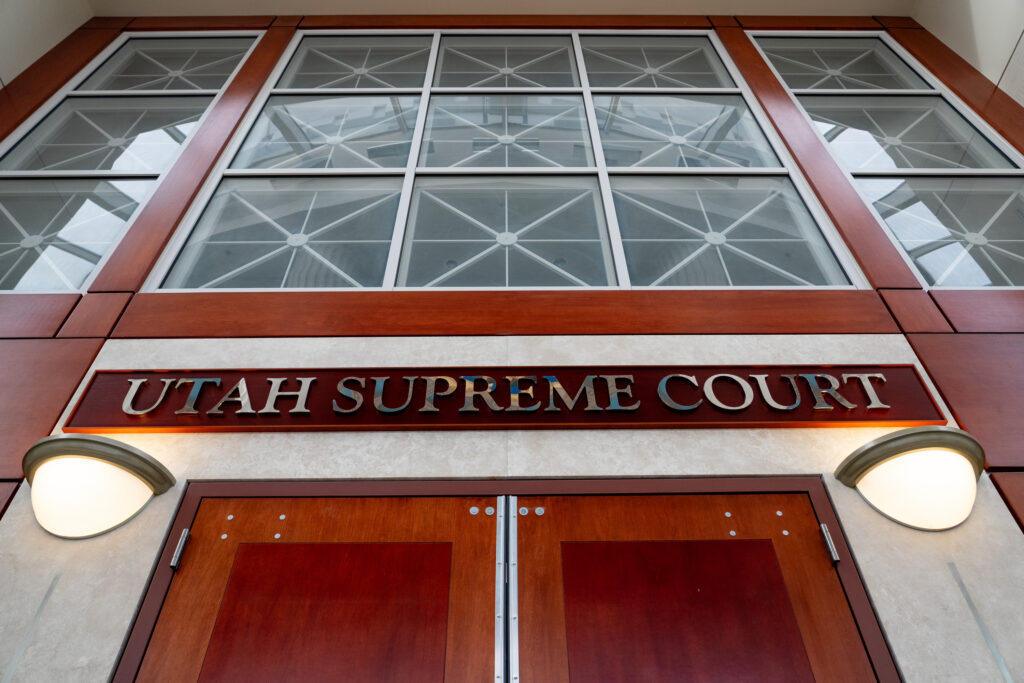


The entrance to the Utah Supreme Court inside the Matheson Courthouse in Salt Lake City is pictured on Wednesday, January 3, 2024. (Photo by Spenser Heaps for Utah News Dispatch)
Utah built one of the most respected state court systems in the country. That reputation was grounded in a merit based judiciary designed to ensure judges were selected for competence and integrity rather than partisan political loyalty. This was not merely an envied tradition, it was embedded in our constitution. Today, that foundation is beginning to crack.
Justice Diana Hagen’s recent resignation cannot be viewed in isolation from the broader political context. The Supreme Court has increasingly become one of the few institutional checks on legislative power. As courts checked efforts to weaken Proposition 4, hostility toward the judiciary has intensified.
Lawmakers recently expanded the Utah Supreme Court from five to seven justices, prompting bipartisan concerns about court packing. Lawmakers also removed the court’s ability to choose its own chief justice, shifting more influence to the governor. Meanwhile, the Utah GOP openly urged voters to reject Supreme Court justices after unfavorable rulings. Taken together, these developments reflect growing political pressure on what should be an independent branch of government.
Against that backdrop, allegations involving Justice Hagen became public after confidential Judicial Conduct Commission records were, in the words of the Utah Supreme Court, “inappropriately released” to the public. The commission had reportedly already reviewed the matter and found the claims to be “speculative, overstated, and misleading.” Co-Equal Utah stated, “That should have been the end of it. Instead, a sitting justice was subjected to a coordinated political pressure campaign until she resigned.”
An even deeper concern is what happens when accusation itself becomes a political weapon. Judges should absolutely be accountable. But accountability should depend on process, evidence, confidentiality, and fairness, not strategic leaking and trial by media. Once allegations are injected into a polarized political environment, reputational damage often becomes immediate and irreversible.
We should ask whether there has been equal concern about the apparent leaking of confidential Judicial Conduct Commission records themselves. If confidentiality protections surrounding judicial investigations can be selectively breached without serious scrutiny, that raises troubling questions about institutional integrity and political pressure.
The release and amplification of these allegations has functioned as a mechanism of political pressure. Even allegations reportedly found to be “speculative, overstated, and misleading” can inflict lasting damage once publicly aired. In this case, they ultimately created an opening for the court to be reshaped politically.
This should concern all Utahns because an independent judiciary is one of the few protections ordinary citizens have against the abuse of concentrated political power. Co-Equal Utah, a nonpartisan organization focused on protecting judicial independence, warned:
“That is how judicial independence dies — not through a single dramatic act, but through sustained pressure designed to make the personal cost of impartiality too high to bear.”
The pattern unfolding in Utah mirrors national trends in which courts, elections, universities, and other institutions increasingly become sites of ideological warfare. In that environment, courts are treated as legitimate only when their rulings produce the desired political outcomes.
The national battle over redistricting has increasingly become a battle over courts themselves. Across the country, judicial rulings on maps are now openly discussed in terms of which party will control Congress. That context matters because it helps explain why judicial independence is becoming increasingly vulnerable to partisan pressure.
What should have remained a Utah debate about Utah’s congressional maps and judicial rulings has increasingly become nationalized, drawing involvement from outside political organizations and national partisan movements. As that has happened, the conflict surrounding Utah’s courts has become part of a much larger national struggle over electoral power, and who gets to shape the rules of democracy itself.
Proposition 4 became a flashpoint because many Utahns believed lawmakers were overriding the expressed will of voters. Gerrymandering is not simply about maps. It is ultimately about political power. When electoral systems become less responsive to voters, citizens increasingly turn to the courts as one of the few remaining institutions capable of enforcing constitutional limits and protecting democratic process.
A constitutional system cannot function if courts are treated as legitimate only when they produce outcomes those in power prefer. Judicial independence is not designed to protect judges from criticism. It exists to protect the public from unchecked political power.
For generations, Utah built a court system that many people believed rose above the political warfare consuming much of the country. That reputation was earned slowly. It can be lost much more quickly.
Co-Equal Utah warned that what happened to Justice Hagen sends an “unmistakable” message to “every judge in Utah: rule against the Legislature, and this is what follows.” Once judges begin fearing political retaliation for constitutionally grounded rulings, the damage extends far beyond any single justice or any single case. Public trust erodes. Institutional legitimacy weakens. And constitutional government itself becomes harder to sustain.
Utahns should think carefully about what we stand to lose.