Candidates for Public Office
Inside the Caucus: Sen. John D. Johnson & Congressman Michael Kennedy at UVU
On the eve of the convention caucus at Utah Valley University, the conversation turned to a question beneath nearly every political fight: who should be making the decisions. For Congressman Michael Kennedy, the answer is usually not Washington. His approach is to push power downward, strengthen states and communities, and restore balance to federalism. Drawing on his Utah legislative experience, Kennedy argues that accountability works best closer to the people, and that long-term stewardship—not short-term politics—should guide how government operates.


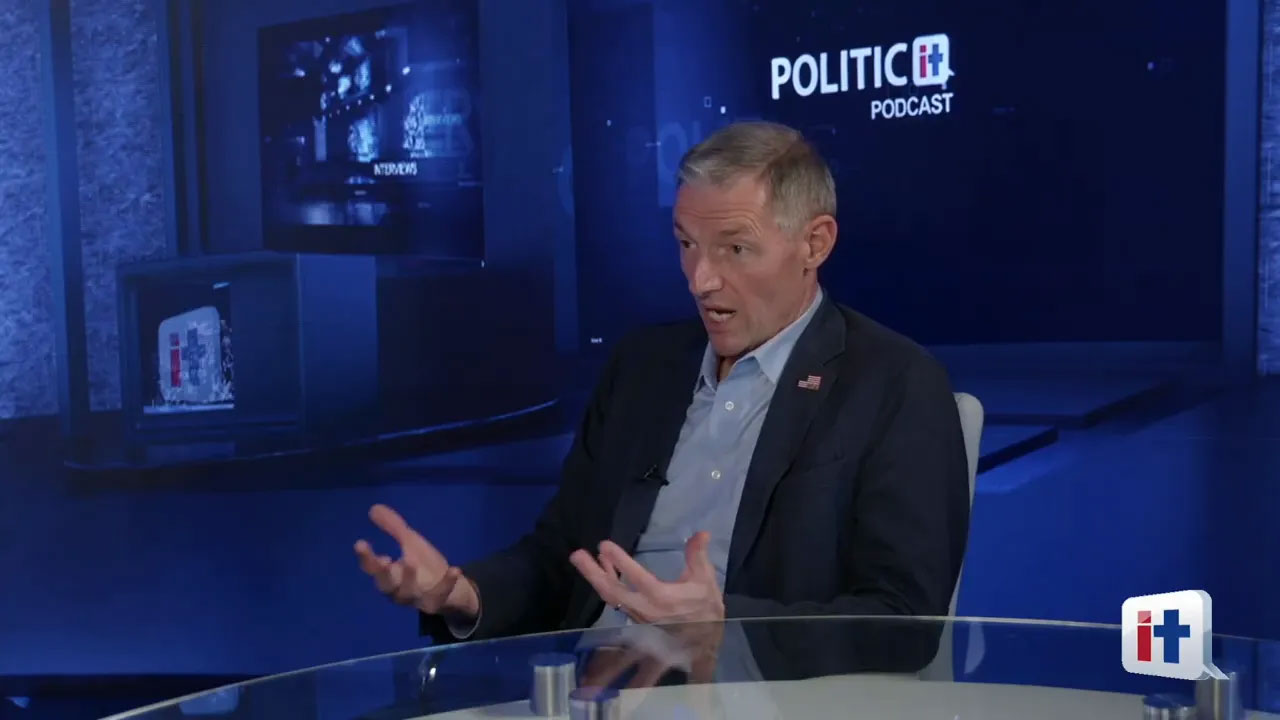

On the eve of convention caucus at Utah Valley University, the conversation turned to a question that sits underneath almost every political fight in Utah and in Washington: Who should be making the decisions?
For Congressman Michael Kennedy, the answer is usually not Washington, D.C.
His governing instinct is straightforward. Push power downward. Strengthen states, communities, and families. Shrink the federal bureaucracy where it has drifted beyond its proper role. Preserve what works, reform what does not, and keep one eye on the long game so the country is still worth celebrating not just at 250 years, but at 500.
That broad framework shaped a wide-ranging discussion with Sen. John D. Johnson, covering federal spending, public safety, education, Medicaid reform, NGOs, NPR, redistricting, immigration enforcement, technology, and Utah’s convention system.
What emerged was more than a campaign conversation. It was a revealing look at how one Utah congressman thinks about government itself, where it has gone off course, and what a course correction might actually look like.
PoliticIt Radio – The Next 250 — Michael Kennedy
A governing philosophy rooted in Utah, not Washington
Kennedy came into Congress after a decade in the Utah Legislature, including years serving alongside Johnson in the state Senate. That experience still frames how he sees public service.
In his telling, Utah tends to do something Washington often cannot: work through differences without losing sight of practical outcomes. The culture is more collaborative, the issues are closer to the people, and the accountability is clearer. That contrast has only sharpened during his first 16 months in Congress.
His summary of the job is simple and memorable: make Washington smaller and Utah stronger.
That does not mean pretending federal responsibilities do not exist. It means restoring the balance of federalism. States should handle what they can and should handle. Families and local communities should not have to ask federal permission to solve every problem. Congress should be more disciplined about what truly requires national action and what has simply become habit.
Kennedy ties that philosophy to America’s 250th anniversary, calling it a moment to celebrate the country’s constitutional experiment and also to ask whether current governing habits are sustainable. For him, patriotism is not just ceremony. It is stewardship.
“My objective as a federal guy is to look for the next 250 years.”
That long-range lens matters, because much of the conversation turned on whether the federal government has taken on too much, spent too much, and drifted too far from accountability.


The problem, as Kennedy sees it: too much bureaucracy, too little accountability
When Kennedy talks about Washington, he does not begin with partisanship. He begins with scale.
In his view, the federal government developed a mindset over decades that it could feed, clothe, educate, insure, regulate, and administratively manage nearly everything. The result has been a sprawling apparatus with staggering debt, unclear lines of authority, and countless executive branch operations that ordinary people cannot realistically track.
The numbers alone tell part of the story. Kennedy points to a national debt of roughly $39 trillion, a figure so large that it has become abstract. But he insists the consequences are not abstract at all. Excess debt narrows future choices, weakens long-term stability, and pushes the burden onto generations that had no vote in creating it.
He also argues that the administrative state has become too insulated. Agencies create rules. Bureaucracies expand. Civil service protections make removal difficult even within the executive branch. Lawsuits and court interventions often complicate efforts to reduce personnel or restructure agencies. To Kennedy, that raises a basic democratic question: who is accountable to whom?
That concern fuels his emphasis on fraud, waste, abuse, and regulatory overreach. He does not treat those as campaign buzzwords. He treats them as symptoms of a deeper institutional problem: government growth without corresponding accountability.
From that perspective, fiscal restraint is not merely about spreadsheets. It is about restoring political control to the people and their elected representatives.
Why saying no matters in a legislative body
One of the most revealing parts of the discussion was Kennedy’s defense of the “no” vote.
Legislatures, by their nature, create pressure for mutual accommodation. Members support each other’s bills. Colleagues do favors. A proposal may seem small in the context of a trillion-dollar federal budget, and the temptation is to say yes because the amount feels minor or because the sponsor is well-liked.
Kennedy rejects that reflex.
He described being one of just six no votes on a recent bill he believed added regulation without meaningful accountability. He also recalled doing the same kind of thing in the Utah Legislature, where saying no sometimes meant being in a tiny minority and absorbing the social cost that comes with opposing the body’s momentum.
His argument is that small items add up, and lawmakers should not stop taking money seriously simply because the federal budget is enormous.
The example he used was $50 million. In Washington terms, that can be treated as trivial. In real life, it is anything but trivial. As Kennedy put it, if someone saw $50 million lying on the ground, they would not shrug and walk past it.
That mindset, he says, is part of the discipline Congress needs more of.
- Not every program deserves support just because it sounds good
- Not every spending item is harmless because it is small relative to the whole budget
- Not every bipartisan vote is a sign of wisdom
For Kennedy, seriousness in government means knowing the difference between compassion and carelessness.
Has Congress made any progress on spending?
Kennedy is candid that Washington moves slowly and that progress rarely comes at the pace voters want. Still, he argues there have been meaningful steps in the right direction.
He highlighted a reduction of $56 billion in spending between fiscal years 2024 and 2025, describing that as notable progress even if critics insist it is not nearly enough. He also pointed to a larger package he referred to as the “big, beautiful bill,” which he said could generate as much as $1.5 trillion in savings over the next decade.
His point was not that the problem is solved. It clearly is not. His point was that directional movement matters. If policymakers are serious about changing the fiscal trajectory, they have to start rewarding actual reductions, not dismissing every cut because it falls short of a maximal goal.
This is where Kennedy’s style comes through. He is not painting a picture of overnight transformation. He is making the case for incremental but real restraint, backed by legislators who are willing to be unpopular when necessary.

Congress is slower than Utah, and that is partly by design
Anyone who has spent time in a state legislature and then moved to Congress notices the difference immediately. Kennedy certainly has.
He contrasted Utah’s relatively nimble legislative process with the federal system’s deliberate slowness. The House has 435 members. The Senate has 100. The House may pass hundreds of bills, only to watch a fraction make it through the Senate. Kennedy noted that in his first 16 months, the House had sent more than 500 bills to the Senate, while only around 40 had ultimately made it through.
That kind of bottleneck can be maddening. But Kennedy also acknowledged that the founders intentionally designed the federal system to be slow. Concentrated power may be efficient, but it is dangerous. Requiring broad agreement makes sweeping change harder.
There is a tension here that he seems comfortable with. Government should not move recklessly. But lawmakers still need to know how to move good ideas through a difficult process.
To explain that, Kennedy reached back to an example from Utah politics: then-Rep. Dan McKay’s successful effort to eliminate the state’s vehicle safety inspection requirement.
For years, attempts to repeal that requirement had failed. Kennedy described how McKay assembled evidence, brought in students to demonstrate that the inspections were not scientifically effective, coordinated with leadership, managed committee strategy, and moved the bill efficiently before opposition groups could bog it down.
The lesson was bigger than vehicle inspections. Good policy does not win simply because it is right. It wins when someone can:
- build the evidence
- organize the votes
- manage the process
- outlast entrenched interests
That, Kennedy suggests, is the real craft of legislating.
Where Kennedy sees meaningful federal action: immigration enforcement and Medicaid reform
Although Kennedy consistently argues for a smaller federal footprint, he does not claim the federal government has no essential role. In fact, some of the examples he highlighted involve core national responsibilities.
The Laken Riley Act and public safety
One bill he emphasized was the Laken Riley Act, named for a Georgia nursing student murdered by an illegal immigrant who had already committed prior crimes. Kennedy framed the legislation as plain common sense: if someone is in the country illegally and commits crimes, that person should be deported quickly rather than released back onto the streets.
For him, this is not a complicated ideological question. It is a public safety question and a basic test of whether immigration law means what it says.
Medicaid work requirements
Kennedy spent even more time on Medicaid, likely because of his background in health care. He described Medicaid as a true state-federal partnership and argued that reforms should focus on preserving help for those who need it while reducing abuse and dependence where possible.
The reform he highlighted most strongly was a work requirement for able-bodied recipients. The idea is not to punish people who are struggling. It is to encourage a pathway into work, even at a modest level, such as 20 hours per week. Kennedy presented that as both humane and practical: if someone can work, helping them reconnect to employment can lead to better coverage and greater independence than long-term reliance on Medicaid alone.
He estimated that this reform could save up to $500 billion over 10 years.
Whether one agrees or disagrees with the policy, the framework is consistent with everything else he said: protect the core purpose of the program, reduce waste, and align assistance with upward mobility rather than bureaucratic permanence.

Federalism in practice: block grants, not micromanagement
When the conversation returned to federalism directly, Kennedy offered one of his clearest policy examples: block grants.
Rather than have Washington micromanage every detail of complex programs like Medicaid, he favors giving states a defined amount of money and allowing them to innovate within that boundary. In Utah’s case, he expressed confidence that the state legislature and local health systems could deliver care more effectively if they had greater room to operate.
That approach is not the same as simply pulling the plug on government support. Kennedy was careful on that point. His argument is not that every program should disappear tomorrow. It is that states should be allowed to solve problems in ways that match their populations, values, and fiscal discipline.
He sees that as a more faithful expression of the “laboratories of democracy” idea. Some states will do things better than others. Some will get things wrong. But that is still preferable, in his view, to a single national bureaucracy dictating one-size-fits-all rules across 50 states and several territories.
The same principle extends to how he votes. Programs that create new bureaucracy or fund narrowly regional interests with national taxpayer dollars are likely to get his no vote.
He gave two examples:
- Federal funding for research on a Hawaii tree fungus
- Federal funding for a Great Lakes fish investigation
Kennedy’s position was not that those issues are unimportant. It was that they are primarily regional concerns and should be funded regionally, by the states and local interests that directly benefit. To him, that is exactly the kind of spending Congress should stop normalizing.
Education, NPR, and the case against legacy federal structures
Education is another area where Kennedy believes the federal government has outlived much of its practical usefulness.
He expressed satisfaction that the U.S. Department of Education had, in his words, become close to a non-entity after defunding efforts early in the Trump administration. His broader point was that local teachers, parents, and state lawmakers are better positioned than Washington to shape education policy in meaningful ways.
The same logic applied to public broadcasting.
Kennedy defended cutting federal support for the Corporation for Public Broadcasting and NPR, questioning why taxpayers should continue subsidizing a media ecosystem that now exists in a vastly different information environment than when those institutions were created.
His argument was less about ideology than about necessity. When there were only a few TV stations and limited radio access, public support for broadcast media could be defended as filling a civic gap. Today, the media environment is saturated. People have endless options. Podcasts, independent media, subscription outlets, streaming services, terrestrial radio, satellite radio, local journalism, and national commentary are all competing at once.
If NPR or similar outlets provide value, Kennedy says, supporters can pay for them directly. If they cannot survive without federal support, then perhaps that is evidence the model itself needs to change.
He also pushed back on the idea that cuts automatically mean collapse, saying such organizations often warn they will be destroyed by the loss of federal funding and then continue functioning anyway.

NGOs, USAID, and where charity should come from
The conversation then moved into a politically sensitive area: non-governmental organizations and foreign aid-adjacent funding streams.
Kennedy floated a suspicion that some NGOs had become conduits through which taxpayer dollars indirectly supported Democratic political infrastructure, particularly through organizations tied to USAID-era funding patterns. He connected that suspicion to an observation that Republicans had recently begun outraising Democrats, suggesting that cuts to NGO funding may have disrupted a longstanding financial advantage on the left.
That is a political claim, and Kennedy framed it as suspicion rather than settled proof. But the more important philosophical point was broader. He does not believe the federal government should function as the world’s social welfare engine or as the automatic underwriter of every worthy cause on earth.
He made the moral distinction plainly: private charity is one thing, taxation is another. If citizens want to help people in need around the world, they can do so voluntarily. That, to him, is charity in the real sense. Tax dollars compelled by law and redistributed through layers of bureaucracy are something different.
At the same time, Kennedy did not take an absolutist position. As a physician, he argued there are legitimate reasons for the United States to invest in international disease prevention and medical research when doing so also protects Americans. He specifically mentioned HIV, Ebola, and the global lessons of COVID.
That distinction matters. Kennedy is not arguing for isolation. He is arguing for a tighter standard:
- Does the spending serve a true national interest?
- Is it a proper federal responsibility?
- Does it protect American health, safety, or security in a direct way?
If the answer is yes, he is open to federal involvement. If not, he would rather leave it to voluntary associations, private donors, states, or regional partnerships.
Science, space, and where Kennedy wants America to lead
Perhaps the most striking shift in the conversation came when Kennedy started talking about science and space policy. For someone so focused on shrinking Washington, he became notably expansive when discussing strategic research and American competitiveness.
As a member of the Science, Space, and Technology Committee, Kennedy argued that certain endeavors are exactly the kind of thing the federal government should be doing because they are too expensive, too complex, and too tied to national security to be left entirely to fragmented private or state efforts.
He mentioned a recent committee discussion with Jared Isaacman about the NASA budget and laid out a vision in which the U.S. must maintain dominance in low Earth orbit, protect satellite infrastructure, and lead in the race to establish a lasting presence on the moon.
His lunar comments were especially vivid. In Kennedy’s framing, the moon is not just a scientific curiosity. It is a strategic domain with resources, opportunity, and future geopolitical implications. Whoever establishes a functioning base first may gain durable advantages, especially if that base includes energy capacity such as nuclear power to survive the lunar night.
He described the competition in explicitly strategic terms, warning that if China or another adversary secures dominance first, the United States could find itself arriving late to a place that is already controlled.
That concern extends beyond the moon. Kennedy linked space policy to:
- satellite protection
- quantum computing
- international space stations
- scientific and military competition with the Chinese Communist Party
For all his criticism of bureaucracy, Kennedy clearly believes government has an essential role where frontiers, deterrence, and national capability intersect.

Redistricting and the fight over Utah’s political map
No conversation about Utah politics is complete without redistricting, and Kennedy did not hold back.
He criticized newly proposed district maps as some of the most gerrymandered he had seen, arguing that they create one heavily Democratic seat and three heavily Republican seats in a way that all but predetermines outcomes. In his description, the Democratic seat is favored by around 25 points, while the Republican seats are favored by margins of 40 to 50 points or more.
For Kennedy, that arrangement undercuts the rhetoric often used by anti-gerrymandering advocates. If the result is one packed Democratic district and three nearly untouchable Republican districts, then the map is hardly a model of neutral representation.
He also pointed to the way the lines divide Utah County while keeping Salt Lake City more intact, contrasting that with earlier maps in which portions of Salt Lake County were distributed across all four districts. Millcreek, he noted, once served as a center point with four representatives tied to it.
The deeper issue is not only partisan balance. It is whether district lines should encourage coalition-building across urban and rural interests or instead harden ideological enclaves. Kennedy’s preference is clearly the former, even as he acknowledges that the current process is likely to govern at least the near term, with the next census in 2030 looming as the major future reset.
The caucus, the convention, and Kennedy’s campaign style
Because the conversation took place just before convention, it naturally circled back to electoral mechanics.
Kennedy made a point of emphasizing that he does not gather signatures. He supports Utah’s caucus-convention process and has consistently chosen to make his case directly to delegates instead. He even noted that he had personally called more than a thousand delegates, both to earn support and to hear what they care about.
That detail mattered to him because it speaks to political style. He wants to be seen as someone who respects grassroots party structure, values retail politics, and is willing to do the labor-intensive work of direct persuasion.
He was running in a district that overlaps substantially with areas he has represented before, including portions of his current congressional territory and a significant share of his old state senate district. He described the district as spanning parts of Sanpete County, Juab County, Tooele, and the southern end of Salt Lake County, including places like Draper, Sandy, and Bluffdale.
That regional familiarity, in his view, gives him a base of trust as he seeks renomination.

How delegate conversations shaped the Protect Act
One of the more interesting moments came when Kennedy explained that conversations with delegates had already shaped his legislative agenda.
He said repeated concerns from delegates about abuse of the H-1B visa program pushed him to introduce the Protect Act. The goal of the bill is to require employers seeking to hire H-1B workers to provide stronger documentation showing they could not find qualified American workers first.
Kennedy’s concern is not with the existence of the visa category itself. He said he believes the H-1B process has merit. His objection is to abuse that undercuts domestic workers, especially in the technology sector.
He offered an example relayed by a delegate: if an American tech worker would command a salary of $200,000, but an H-1B worker could be brought in for $60,000, some employers may be tempted to game the system and use foreign labor to suppress wages rather than fill true labor shortages.
The Protect Act, as Kennedy described it, would put “teeth” into the process so that companies have to prove genuine need before going abroad for labor.
The phrase that captures his approach is easy to recognize: hire American citizens first.
AI and the future of work
That labor conversation naturally led to artificial intelligence.
Kennedy’s take was cautious but optimistic. He acknowledged that AI is likely to disrupt many sectors, including technology and health care, but he does not treat disruption as a reason to freeze progress. Instead, he sees AI as part of the long pattern of transformative technologies that change how people live and work.
Cars changed transportation. Airplanes changed distance. Other tools replaced older systems before them. AI, in Kennedy’s view, will do the same.
What matters is how government responds. Here again, he defaults toward state-level flexibility. He praised Utah for being innovative in the AI space and warned against federal overregulation that would prevent states from experimenting, adapting, and moving quickly in a fast-changing field.
That stance fits the rest of his philosophy almost perfectly. Encourage innovation. Avoid premature federal control. Let states lead where they are capable of leading.
The through-line: serious people, limited government, and practical conservatism
Across all these topics, from spending and immigration to space policy and district maps, Kennedy kept returning to one essential idea: government needs serious people.
By that he seems to mean lawmakers who understand the proper role of each institution, resist the urge to spend reflexively, and are willing to do the difficult work of moving reform through slow systems. He does not speak as a bomb-thrower. He speaks more like a process-minded conservative who believes in civility, coalition-building, and persistence, but who also thinks too many politicians have stopped asking first-principle questions about what government is actually for.
His ideal public servant is someone who:
- understands constitutional roles
- takes taxpayer money seriously
- trusts states and local communities
- supports strong action where federal duties are real
- can say no, even when that is unpopular
There is also something distinctively Utah in the way he frames that vision. He repeatedly described Utahns as civil, thoughtful, capable people who largely want to help one another and want government to stop making ordinary life harder than it needs to be.
That description doubles as his pitch for representation. He sees himself as carrying a conservative message in a way that is forceful but not inflammatory, collaborative but not compromising on fundamentals.
Why this conversation matters beyond one convention
Although the immediate context was a party convention and a contested district, the discussion touched on issues much bigger than a single election cycle. It raised enduring questions about whether federalism still has practical force, whether Congress can recover fiscal seriousness, and whether states like Utah can reclaim authority in areas that have gradually drifted to Washington.
It also illustrated an increasingly important divide within American politics. The old debate was often framed as government versus no government. The more relevant debate now may be which level of government should do what, and under what conditions federal power is justified.
Kennedy’s answer is clear:
- National government should handle national responsibilities
- States should have room to innovate
- Local communities should not be smothered by distant bureaucracy
- Public money should be spent with discipline, not sentimentality
That is a coherent worldview whether one agrees with every conclusion or not. And in a political climate often dominated by slogans, coherence is worth noticing.
Final takeaway
The conversation at UVU offered a concise map of how Michael Kennedy approaches public service: fiscally skeptical, structurally conservative, pro-state, wary of bureaucracy, strong on enforcement, and unusually attentive to the mechanics of legislating.
He wants less federal micromanagement in education, Medicaid administration, and regional spending. He wants tougher lines on illegal immigration and H-1B abuse. He wants cuts to taxpayer support for institutions that can stand on their own, from NPR to various NGOs. He wants strategic investment where federal power is truly warranted, especially in disease research, advanced science, and the space race. And he wants a Congress willing to recover the habit of saying no.
At a moment when Utah delegates were preparing to make decisions about representation, that message was not just campaign rhetoric. It was a governing blueprint.
Whether that blueprint continues to gain traction will depend on the same thing Kennedy emphasized throughout the discussion: building trust, organizing support, and proving that limited government can still be an active, serious, future-oriented form of leadership.
On the eve of the convention caucus at Utah Valley University, Senator John D. Johnson sits down with Congressman Michael Kennedy for a timely and substantive conversation about the issues shaping Utah’s future. From the economy and public safety to education and federal-state dynamics, this episode breaks down what matters most to everyday Utahns—just as delegates prepare to make critical decisions.
Don’t miss this inside look at the priorities, challenges, and opportunities facing our state, only on the PoliticIt Podcast.
#politicit #utahelections #utpol