Utah News Dispatch
Focused on pollution from far away, feds propose raising northern Utah’s ozone ranking


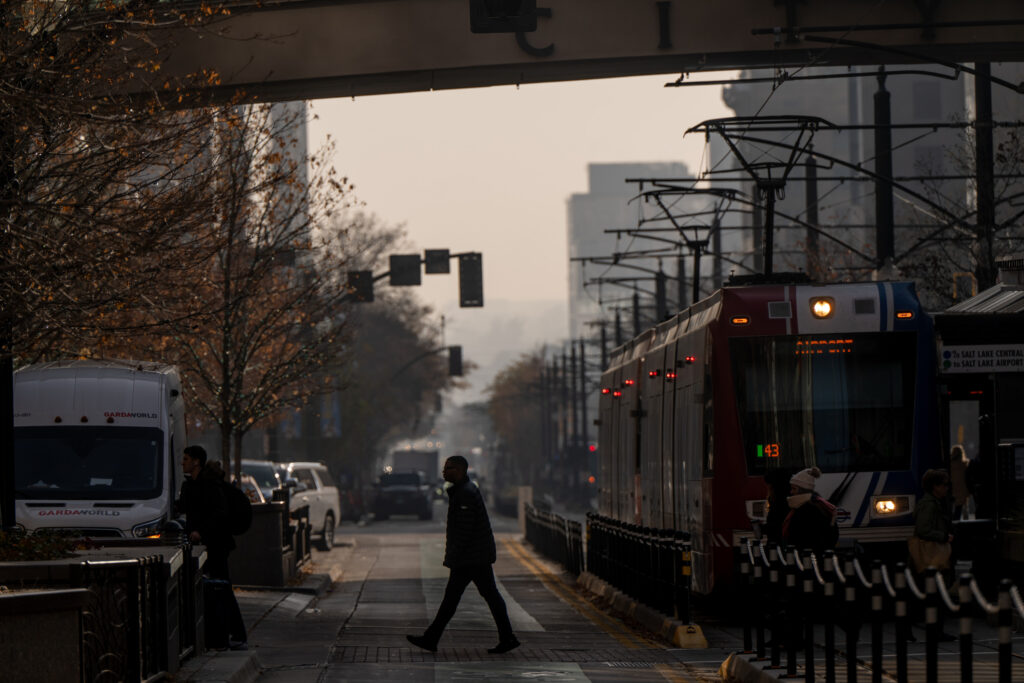


A haze of particulate pollution hangs over downtown Salt Lake City on Friday, Dec. 6, 2024. (Photo by Spenser Heaps for Utah News Dispatch)
Federal air quality regulators are taking steps toward raising northern Utah’s grade on ozone pollution, not because the air is cleaner but in a recognition of emissions making their way to the region from as far away as Asia.
The U.S. Environmental Protection Agency on Tuesday proposed repealing a Biden-era designation of “serious” nonattainment for the northern Wasatch Front. If finalized, the proposal would keep Utah in the less severe “moderate” category. The rationale is that the region would have met federal air quality standards by its August 2024 deadline if not for the foreign emissions, the EPA said.
Utah leaders have long argued only a small amount of ozone pollution originates in the state from sources they can control, rather than other countries or natural causes like wildfires. That’s all the more reason, environmental groups say, that the state should improve what it can and work hard to keep within federal limits. Several condemned Tuesday’s announcement.
SUBSCRIBE: GET THE MORNING HEADLINES DELIVERED TO YOUR INBOX
“What’s the point of having an Environmental Protection Agency that won’t protect us?” said Luis Miranda, a Sierra Club organizer, in a statement.
Utah’s Department of Environmental Quality and Utah Sen. John Curtis welcomed the proposal, which is subject to a 30-day comment period and pertains to Salt Lake and Davis counties, along with parts of Weber and Tooele counties.
“For too long, Utah has faced the prospect of being penalized for air pollution we did not create and cannot control,” Curtis said in a statement.
Bryce Bird, director of the Utah Division of Air Quality, noted the federal agency just finalized a similar shift in Arizona’s Maricopa County. He’s hoping for the same outcome in Utah.
“If we zeroed out all of the emission sources that we can regulate here locally, we wouldn’t necessarily have attained the standard without this relief,” Bird told Utah News Dispatch.
The “serious” designation mandates stricter government permitting and planning, requiring greater investment from businesses in emission-curbing measures. It was put on hold as the state made a case for reconsideration, according to the department.
Lexi Tuddenham, executive director of HEAL Utah, said the “serious” label helped keep a spotlight on summertime pollution associated with asthma, babies born at low birth weights and other health problems.
“It helped give us the impetus to take action, to continue to clean up our air,” Tuddenham said. “I think there are a lot of people doing good work across the state to try to address this, but frankly, we need the pressure on, because it’s an externality in many cases that doesn’t get valued to the cost of doing business.”
She noted Utah’s early modeling indicated the international impact was more limited. A later report — paid for by the Utah Petroleum Association and the Utah Mining Association — identified greater foreign emissions and was conducted using a modeling technical process not available at the state did not have the tools to do itself , according to the Division of Air Quality.
Utah consistently ranks among the fastest growing states, and the EPA sees its proposal as helping to keep the trend going.
“With this proposal, EPA is working to cut costly red tape so that communities and businesses can focus on growth,” said Cyrus Western, the EPA regional administrator over Utah, Colorado, Wyoming, Montana and the Dakotas.