Utah News Dispatch
Curtis hopes DHS follows reforms and ‘the Utah way’ weeks after deadly Minnesota shooting


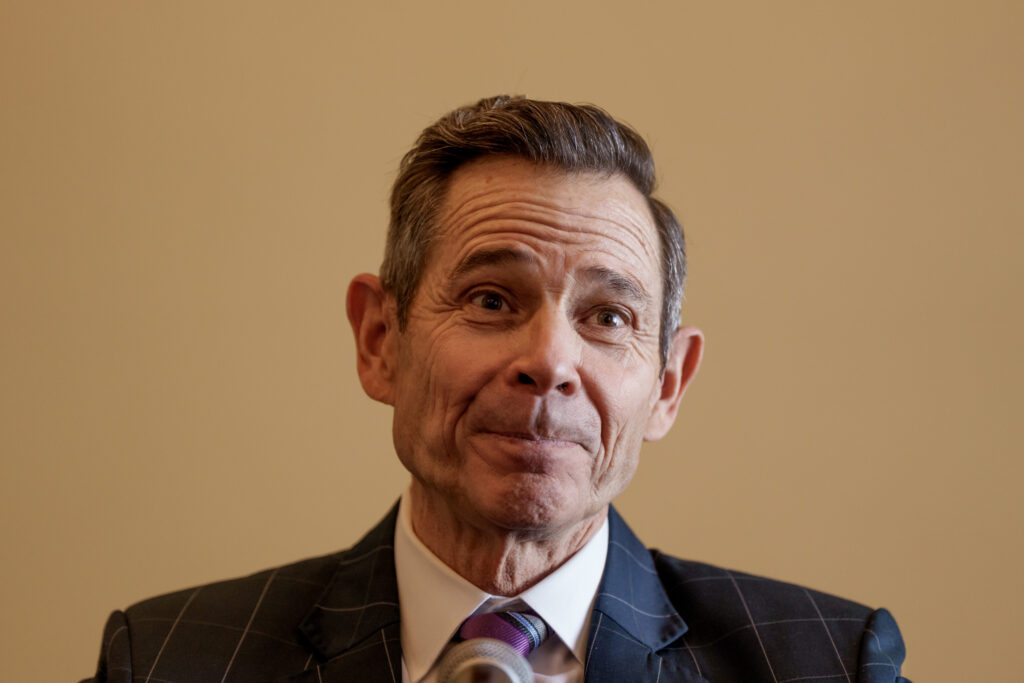


Rep. John Curtis, R-Utah, talks to media during a press conference at the Capitol in Salt Lake City on Thursday, Feb. 19, 2026. (Photo by Spenser Heaps for Utah News Dispatch)
Weeks after calling to open an independent investigation into the fatal shooting of 37-year-old Alex Pretti by federal immigration agents in Minnesota, Utah Republican Sen. John Curtis hopes accountability is on its way.
After Secretary of Homeland Security Kristi Noem’s response to the shooting, promptly denying wrongdoing from the agents and painting Pretti as the aggressor despite existing contradictory video evidence, Curtis asked for accountability and vowed to work with a bipartisan group of senators to demand real oversight and transparency.
SUBSCRIBE: GET THE MORNING HEADLINES DELIVERED TO YOUR INBOX
Weeks later, Curtis remained critical of Noem’s response to the shooting, saying she should have called for an independent investigation then.
“That’s what should have happened, and that it didn’t was a big mistake, and I think will forever undermine trust that she has with the American people,” Curtis told reporters during a visit to the Utah State Capitol Thursday. “Now, at this point, I think it’s up to the president to see if that’s salvageable, but I do think a lot of trust was lost.”
Utah leaders ask for Minnesota shooting investigation — and de-escalation
That trust, he said, is hard to rebuild, but the department could start with “reasonable reforms,” and demonstrate that its goals can be accomplished “the right way.”
“I believe that this is a false narrative that we cannot have rule of law and compassion,” Curtis said. “I think that’s the Utah way. I think the Utah compact asked for rule of law and compassion, and I think we should ask for that on a national level as well,” pointing to the state’s 2010 declaration on the principles that should guide immigration policy and enforcement.
However, reasonable reforms in Curtis’ view are nuanced and may not include requiring Immigration and Customs Enforcement agents to remove their masks. While under normal circumstances the government wouldn’t want its law enforcement wearing them, he said there have been too many instances of doxing.
“It’s easy for me to say this is not just as clean cut as ‘don’t wear a mask,’ right? There ought to be penalties (for doxing),” he said. “If we have the appropriate penalties for that, then we can have that conversation.”
However, revising training procedures for agents and the short timelines before they’re out on the street must be a part of those reforms.
But one big ask from the Utah senator is that Department of Homeland Security officials testify before Congress.
“I think we need to make sure that actually happens. The only way you restore trust is to make sure that happens,” Curtis said.
Curtis says he’s pleased with President Donald Trump’s reaction, saying the president promised to ensure there would be an independent investigation. That hasn’t happened yet. But Curtis said he expects Kentucky Republican Sen. Rand Paul, chair of the Senate Committee on Homeland Security and Governmental Affairs, to take action.
“I can guarantee you he won’t give up on that. We’ll see how willing those officials are to come in and how hard Congress has to push,” Curtis said. “But I’ve not lost my enthusiasm to have that accountability and have those people come before Congress and explain.”
AI federal preemption?
Utah legislators have been in discussions with the White House, which have blocked progress on a state proposal requiring artificial intelligence companies to write and post public safety plans and risk assessments for certain models. The bill had advanced to the House floor, but was ultimately circled by House Majority Leader Casey Snider, R-Paradise, who argued it needed more work.
Utah bill requires AI companies to share safety plans for children and the public
According to an Axios report, the White House Office of Intergovernmental Affairs told state lawmakers the bill was “unfixable” and goes against the Trump administration’s AI agenda. The bill has remained frozen in the House calendar ever since.
In the middle of the debate over federal and state roles on regulating AI, Curtis says everyone is wrestling with what’s appropriate. Especially, he said, when overregulation could push AI innovation overseas, and at the same time the government struggles with abuses it cannot currently control.
“My colleagues and I are trying to figure out what those guardrails are, what are the appropriate ones,” he said. “Clearly, there’s a major category when it comes to our youth that we can probably all coalesce around and agree on, and then there’s some that are more difficult.”
Regulating AI has been an issue that has divided Republicans. After Trump signed a controversial executive order to establish the grounds to preempt states from governing artificial intelligence, Utah officials have expressed concerns, including Herriman Republican Rep. Doug Fiefia, who co-chairs a national task force on state AI policy and sponsored the bill the White House is opposing.
Curtis acknowledged that dispute.
“It’s widely reported in the news that there’s a big push to take away the ability of states to regulate on this. As you might guess, our state is pushing back on that,” Curtis said. “I personally think there’s probably a lane for states and there’s probably a lane for federal government. We need to define that.”