
Utah News Dispatch
What to know about Utah’s new voter privacy law and how clerks are responding to concerns


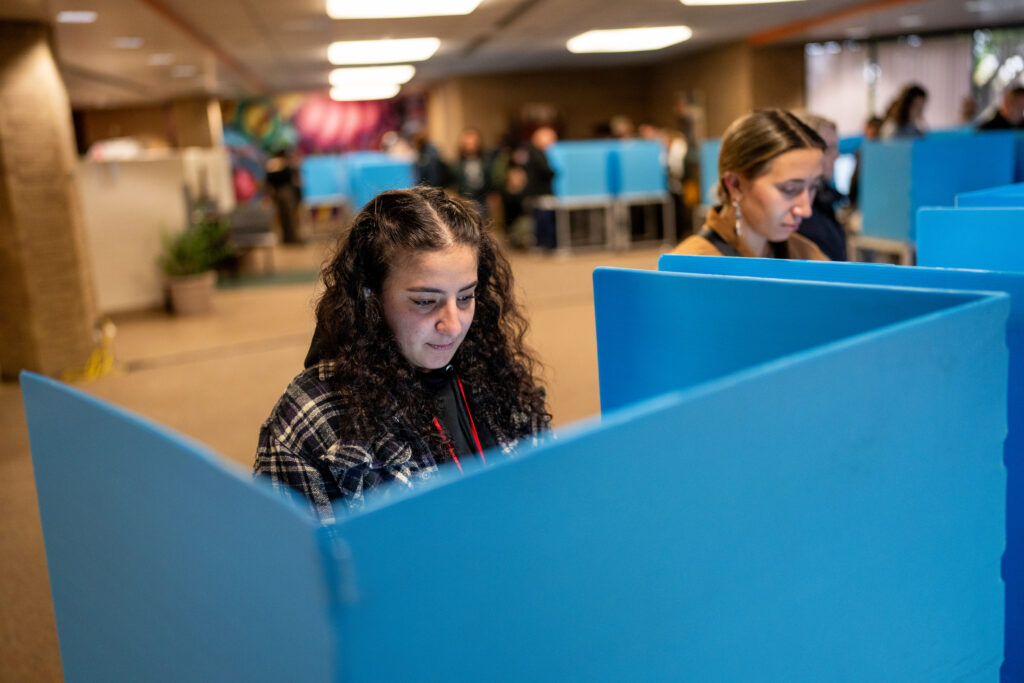


Nadia Ammar, 28, casts her ballot at the Salt Lake County Government Center in Salt Lake City on Election Day, Tuesday, Nov. 5, 2024. (Photo by Spenser Heaps for Utah News Dispatch)
In preparation of a new law taking effect May 25, Utah’s top election official, Lt. Gov. Deidre Henderson, started issuing letters last week to more than 300,000 Utah registered voters who had previously opted to keep their voter registration records withheld and private.
Now, under SB153, which was signed into law last month by Gov. Spencer Cox, that information — name, address, age range, party affiliation, and vote history (meaning which elections you’ve voted in, but not how you voted) — will become available to anyone who requests voter registration lists for a fee.
However, records for those who qualify for an “at-risk” voter status will be shielded and anonymized.
Registered voters who fall under any of the following categories can be eligible for an “at-risk” protected designation, according to the law:
- A person who is a victim, or is likely to be a victim, of domestic violence or dating violence.
- Law enforcement officers.
- Individuals protected by a protective or protection order.
- Members of the armed forces.
- Public figures. A public figure is defined in Utah law as “an individual who, due to the individual being considered for, holding, or having held a position of prominence in a public or private capacity, or due to the individual’s celebrity status, has an increased risk to the individual’s safety.” Its definition does not include elected officials or those appointed to fill a vacancy in an elected public office.
- A person who resides with any of the individuals described above.
Voters wanting to apply for an “at-risk” voter status and protect their records must meet the qualifications and submit a request to their county clerk by May 6. The forms are available at county clerk offices or online at vote.utah.gov/voter-privacy-information.
Private voter info to become public, but some Utahns, including police, can get exemptions
The lieutenant governor’s website emphasizes that while the new law allows “basic registration records” to be granted to anyone who requests it and pays the fee, the following personal information will remain “strictly private for all voters and may only be disclosed to government entities for election administration purposes”:
- Social security numbers
- Driver’s license or state identification numbers
- Full dates of birth
- Email addresses
- Phone numbers
- Signatures
It’s important to note that this isn’t the first time basic voter registration information has been publicly available. That information was public before the Utah Legislature in 2018 passed a law that allowed Utahns to opt into a “withheld” status to keep their voter registration records private. Since then, Utah lawmakers have debated whether that law went too far and created unintended consequences that pose challenges for candidates and political parties.
SB153 — sponsored by Sen. John Johnson, R-North Ogden, and Rep. Trevor Lee, R-Layton — is the latest change to privacy laws that rolls back the “withheld” option for Utah voters.
But since the letters notifying of the new law started hitting mailboxes, some Utah voters have reacted with concern. The change also comes during a time of heightened concern of doxxing on social media.
Salt Lake County Clerk Lannie Chapman told Utah News Dispatch on Tuesday that her office has been “getting a lot of questions” about the new law.
She said her office hasn’t received “a ton” of unregistration requests but some people “are fearful for probably many reasons,” including those that “really value their privacy, or it could be that they’ve experienced some trauma in the past and they really do not want people to get ahold of them.”
Chapman noted that there’s a provision in SB153 that explicitly prohibits election officers like herself from “encouraging” or “discouraging” people from submitting an “at-risk” designation request. To those who are worried about their privacy, she said she’s been encouraging them to learn about the details of the law, and if they have concerns to contact their legislators to express their opinions.
SUBSCRIBE: GET THE MORNING HEADLINES DELIVERED TO YOUR INBOX
“This is a brand new law. We’re all learning it as we go,” she said. “We want to make sure that people that should be protected by law maintain those protections and still have their voice heard in our local elections.”
For those who are rejected for an “at-risk” designation, there are no appeal processes in the new law. However, Chapman noted there’s “nothing that would preclude somebody from applying again.”
“We want to make sure that we’re protecting people to the best of our ability, so we are expediting and moving these forms front and center,” she said. “And if there’s an issue that we see with the form or a reason why we wouldn’t grant it, we are currently working on a mechanism to make sure that the voters understand why we came to the conclusion we came to.”
As for those who are thinking of ways to game the system — perhaps by re-registering to vote briefly before an election then un-registering again shortly after the election — it’s not guaranteed that will protect their records.
“There is no guarantee that will work and there is a chance they could appear on a voter list,” the lieutenant governor’s office told Utah News Dispatch when asked about that scenario. “They would also appear on a provisional ballot list.”
Chapman also warned that could create added obstacles for voters.
“The issue I see is they would have to be very, very thoughtful when elections are coming up to make sure they re-register if they’d like to participate using a by-mail ballot,” she said. “It’s a lot more hassle.”
Asked if the new law could create a chilling effect for voters who are concerned about their privacy, Chapman encouraged people to learn about the law and if they have concerns to contact their state senators and representatives.
“Learn about it. Educate yourselves,” she said. “And if you love it, if you hate it, if you have opinions, let your representatives know.”