
Utah News Dispatch
Uncertainty swirls around Salt Lake City ICE warehouse amid DHS review


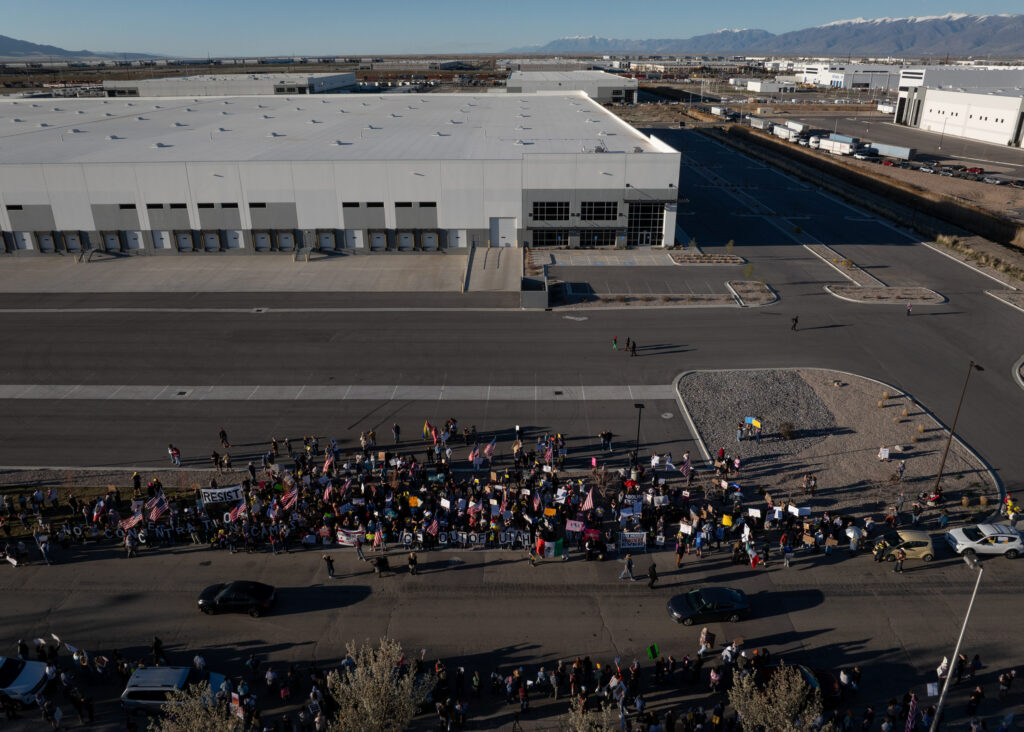


People protest outside a planned ICE detention facility in Salt Lake City on Wednesday, March 18, 2026. (Photo by Spenser Heaps for Utah News Dispatch)
More questions than answers remain about what the Department of Homeland Security’s review of contracts executed under former Homeland Security Secretary Kristi Noem means for a proposed “mega” detention center in Salt Lake City.
After newly-appointed Homeland Security Secretary Markwayne Mullin was sworn in, DHS paused purchases of new warehouses as it reviews Noem-era policies and procedures.
Noem was fired March 5, but days later U.S. Immigration and Customs Enforcement finalized the purchase of the Salt Lake City warehouse for $145.4 million — the highest price federal officials have paid for a warehouse as part of the Trump administration’s $45 billion plans to expand ICE detention center capacity.
It’s now unclear what the DHS review means for the already-purchased warehouse in Salt Lake City and whether federal officials will move forward with plans to renovate it into a large-scale detention center.
In response to a request for comment on the warehouse’s status, a Department of Homeland Security spokesperson pointed to a statement issued last week.
“As with any transition, we are reviewing agency policies and proposals,” DHS said. “As Secretary Mullin said in his confirmation hearing: ‘I will work with the community leaders and make sure that we are delivering for the American people what the President set out … We want to work with community leaders. We want to be good partners.’”
The department did not immediately respond to follow-up questions specifically asking whether plans for the Salt Lake City warehouse have been paused amid the DHS review. But in a story published Tuesday, The Atlantic reported that after Mullin took charge of the department on March 24, he “ordered a pause on conversion plans for the warehouse in Salt Lake City as well as for 10 others scattered across the country, seeking to defuse backlash from local jurisdictions.”


When asked about the news of ICE warehouse purchases being under review by DHS and if it could potentially jeopardize the proposed detention center in Salt Lake City, Mayor Erin Mendenhall told Utah News Dispatch last week she’s hopeful it doesn’t bode well for the facility, but it’s also unclear what it means for the proposal.
It doesn’t appear, however, that DHS is rushing to move forward with it, she said.
“We’re grateful that it doesn’t appear to be full steam ahead,” Mendenhall said. “We’re doing everything that we can — at every angle we can — to try to convey why this is not an appropriate place for any ICE facility, why Salt Lake City is not an appropriate place for any ICE facility.”
Asked if the review could delay or even doom the proposed detention center even though the purchase has already been finalized, Mendenhall said: “I am hopeful that by some grace of God it won’t happen in Salt Lake City. I am. Because Salt Lake City Hall, we’re not the only people talking to DHS about why this is an extremely inappropriate activity in the city.”
How the deal came together also remains a mystery. The entity that sold the warehouse, RREEF CPIF 6020 W 300 S LLC, is registered in Delaware and tied to a fund managed by DWS Group, a subsidiary of Deutsche Bank. Representatives from RREEF and DWS have not responded to emails from Utah News Dispatch seeking comment.
SUBSCRIBE: GET THE MORNING HEADLINES DELIVERED TO YOUR INBOX
A Republican state lawmaker, Rep. Matt MacPherson, supports the center in his district and may have more insight from the federal government soon. He’s traveling to Washington, D.C., next week with fellow GOP state lawmakers, he said, and the group plans to talk with representatives from the Trump administration about the facility, among other topics.
MacPherson, of West Valley City, said he’s “only heard positive things from constituents about the possibility of a facility” and sees it as a way to free up more room in Utah’s prisons and jails.
He previously noted ICE doesn’t have large, dedicated detention space in Utah and while it contracts with jails to hold some detainees, current state law places restrictions on that practice.
In a letter sent to Mullin on Friday, Salt Lake County Mayor Jenny Wilson urged him to “abandon” the proposed detention center in Salt Lake City.
“I respectfully urge the Department of Homeland Security to reconsider and abandon this proposed site,” Wilson wrote.
In her letter, Wilson outlined her concerns, which she described as “both practical and principled.”
“At a basic level, this facility is not suitable to house what has been reported could be up to 10,000 detainees,” she wrote. “More broadly, I believe many residents of Salt Lake County — and Americans across the country — are seeking a more measured, effective, and balanced approach to immigration enforcement.”
She said the proposed mega center “raises serious concerns related to infrastructure capacity, public safety, correctional staffing, economic development, and the appropriate role of state and local government in decisions of this magnitude.”
Wilson said the “scale and approach of this proposal are not aligned with the interests of Salt Lake County residents nor our business community,” describing it as sitting at the “heart of a critical industrial corridor” within the Utah Inland Port Authority’s jurisdiction, where state leaders have invested significantly to create a logistics hub meant to maximize Utah’s import and export potential.
“Introducing a detention facility of this scale risks undermining that vision and weakening a sector foundational to our regional economy,” Wilson wrote.

Roads in the state-governed shipping and trade hub are already busy, with UPS trucks and semitrailers driving in and out in a constant cycle. The center would bring even more traffic.
But without answers to questions like when it might open, who would run it, and the demand it would place on sewer and water systems, it’s hard to get a clear picture of how it could affect the district and its its efforts to attract and keep manufacturers, said Ben Hart, executive director of the Utah Inland Port Authority.
Hart told Utah News Dispatch the facility won’t necessarily be bad for business. He noted an industrial building on the district’s less developed western side is adjacent to the Utah State Correctional Facility, saying the prison is “really well-run, and I think there’s confidence in the leadership.”
“If it’s something that’s well done, then it doesn’t have to be something that is negative overall,” Hart said. “But when you hear that type of facility is coming in, I mean, does that raise questions for those who are looking at locating to the area? Absolutely, of course, I think anyone would acknowledge that.”
He said he’s not familiar with any deals falling through as a result, “but it’s something that we’re very sensitive to, again, because we want the best and brightest companies out there in the northwest quadrant.”

Wilson also said that neither state or local leaders — or the state’s federal delegation — have been “meaningfully consulted” on the project.
“This absence of engagement represents a significant departure from that principle and risks being perceived as an override of state and local authority,” she wrote. “This is not simply a federal facility. It is a project that will rely on local infrastructure, affect regional economic development, and place real and ongoing demands on local public systems. Proceeding without partnership undermines the likelihood of success.”
Wilson also listed more specific concerns with the proposal, including that the warehouse is “not designed for human habitation,” is not compatible with the site’s current local zoning for manufacturing and not detention, its impact on the inland port’s “economic vitality,” and its sheer scale compared to the county and state’s existing jail and prison capacity.
Salt Lake County’s jail system, she wrote, typically houses between 2,000 and 2,500 inmates while the Utah Department of Correction’s prison system houses about 6,000 to 7,000 statewide.
“A single facility holding up to 10,000 detainees would exceed the capacity of any comparable system in Utah and represents an unprecedented concentration in one location,” she wrote.
A facility of that size would also put additional pressure on already strained local law enforcement, emergency services and public health systems, Wilson said. Its surrounding utility and road infrastructure is also “not designed to support a facility of this scale,” she wrote.