
Utah News Dispatch
Cox appoints 2 more justices in year of major changes to Utah’s Supreme Court


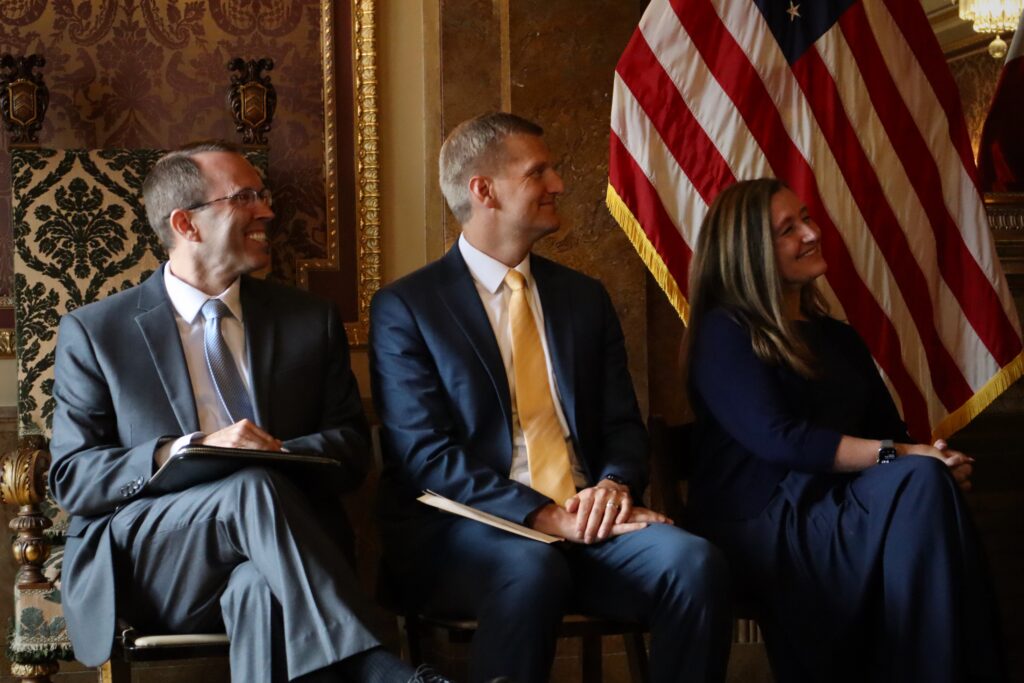


Utah Supreme Court nominees Matthew Bell and Michael Menssen, sitting with Associate Chief Justice Jill Pohlman, react to remarks from Utah Gov. Spencer Cox on Friday, Aug. 28, 2026 at the Utah Capitol. (Annie Knox/Utah News Dispatch)
Gov. Spencer Cox on Friday announced he picked a judge and an attorney for two open seats on the Utah Supreme Court, the latest changes in this year’s reshaping of the state’s highest court.
Cox appointed 5th District Judge Matthew Bell and civil litigator Michael Menssen to fill the seats vacated by retiring Chief Justice Matthew Durrant and former Justice Diana Hagen, who stepped down in May after a dismissed complaint of misconduct against her was made public.
In a press conference at the Capitol Friday, Cox told reporters that “originalism is very important to me and to these justices as well,” referring to the judicial philosophy focused on the text of the constitution and its meaning as intended by the Founding Fathers.
SUBSCRIBE: GET THE MORNING HEADLINES DELIVERED TO YOUR INBOX.
“There is no place for judicial activism in the system,” Cox said. “If you want to make laws, then get another job.”
Earlier this summer, Cox tapped lawyers to fill a two-seat expansion of the Supreme Court under a new state law. The expansion followed a string of legal setbacks the court dealt the Legislature, including in a redistricting lawsuit. Lawmakers backing the change insisted growing the bench would help the court review cases more efficiently.
After all four open seats are filled, the governor will have appointed six out of seven justices.
Hagen’s resignation came after the Utah House of Representatives released the dismissed complaint in response to a public records request. The complaint alleged Hagen had an extramarital affair with an attorney involved in the state’s redistricting case. Both denied the allegations, and Hagen said she stepped down to avoid dragging her family and friends into the controversy once the governor and top Republican state leaders sought an independent investigation into the allegations.
The governor called Durrant “a towering figure in Utah’s legal community” who has spent more than 25 years on the state’s high court, with 14 years as chief justice.
“And to say his shoes are not easy to fill is certainly an understatement,” Cox said.
In another change, the governor, rather than the justices, will appoint the new chief justice for the first time under a 2025 measure he signed into law.
“I’m going to take my time on that,” Cox said of the process Friday. “We want to make sure we have a fully-staffed court before I make a decision like that.”
He pledged to reach out to each justice for their perspective on the matter and said he anticipates making a decision in six to eight weeks. He noted that upcoming appointment, like the ones he announced Friday, is subject to approval by the Utah Senate.
Bell, the current presiding judge for the 5th District encompassing Washington, Iron and Beaver counties, was previously an assistant U.S. attorney and a trial attorney in the U.S. Department of Justice’s antitrust division. He began his career as a corrections officer and police officer, Cox said.
“It is hard to imagine another candidate so well prepared to consider and rule on the issues that impact every level of our system,” Cox said.

The governor described Menssen, who specializes in complex commercial and labor law, as “one of the finest civil litigators in our state” and praised his work with groups helping to expand legal aid for low-income Utahns.
Bell said the oath he’ll take if confirmed “means applying the law faithfully and objectively as it is written, not as we wish it to be.”
Menssen agreed.
“In determining what the law is, a judge must be open-minded and be guided by neutral, objective decision-making, not the judge’s own policy preferences,” he said.
Menssen received his law degree from the University of Virginia; Bell graduated from Brigham Young University.
The Appellate Judicial Nominating Commission put forward a list of three women and nine men for Cox to consider. The list also included three Utah Court of Appeals judges.
Utah Senate confirms 2 new Utah Supreme Court justices despite concerns over one’s residency
The Utah Senate in June confirmed his earlier picks of justices Stephen Dent, a former prosecutor, and Jay Jorgensen, a prior attorney for The Church of Jesus Christ of Latter-day Saints. Cox also named Justice John Nielsen to replace former Associate Chief Justice John Pearce last year.
The series of changes has meant the Utah Supreme Court is no longer a majority of women.
Cox previously pushed back on criticism that not enough women were considered for the two expanded seats, filled earlier this summer, noting he’d appointed both Associate Chief Justice Jill Pohlman and Hagen. He said his focus was on finding the best legal minds for the job.
On Friday, Cox recalled telling the new appointees that “I hope that they will rule against me and against the Legislature whenever they feel like that is necessary, that nothing in this process should make them feel beholden to me for appointing them, beholden to the Senate for confirming them. It is the exact opposite.”