
Utah News Dispatch
How much ice hides in Timpanogos Rock Glacier? Researchers compared its volume to an ancient wonder


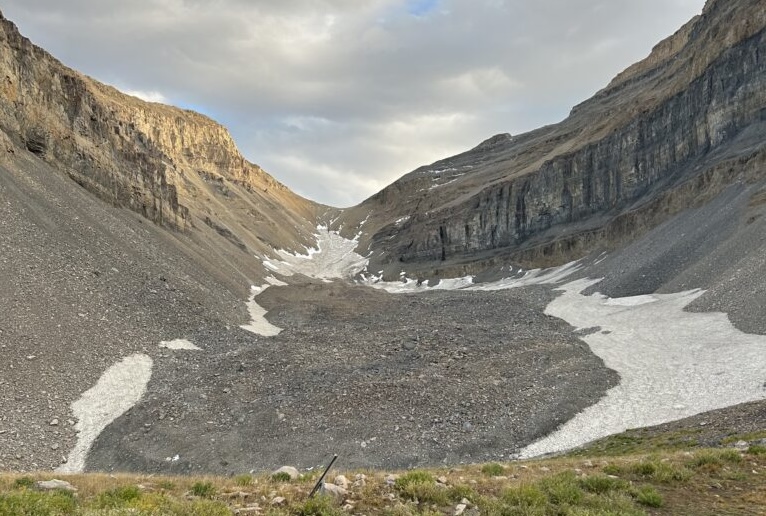


Mt. Timpanogos rock glacier. (Photo by Bronson Cvijanovich)
With a novel 3D technique, a University of Utah team has brought to light the unaccounted masses of ice hidden at the Timpanogos rock glacier, finding both a good measurement of how much ice it contains, and also how the rock glacier located near Salt Lake City and Provo formed.
The Timpanogos Rock Glacier stores 1.5 million cubic meters of ice, a University of Utah news release says. That’s enough frozen water to fill 600 Olympic-sized swimming pools. The number is also similar to the volume of the largest pyramid in Giza, Egypt, said Bronson Cvijanovich, a former graduate student in the Department of Geology & Geophysics.
SUBSCRIBE: GET THE MORNING HEADLINES DELIVERED TO YOUR INBOX.
“Timpanogos Rock Glacier is surprisingly ice rich. It is 83% ice and 17% loose rock,” said Cvijanovich, lead author of a study measuring the internal ice content of the rock glacier.
Rock glaciers are common in the Wasatch and Uinta ranges. Timpanogos is one of 836 in the state. While their footprints can be outlined with satellite imagery, “the 3D shape, depth and ice they obscure is harder to reveal,” the university said in the release.
“There’s a lot of ice that’s hidden in Utah’s mountains,” said Leif Anderson, a glaciology professor who oversaw the study. “When we are high in the mountains and walking across loose rocks or rubble, you don’t realize there could be 120 feet of ice buried beneath your feet.”
To estimate the ice content, a team hiked about five miles in an elevation gain of 3,500 feet to get to the rock glacier on different occasions in 2024, hauling sensitive instruments, like a gravimeter, and took gravity readings at 232 spots separated by about 80 feet in a grid atop the rock glacier.


The gravimeter measures density differences between rock and ice, the university said in the release, which allowed the researchers to calculate the 3D shape of the buried ice body. After those measurements were collected, the team had to correct them to take into account differences in gravity due to factors like the position of the sun and the moon, the location’s terrain, latitude and elevation.
But, how does ice get into the rock glacier in the first place? Another study from University of Utah researchers showed with a new mathematical model that rock glaciers gain mass because “rockfalls bury persistent snow in the upper parts of rock glaciers,” the release says.
“In the Wasatch, the mountains themselves are eroding and burying the snow, and that’s why the rock glaciers exist,” Anderson said.
And, despite climate change the Timpanogos Rock Glacier apparently keeps on adding ice, the researchers said.
“Rock glaciers flow downhill just like a glacier or river, but the important distinction here is that the thick carapace of loose rock actually protects and hides the ice, making these climate-resilient water storage sites that may still be adding frozen water. From a water resource standpoint, it is really important, especially in a warm and arid state like Utah,” Cvijanovich said.