
Utah News Dispatch
Volunteers count Utahns sleeping on the streets as state’s homeless strategy shifts


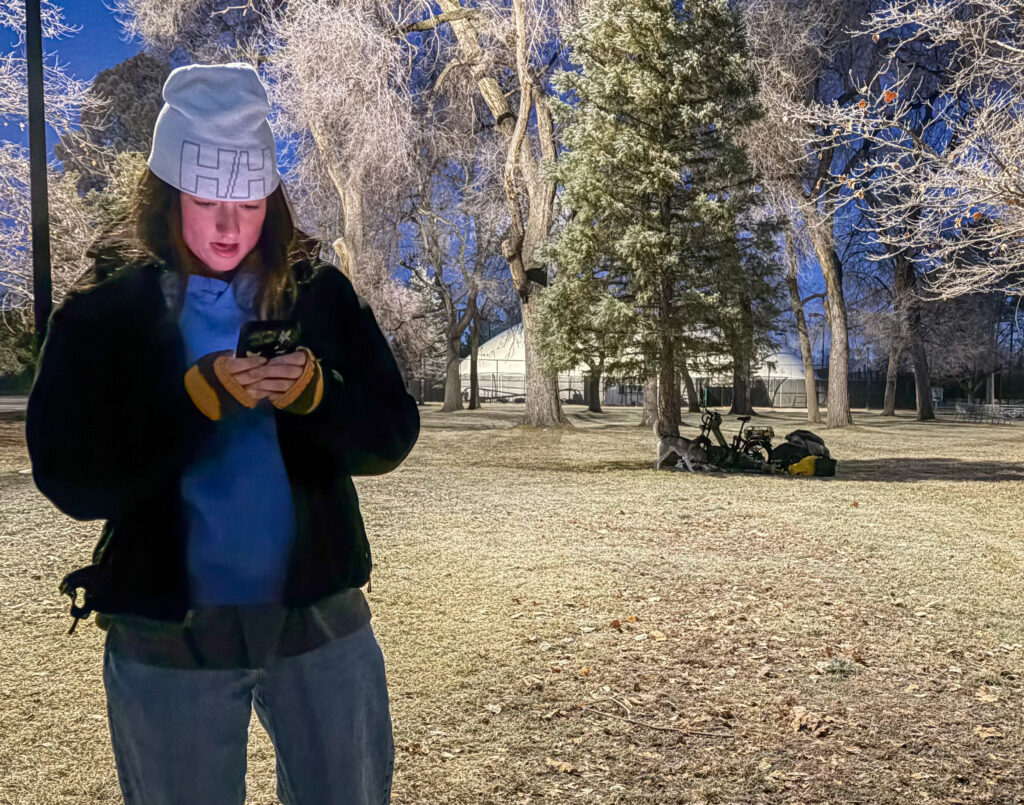


Justine Nicholson, a volunteer with Utah’s Point-in-Time Count and a University of Utah student, records details about a person experiencing homelessness in Salt Lake City on Friday, Jan. 30, 2026. (Photo by Aline Walker for Utah News Dispatch)
For three days, volunteers across the state got up before the sun to count Utahns experiencing both sheltered and unsheltered homelessness in their communities, finishing their work before most people even knew they were there.
The Point-in-Time Count is a nationwide event that seeks to provide a snapshot of how many people are experiencing some form of homelessness in any given area. Volunteers in Utah conducted the state’s count early Thursday, Friday and Saturday, collecting data that is used to inform government leaders about the state of homelessness, and can play a role in policymaking and resource allocation.
According to Point-in-Time Count volunteer coordinator Katie Zimmerman, people who have experienced homelessness in the past, or “lived experts,” play a large role in the Salt Lake Valley Coalition to End Homelessness and the count training process.
“Everyone who was on the (training) panel is actively involved in the Salt Lake Valley Coalition to End Homelessness. They advise policy and where funding should be sent. They help with grant writing. They present new ideas and offer their perspective as a lived expert,” Zimmerman said.
This year, 57 count volunteers in Utah were lived experts who had personally experienced homelessness. For them and other volunteers, the count is about more than data collection.
SUBSCRIBE: GET THE MORNING HEADLINES DELIVERED TO YOUR INBOX
Jeffery Rose, an associate professor in the Department of Parks, Recreation and Tourism at the University of Utah, has worked alongside the Salt Lake Valley Coalition to End Homelessness by getting his students involved in the count for the last six years.
“I want students involved in the real world. You know, if you think about the (parks and recreation) program, you’re probably thinking about skiing or canyoneering or backpacking, or things of that nature,” Rose said. “But I also want us to think about being outdoors in a broader sense. How can we sensitize ourselves to community concerns, and how can we contribute?”
This year’s count comes as Utah begins a shift away from “housing first” solutions to interventions focusing on accountability and treatment.
The state has proposed building a 1,300-bed homeless services campus, with Gov. Spencer Cox’s office saying its “target market” is “high utilizers of the criminal justice system.” The campus would include mental health beds for involuntary commitment and an “accountability center” for addiction treatment that would serve as an alternative to jail.
The high-priced proposal, which has not yet been funded, is being seen as a test case that critics nationwide have called a move to “criminalize” and “isolate” people experiencing homelessness.
Conducting the Point-in-Time Count
Every volunteer goes through a training session with Salt Lake Valley Coalition to End Homelessness before the count to learn the process, collect supplies and be assigned a track, which are mapped out and distributed by the event’s organizers. Then, volunteers have from 4 a.m. to 6 a.m. to search their assigned area.
On Thursday at 3:20 a.m. a group of Rose’s students met in frigid temperatures at Herman Franks Park in Salt Lake City to begin searching their track, spanning from 900 South to 1300 South and State Street to 700 East. The group, led by parks and recreation student Justine Nicholson, was approached by Salt Lake City police officers at 3:27 a.m. who told them officers had just cleared Liberty Park of anyone experiencing homelessness, and that they were likely “hiding” in the surrounding neighborhood.
Volunteers in this year’s count were able to attend the training in-person for the first time since 2020, including hearing from a panel of lived experts. The panelists described their interactions with law enforcement when they lived on the streets, and the ways they would hide from police, which Nicholson referenced multiple times throughout the night.
“One of the formerly homeless ones said to look in the trees, because that’s where he would’ve hidden,” she said.


The group drove up and down every street on their track, checking behind businesses and under cars. After an hour of searching, the group added their first person to the count at 3:55 a.m.
Once a group encounters someone experiencing homelessness, the process is relatively simple. First, volunteers introduce themselves and offer food, water, clothes and other supplies provided by the coalition. Then, volunteers conduct a survey to collect information about the person’s current circumstances of homelessness, substance use, disability, or anything that could limit their ability to work or live independently. If someone is unwilling or unable to participate in the survey, they are counted anonymously and their location is recorded.
Ultimately, the survey shouldn’t take longer than a few minutes, but some of the group’s interactions lasted up to 20 minutes. “From my experience, a lot of them just want to talk. A lot of them want to get their story out,” Nicholson said. “And I think that being someone for them to bounce those off of is helpful.”
While Nicholson originally started volunteering with the Point-in-Time Count through Rose’s class, the experience meant more to her than her grade. After meeting the first person experiencing homelessness that night, she shared why the initiative is so important to her.
“My grandpa, the last six years of his life, he was homeless. And it was because he went into medical debt for having HIV, and I would go pick him up off the street for Thanksgiving dinner,” she said. “I think that’s why I like doing this, I felt so hopeless then. Like, what can a 16 year-old do?”
How effective is the count?
Zimmerman, the volunteer coordinator with Salt Lake Valley Coalition to End Homelessness, is one of three people in the state who create the track maps. She explained that the previous year’s count data is compared to that area’s census tract. Then each Point-in-Time Count track is designated as a low-, medium- or high-density area for homelessness.
Nicholson’s track was a high-density zone, meaning volunteers should expect to count 10 or more people experiencing homelessness. On the first night, her group counted three. According to Zimmerman, the coalition sends an alert to law enforcement notifying them that the count will be taking place, and asking that no sweeps or abatements be performed during that week. However, both Rose and Zimmerman said this isn’t the first time that law enforcement conducting a sweep has impacted the count.
“In some of our research, people have referred to law enforcement around homelessness as ‘Operation Leaf Blower,’” Rose said. “Meaning you’re just taking a leaf blower and kind of scattering this problem, and you do move the leaves away from here, but the leaves land somewhere else.”
Rose said he believes that while initiatives like the Point-in-Time Count and outreach programs chip away at the issue, unsheltered homelessness will always be a problem as long as there’s insufficient housing.
“My hope for myself, for my students and for us as a community, is to realize that for the folks who get caught in this trap, it’s rarely due to personal problems,” he said. ”It’s rarely due to some failure on their part, it’s due to the structural problems that, quite frankly, that all of us create.”