
Utah News Dispatch
A lost ‘golden goose’ or ‘reasonable’ deal? How a landfill tested Utah’s school trust lands system


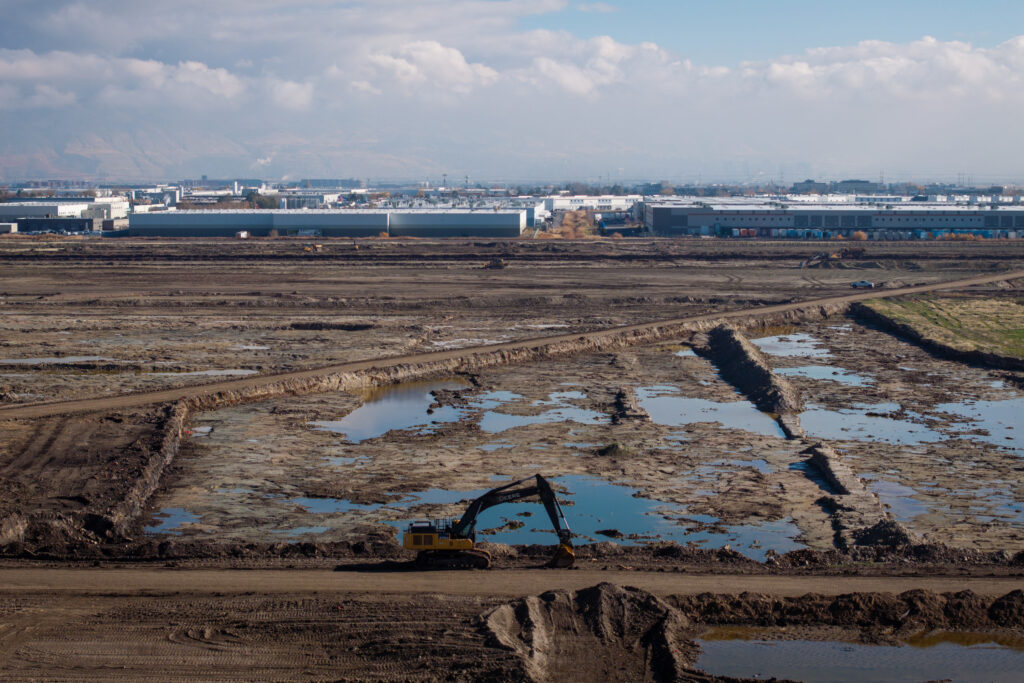


Remediation efforts continue at the old North Temple landfill in Salt Lake City on Friday, Nov. 21, 2025. (Photo by Spenser Heaps for Utah News Dispatch)
Key points
- The site of the former North Temple landfill, located in a prime spot in Salt Lake City’s northwest quadrant, was donated to a state agency tasked with using land to generate revenue to support state beneficiaries, including Utah public schools.
- After years of difficult negotiations, the land was sold to the Utah Inland Port Authority in a $10 million package with the goal of remediating and developing the site to eventually make it a hub for high-paying “advanced manufacturing” jobs.
- The deal raises questions about whether Utah’s public schools were shortchanged by the sale. Current state officials who executed the purchase last year argue the deal was fair, but a former trust lands director disagrees.
Today, truckloads of decades-old waste are being unearthed from about 770 acres in a remote area between the Great Salt Lake and Salt Lake City International Airport as part of a yearslong cleanup project that’s expected to cost the Utah Inland Port Authority upwards of $200 million, maybe more.
The area was once an old Salt Lake City garbage dump, known as the North Temple landfill, which sat dormant for decades after it closed down in 1979. For years, state and local players tried to figure out what to do with it. But it wasn’t until the Utah Inland Port Authority bought the land in early 2025 that the first shovel dug in to start cleaning up the site — an area state leaders have long eyed as ripe for industrial development, if not for the pesky landfill.
Cleanup has begun on a decades-old landfill in Salt Lake City – all for the Utah Inland Port
But the story of how the Utah Inland Port Authority came to own the land is complex and messy.
After years of tough negotiations, the land’s previous owner — the Utah Trust Lands Administration, an independent state agency that’s tasked with using a large portfolio of trust lands to generate money for certain state institutions, largely public schools — agreed to sell all 770 acres for a $10 million package.
The deal raises questions about whether Utah’s public schools were shortchanged by the sale. Current state officials who were involved in and executed the deal in early 2025 argue the state’s school kids got a fair shake, but a former trust lands director who was in the saddle when the land was first donated back in 2018 vehemently disagrees.
Behind the scenes, trust lands officials wrestled with selling the property while under pressure from top state leaders, who wanted the port authority to clean it up faster and steer its future. The trust land system’s independent advocacy office at one point even questioned whether selling the land would violate trust land officials’ fiduciary duty to their beneficiaries — namely, public schoolchildren.
That’s according to hundreds of pages of documents and emails Utah News Dispatch obtained through public records requests from several state agencies, along with multiple interviews spanning months with trust lands and inland port officials.
But in the end, officials with the Utah Land Trusts Protection & Advocacy Office — which acts as a watchdog for the Trust Land Administration’s beneficiaries’ interests — told Utah News Dispatch they decided the sale was “reasonable” when considering the complex issues surrounding the landfill, especially the evolving factors that put downward pressure on its value like liability issues, zoning changes and ballooning cost estimates for remediation.

To David Ure, a former director of the Utah Trust Lands Administration, the state’s trust lands system and therefore Utah’s school kids lost out on potentially hundreds of millions of dollars in future trust lands investment. And he thinks trust land officials violated their fiduciary duty by accepting a sale package that valued the land at only $8 million.
But Michelle McConkie, the agency’s current director who signed off on the land sale in early 2025, defended the deal in a prepared statement provided to Utah News Dispatch this week.
“Over the years, there have been many speculative ideas about possible future investments and uses of the property,” McConkie said. “In deciding to sell, TLA and its Board of Trustees considered recent zoning and land use changes by Salt Lake City and the Utah Legislature, as well as environmental cleanup liabilities of potentially hundreds of millions of dollars that have now been assumed by (the Utah Inland Port Authority). The millions of dollars realized from the sale and associated earnings are benefiting Utah’s public schools.”
It all started with a donation from a church-owned real estate company
To fully understand the issue, the clock must be rewound years, back to 2018.
That year, a real estate arm of The Church of Jesus Christ of Latter-day Saints donated about 770 acres of the old Salt Lake City landfill to the Trust Lands Administration, which at the time was called the School and Institutional Trust Lands Administration, or SITLA.
That donation agreement, obtained by Utah News Dispatch through a public records request, explicitly said the donation was meant to “support Utah’s state school trust and to enhance the substantial financial benefits that it provides to K-12 schools, and current and future generations of Utah school children.”

The agreement also valued the land at the time at about $75 million — and established a future revenue sharing agreement between the church’s Deseret Trust Company and SITLA, in which both parties would share equally in proceeds generated from the land development once a threshold value of $75 million was realized by SITLA.
But first, the landfill needed to be cleaned up.
Fast forward several years. Utah trust lands officials had a phased, incremental plan to remediate the landfill and develop it alongside market forces, but it would take years, maybe decades. For state leaders wanting to see faster and more comprehensive progress at the site — envisioned to be the beating heart of Utah’s inland port — the existing plan wasn’t good enough.
Plus, since the donation, the Utah Legislature had also created the Utah Inland Port Authority — with a sprawling jurisdiction over the “northwest quadrant” of Salt Lake City land that state officials saw as ripe for industrial development at the heart of the port’s jurisdiction.
So top state leaders — including Gov. Spencer Cox, Senate President Stuart Adams, and now House Speaker Mike Schultz — wanted the Utah Inland Port Authority to buy the property from SITLA to more quickly clean it up, steer its development and reap its tax increment, which is new tax revenue generated from development.
But that put the Trust Lands Administration in a potential tough spot. Trust lands officials are required under Utah law to not sell land below fair market value, and they have a fiduciary duty to put trust lands’ beneficiaries first. And under the 2018 donation agreement, the landfill’s future development was specifically supposed to benefit public schoolchildren.


Emails show discussions over the landfill conundrum spanned years, but negotiations heated up in 2023 and the latter part of 2024.
In a May 2023 email, Kim Christy — who was at the time the director of the Utah Land Trusts Protection & Advocacy Office — told the office’s committee members that the landfill was an “important, yet controversial, ingredient of the Inland Port Authority,” and that the Legislature has “largely stepped into the driver’s seat, replacing much of what was once Salt Lake City’s jurisdiction” over the landfill.
“Tensions between SITLA and Legislative Leadership have reached a dangerously high pitch,” Christy wrote.
Eventually, trust lands officials moved forward with a sale. In November 2023, they considered a price of $31 million. Negotiations hit a dead end before picking up in summer of 2024. Ultimately, later that year, the price tag came down even further to $10 million ($8 million for the land itself, plus $2 million to reimburse what SITLA had already spent on efforts to clean up the landfill).
In the end, the Utah Trust Lands Administration and Utah Inland Port Authority boards approved the sale in the closing months of 2024. The total $10 million transaction was finalized on Feb. 10, 2025, according to its closing document.
The answer to the question of whether the Utah Trust Lands Administration (and by extension public schools) got a good or bad deal out of the transaction depends on who you ask.
‘It was our golden goose’
To David Ure, a former lawmaker who served as director of the Utah School and Institutional Trust Lands Administration from 2015 until 2022, the port authority’s purchase of the landfill for $10 million was a terrible deal.
Ure spoke out against the landfill deal in multiple interviews with Utah News Dispatch out of frustration for what he sees as potentially hundreds of millions of dollars in lost long-term land investment that would have been managed by the state’s trust land system and therefore would have gone to Utah’s public schools.
“It was our golden goose to lay eggs for the kids for 15, 20, 30 years,” he said.
Ure was SITLA’s director at the time the agency accepted the donation. He retired from the agency in 2022, before the landfill sale was finalized in 2025.
When the Utah Inland Port Authority bought the land for only $8 million, Ure said Utah’s land trust system and its beneficiaries were shafted.

If the land had stayed in the hands of the Trust Lands Administration — which had a phased plan to clean up and develop the site, paid for by new tax revenue generated by development on the property — Ure predicted it would have eventually generated “well over $100 million to $150 million, easily” for Utah’s schoolchildren. “And I think that would be on the conservative side.”
If it had to be sold, Ure thinks the price tag for the land alone should have been at least $50 million, rather than $8 million.
Ure said when he was SITLA’s director, he faced pressure from state leaders to let the port authority buy the land and he refused — but the pressure on the Trust Lands Administration continued after he retired. Documents obtained through an open records request back up this claim, with emails from trust lands officials to the governor and legislative leaders acknowledging state leaders’ desire for the port authority to own the property and control its “destiny.”
It was our golden goose to lay eggs for the kids for 15, 20, 30 years.
– David Ure, former executive director of the Utah Trust Lands Administration
Asked if he thinks SITLA violated its fiduciary duty to the beneficiaries by selling to the port authority at that price, Ure said: “I say yes.”
“But when you have a gun pointed to your head from both sides, what choice do you have?” he added.
To add insult to injury, Ure said, he also thinks the contractor that was hired by SITLA and now the Utah Inland Port Authority to clean up the property — a group of companies known collectively as Ninigret — got a sweeter deal than the Trust Lands Administration.
In a separate transaction, the Utah Inland Port Authority also paid Ninigret — which was first hired by the SITLA to develop a remediation plan to clean up the landfill — $10 million as a one-time fee to give up the company’s rights to a revenue sharing agreement Ninigret had previously struck with SITLA, in which the company would have received a share of gross proceeds generated from the property.
That’s on top of what Ninigret continues to be paid for its ongoing remediation work, estimated to cost the Utah Inland Port Authority upwards of $200 million. As program manager of the project, Ninigret will also be paid a quarterly “management fee” equal to 4.5% of all project costs associated with contracts for the remediation work, according to the transaction’s closing document.

A ‘fantastic deal’
The port authority’s executive director, Ben Hart, and Utah Inland Port Authority Board Chair Abby Osborne, told Utah News Dispatch that the port authority’s purchase of the property from the Trust Lands Administration was more than fair to the state’s trust lands system.
“No questions asked, they got a fantastic deal for all of their stakeholders,” Hart said, pointing out that SITLA had acquired the land for free. “We have no qualms whatsoever saying they had a great deal. We feel fine with the transaction and feel like we paid them a lot of money.”
Osborne pointed to the $150 million to $225 million that’s been estimated as the cost needed to remediate the full landfill site — currently envisioned to eventually be a site for high-paying “advanced manufacturing” jobs at the heart of the port authority’s jurisdiction.
“There’s hundreds of millions of dollars going into a remediation process that would have been incurred by the schoolchildren of Utah to get to the point where it was actually developable,” she said. “So for them to be able to get $10 million and walk from it and not have the environmental burden that we’re going through … I mean, this is a significant undertaking to clean this up.”
In addition to the $10 million paid to the Trust Lands Administration for the land and previous contractual agreements, Hart said the port authority also paid $5.9 million to the church’s Suburban Land Reserve so it would release its claims to future revenue generated by the site’s development.


“It’s not just about the price that we paid to them, which was far and away above what they had paid for, it’s also about the willingness to step into the liability requirements and contractual (commitments),” Hart said. “The other thing we did was guarantee dates in terms of when we were going to get the property remediated.”
As part of the sale, the port authority agreed the first phase of the remediation would be completed within three years of closing on the sale, which took place on Feb. 10, 2025, according to the deal’s closing document. It also requires that the “full remediation and cleanup of the property” occur within six years.
As for Ninigret, Hart told Utah News Dispatch that the $10 million one-time fee was necessary to pay to the company as an “enticement and inducement” to “give up their financial rights of the prior contract” with the Trust Lands Administration and instead execute an agreement to continue remediation with the Utah Inland Port Authority.
If you look at the net present value of $8 million to the school kids, it would have been generations before they ever got any type of equivalent payment for that.
– Ben Hart, executive director of the Utah Inland Port Authority
The $10 million check to Ninigret, Hart said, “really was in recognition that they were going from a very lucrative proceeds sharing agreement (with SITLA) to a contract management agreement” with the port authority.
To Ure’s concerns that Ninigret got a sweeter deal, Hart strongly disagreed, calling it “absolutely false.”
“It is really easy for people who haven’t been part of this deal for more than four or five years now to stand back and try and criticize those who were trying to get a deal done,” he said, noting that four different parties — Ninigret, SITLA, the port authority and Suburban Land Reserve — all had a part to play in settling on a resolution.
“We had to get everybody to come together and get a deal done for the betterment of the landfill, the betterment of the west side of Salt Lake County,” he said. “So for someone to come in and try and poke holes in that deal who was not involved, who quite frankly couldn’t get a deal done when he was here, feels much more like sour grapes than any actual, real substantive criticism.”
To Hart, that $8 million paid for the landfill was money Utah’s school kids realized sooner rather than decades later.
“If you look at the net present value of $8 million to the school kids, it would have been generations before they ever got any type of equivalent payment for that,” he said. “They got $8 million in 2025. They would have had to have waited decades before they would have gotten the equivalent amount of money back into the school fund (under SITLA’s remediation plan).”

At the Utah Inland Port Authority’s celebratory “first scoop” event last spring, Hart acknowledged that the two years of negotiations with trust lands officials were “difficult.” But ultimately, he said state leaders did not want a remediation that would span 20 or 30 years, and they believed the port, with its bonding capabilities, would be better positioned to finance the cleanup.
“We don’t begrudge SITLA at all,” Hart said at the first scoop event. “They had a vision. They had some financial constraints. The port does not have those, so we felt like we were the better entity to take this on.”
Osborne said the Utah Inland Port Authority Board was “passionate” about buying this land because it sits in the “heart” of the northwest quadrant, an area that has long been eyed for the port authority’s development.
Osborne also acknowledged “these were tough, complicated negotiations,” but she said “at the end of the day I have nothing but great things to say about trust lands and how this thing went.”
The hope is that after the landfill property is cleaned up and developed, it will start generating tax revenue that will eventually recoup costs of the remediation — but also generate hundreds of millions for the state of Utah. However, it’s still far too early to say how much money the land will eventually generate. Right now, Osborne said port officials are “focused on the remediation.”
It’s possible that future revenue generated by the land’s developments could come back to Utah’s school districts in the form of property tax revenue, but if it did, that would be far in the future.
“We’ll get it done. There will be a revenue source back to schools at some point when this is fully developed,” she said. “I think this is a good thing for the state of Utah.”
Why was the land value reduced to $8 million?
When asked how the price changed over the course of the deal, Hart pointed to the “liability” of the landfill due to its environmental risks the Trust Lands Administration took on when it accepted the donation.
“Their willingness to enter into that agreement and take on that liability was the reason they got it for a reduced price,” Hart said. “As part of our transaction, we took on those same liability requirements, plus some additional ones, that SITLA was required to take on. So we allowed them to walk away from the deal and we inherited those same responsibilities for liability.”
The $31 million price contemplated in 2023 did not include the Utah Inland Port Authority taking on the environmental liability of the landfill property — while the $10 million price that was later agreed to did, Osborne said.
“We took on the liability with a reduced price,” Osborne said.


Asked about the $75 million value included in the 2018 donation agreement to SITLA, Hart said that value was “way inappropriate in terms of the price for this property.”
“It was out of orbit, and there was no way that was a price we were willing to pay,” Hart said.
When pressed on Ure’s concerns that Utah’s trust lands system and therefore its beneficiaries has lost out on millions due to the port authority’s purchase of the landfill, Osborne said Ure “was the executive director for a long time, and nothing ever happened here.”
“We’re finally actually at a point where we’re remediating, we’re going to have development out here at some point,” she said. “We’re actually doing what he said he was going to do decades ago and never did.”
Ure, in response to Osborne’s comments, argued that SITLA had a plan to remediate and was moving forward with it, but it kept running into roadblocks because SITLA officials didn’t have a clear direction or vision from the inland port on how the property should be used.
“We had a plan to clean it up and pay for it as we went,” Ure said, “and they wouldn’t let us proceed.”
Changing vision
At the time of issuing $150 million in bonds in 2021 (which will now in part fund the landfill’s remediation), port authority officials envisioned using the bonds to fund a massive truck-to-train transloading facility. But those plans were later abandoned, the port authority’s brand and leadership changed amid frustration over lack of progress.
Now, state leaders are envisioning the landfill site to eventually be a hub for high-paying “advanced manufacturing” jobs — which could include aerospace, biotech or automotive industries, Hart said — though it’s too soon to say what companies will eventually build there.
While developing a remediation plan for the landfill, emails show trust land officials ran into issues because of the changing leadership and evolving vision of the port.
In an April 26, 2023, email to the governor and legislative leaders including Adams, then-House Speaker Brad Wilson, Schultz and Sen. Jerry Stevenson, Kyle Pasley (then SITLA’s managing director of real estate development) wrote that for three years, trust lands officials had been discussing how the landfill would be “incorporated into a long-range plan for the area.”
“Over that time there have been changes in UIPA leadership, both on a staff and board level. We have struggled with ascertaining a clear direction from each iteration of UIPA staff on the vision that we have been asked to accomplish as SITLA has been asked to respond to numerous iterations of proposals on use,” Pasley wrote.
“Recently we have been informed that the current vision is for (the Utah Inland Port Authority) to own the property in order to control its destiny,” he wrote. “We further understand that this vision is the wish of state legislative leadership and the Governor. We are, of course, happy to move forward in bringing this vision to pass.”

But in order to move forward with a deal, Pasley listed several issues that would need to be addressed, including SITLA’s contractual agreements with Suburban Land Reserve through the donation agreement, liability issues, efforts SITLA had already undertaken to develop a remediation plan with the Department of Environmental Quality.
“Suffice it to say, SITLA has and continues to be willing to work with UIPA and state leadership to enact whatever vision is settled upon,” says the letter Pasley sent to state leaders signed by him and other SITLA leaders. “Respectfully, SITLA only asks that we come to an agreement that allows SITLA to fulfill our legal, fiduciary, and outside contractual obligations.”
The $75 million figure included in the donation agreement was “based upon the tax deduction taken by SLR which reflects the value of the property that was established by appraisal at the time of donation” in 2018, Pasley also wrote.
That letter also said that SITLA “takes its contractual obligations to SLR to actively market and develop the property for sale seriously and must make every effort to support the donation amount, tax deduction, and the Deseret Trust Company’s financial interest in the donated property.”
Officials with The Church of Jesus Christ of Latter-day Saints and Suburban Land Reserve declined a request for comment for this story, and they didn’t respond to questions asking whether the sale could have impacted the church’s tax deduction.
Advocacy office says deal was challenging, but ultimately ‘reasonable’
In an interview with Utah News Dispatch that took place before he retired in April as director of the Utah Land Trusts Protection & Advocacy Office, Christy said there were indeed concerns during the negotiations about whether selling the land to the Utah Inland Port Authority would violate the Trust Lands Administration’s fiduciary duty to its beneficiaries.
There were also questions raised about whether the Trust Lands Administration would violate the law if it sold the land for less than “fair market value.”
But given the complex factors surrounding the property, its remediation, and change in jurisdiction after the Utah Inland Port Authority was created, in the end he said the Protection & Advocacy Office concluded the deal was “justified.”
“Looking at this holistically in the context of how it evolved … I think it’s fair to say that the outcome was reasonable,” Christy said. “We are sensitive to all the dynamics that were playing (out), but overall the $8 million is a great benefit, obviously, to the schoolchildren of the state.”
While Utah’s Trust Lands Administration is mandated to have allegiance to its beneficiaries, Christy said it also faces a “practical reality” that “to get transactions done, you’ve got to be a community player.” He also noted that there’s a bigger picture to keep in mind, that development on trust lands does also benefit the state as a whole, not just the beneficiaries.
Still, he said the landfill transaction was “without question, probably the most difficult transaction that has ever been presented to SITLA in its 30 years of operations.” He said it really was “a test of this trust system.”

“It was a discovery process for all of us,” he said. “There were times along the way where it was easy for us to be critical of (the sale) … but I think all of us came to the realization that these factors that I just described were really what justified where we ultimately landed.”
When asked about what put downward pressure on the value of the land — from $75 million in 2018 down to a contemplated $31 million price in 2023, then eventually $10 million in late 2024 — Christy said several factors came into play.
He said trust lands officials considered $31 million after estimated costs of remediation “changed quite substantially with discussions and input from different stakeholders.”
Looking at this holistically in the context of how it evolved … I think it’s fair to say that the outcome was reasonable. We are sensitive to all the dynamics that were playing (out), but overall the $8 million is a great benefit, obviously, to the schoolchildren of the state.
– Kim Christy, former director of the Land Trusts Protection & Advocacy Office
Another key element, Christy said, was a 2024 bill that the Utah Legislature passed that downzoned the property by restricting it from being used for warehouse distribution. “That was a major element that I think propped up a higher value initially, but then it ultimately took on a different complexion when that restriction was established,” Christy said.
That 2024 bill — SB264 — was sponsored by Sen. Jerry Stevenson, who previously served as a member of the Utah Inland Port Authority Board. He was also an original architect of legislation that created the Utah Inland Port Authority.
In August 2024, the Salt Lake City Council also adopted a zoning change that prohibited warehouse distribution centers in the area.
That bill was “one of the drivers, frankly” that pushed down on the land value, Christy said, along with other factors like liability and the estimated costs of upwards of $225 million to remediate. “That number is far greater than what was initially anticipated,” he said.
Anticipated ‘tough’ questions
Toward the end of 2024, as the Trust Lands Administration moved forward with finalizing the $10 million sale of the landfill to the Utah Inland Port Authority, the Land Trusts Protection & Advocacy Office prepared for the possibility that it would face hard questions about the sale.
Included in the records obtained by Utah News Dispatch was a document dated December 2024 that outlined the office’s prepared responses to questions asked about the transaction.
“PREPARE FOR TOUGH QUESTIONS,” a subhead on the document said, while listing the following questions and responses:
- Is this transaction fair to the Public Schools Trust? “It is unfortunate that the marketability of this parcel has diminished so substantially and will not meet the values and opportunities originally anticipated. However, considering all factors including zoning changes and future remediation estimated between $150 million to $225 million or more required for this site, we feel that sale of the parcel is the best option currently.”
- As a watchdog, do you agree with the Trust Lands Administration/Board of Trustees decision? “The Land Trusts Protection & Advocacy Office is sensitive to and understands the complexity of this parcel. We respect the findings and transparency of the Trust Lands Administration and its Board of Trustees.”
- Are politics influencing this transaction? “The Land Trusts Protection & Advocacy Office recognizes there are many influences impacting the NW Quadrant property, largely related to environmental liability and remediation costs, but there are also many unique and evolving interests in the future management of this property due to its location within the Northwest Quadrant.”
The office also prepared a general statement saying that after the land was donated in 2018, it has “monitored complex and evolving issues impacting this parcel: Legislation, creation of the Utah Inland Port Authority, changes in UIPA leadership, municipality input, zoning changes, and liability and remediation issues.”
“The Land Trusts Protection & Advocacy Office and the School LAND Trust Section at the Utah State Board of Education respect the complex work, negotiations, due diligence, and transparency of the Trust Lands Administration and the decision of its Board of Trustees to sell the (landfill) property on behalf of the Public Schools beneficiary.”
When asked about the zoning changes and the impact on the sale price, Hart said “the port did not ask for the zone change. … We were not involved in that decision. Ultimately that was a decision of the Legislature.”
The thought behind the zoning change, Hart said, was lawmakers’ desire not to see more warehouses being built in the area. Instead, “they wanted to see industries that were going to have a much more positive economic multiplier,” he said, like high-paying advanced manufacturing jobs, rather than “just distribution centers.”
But because there’s currently a high demand for warehouse distribution centers and the zoning change placed restrictions on what kind of potential businesses would eventually be able to operate there, Hart said that zoning change did have a negative impact on the property’s value.
“To not have the opportunity for as many tenants, it hurts the marketability and the value of the property,” Hart said — a ramification the port authority now faces as its current owner, he noted.
Regardless of the zoning changes, Ure argued that the ground itself is still worth more than what the port authority paid.
“It’s still valuable land,” Ure said. “Very valuable land.”


But putting a price on land locked up by a landfill and facing hundreds of millions in remediation costs wasn’t straightforward — and notably, an appraisal was not included in the documents provided to Utah News Dispatch.
When asked if there were ever any appraisals conducted to set a fair market value during the negotiations with trust lands officials and the Utah Inland Port Authority, Christy said “no official appraisals were conducted to our knowledge.”
Why not? He said that was a “good question.”
“An official appraisal would have been a reasonable expectation, but to my knowledge it wasn’t established,” he said, though he also noted that the Utah Trust Lands Administration director has the option of using official appraisals or “doing its own internal estimates of value, so I don’t think that anything was necessarily violated relative to the process SITLA chose to take.”
Fiduciary duty concerns and an ‘element of compulsion’
Documents obtained from the Protection & Advocacy Office through a public records request illustrated how trust land system officials, including Christy, grappled with the difficulty of the sale and even expressed concerns that it could violate state law.
For a closed SITLA board meeting dated Sept. 21, 2023 — more than a year before the $10 million sale was finalized — Christy drafted a list of talking points, in which he wrote that the Advocacy Office and Committee had concerns with the proposed landfill sale, and that the Committee could not “in good conscience support the pending transaction for the following reasons.” His talking points listed the some of following issues:
- “It appears to be a clear breach of the fiduciary duty of the State as a whole (including that of the Governor and the Legislature) and a violation of the fiduciary duty delegated to SITLA.”
- “The element of compulsion that appears to underlie this transaction is profoundly troubling.”
- “The Advocacy Committee cannot condone a sale below fair market value,” another bullet point read, while pointing to state law and the Utah Constitution.

At the top of the page, Christy had written the words “Trust principles and abuse of power have collided,” but it was crossed out and replaced with: “Trust system is at a crossroads in terms of the future viability of the Trust System.”
Asked about those crossed out words and what he meant by them, Christy told Utah News Dispatch that the fact that they were crossed out “speaks for itself” and that wasn’t the “tenor” that he wanted to express during the meeting, but rather it was written down as a note to himself. He also said that as the negotiations evolved, “on first blush” issues surrounding the sale price and the pressure SITLA was facing from political leaders seemed “fairly glaring.”
But over time, Christy said he came to the conclusion that the deal landed in an “appropriate” place considering the complex factors at play, particularly the zoning restrictions enacted in 2024.
Christy also noted that after consulting with legal counsel, the Advocacy Office realized that it “does not have veto authority,” but rather its role is to advocate on behalf of beneficiaries’ interests.
Editor’s note: The key points for this story were written by a Utah News Dispatch journalist.
How does Utah’s school land trust system work?
Four agencies make up Utah’s School and Institutional Trust System.
The Trust Lands Administration manages about 3.3 million acres of trust lands in Utah, granted by Congress at statehood in 1896 with the requirement that revenue earned from the sale or lease of the land be placed into permanent endowment for public schools, called the Permanent State School Fund.
The revenue is generated from activities like energy development, real estate and grazing. Since 1994, Utah’s combined permanent funds have grown from $50 million to $4.1 billion as of early 2026, according to trust lands officials.
The School LAND Trust program, housed in the State Board of Education, distributes annual investment earnings directly to local K-12 schools and empowers communities to decide how best to meet their needs through land trust councils that decide how to spend the money.
The Utah School & Institutional Trust Funds Office is made up of an independent team of investors tasked with investing the revenue in the Permanent State School Fund to grow the endowment.
The Utah Land Trusts Protection & Advocacy Office monitors trust lands management to ensure returns are maximized while ensuring the fund’s beneficiaries’ interests are protected and represented.