Utah News Dispatch
Utah Republican Party delegates pick challenger over congressional incumbent, split on another

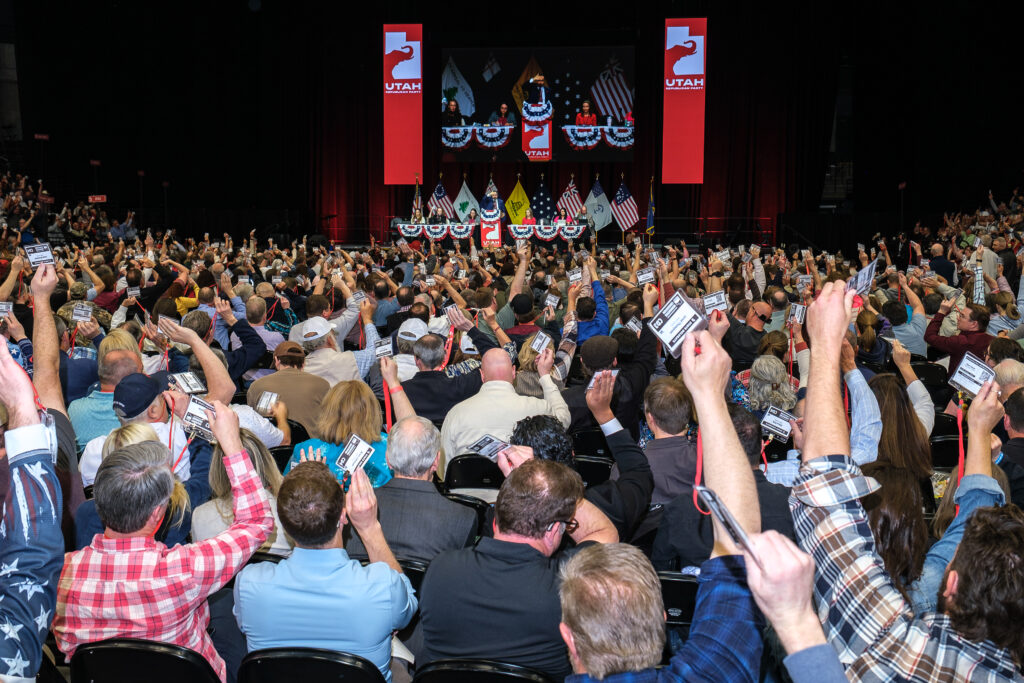

Delegates take part in a vote during the Utah Republican party nominating convention at the UCCU Center in Orem on Saturday, April 25, 2026. (Photo by Marco Lozzi for Utah News Dispatch)
The stage is set for the Utah Republican Party’s primary on June 23 under a new court-ordered congressional map that has shaken up Utah’s political landscape by turning one of the state’s four red districts blue.
For Utah’s 1st Congressional District — where a Democrat is expected to win — delegates handed Riley Owen, a Navy intelligence officer, the party’s nomination.
In the 2nd Congressional District, delegates nominated Utah state, Rep. Karianne Lisonbee, R-Clearfield, with 61.5% of the vote — but because incumbent Rep. Blake Moore already qualified for the ballot by gathering signatures, the two will face off in the primary.
For the 3rd Congressional District, incumbent Rep. Celeste Maloy will compete with former state lawmaker and gubernatorial candidate Phil Lyman in the primary.
And for the 4th Congressional District, incumbent Rep. Mike Kennedy will run unopposed, giving him a clear path to the Nov. 3 general election.
What’s at stake in the Utah Republican Party’s nominating convention this Saturday
In Utah, where the Republican party dominates in statewide races, the ultimate winners of the congressional races will almost certainly be decided by the June 23 primary, well before the November election.
To play their partial role in that primary selection process under Utah law — which allows a dual path to the primary ballot through either signature gathering, party nomination or both — about 3,500 of the Utah Republican Party’s 4,000 state delegates flocked to Utah Valley University on Saturday to cast their votes for their preferred candidates.
The all-day party convention took place at the same university campus where conservative activist Charlie Kirk was shot and killed about seven months prior.
Kirk’s killing loomed large over the convention with tightened security measures including metal detectors and bag restrictions. Utah GOP Chair Rob Axson recognized Kirk during his opening speech, and delegates honored him with a standing ovation and a moment of silence.
Prior to the convention, several GOP candidates — including Maloy and Moore — already qualified for the primary by submitting more than the 7,000 verified signatures needed, according to tallies posted by the lieutenant governor’s office. But others — like Kennedy — opted not to gather signatures and relied solely on capturing enough delegate support to get on the ballot.
Under party rules, a candidate who gets at least 60% of the delegate vote nabs the nomination. If no candidate gets at least 60%, the convention’s top two vote getters qualify for the ballot.

Throughout the convention, many candidates had similar rallying cries: opposition to signature gathering, condemnation of the court-ordered redistricting process that led to Utah’s current congressional map, support for efforts to enact transgender restrictions such as keeping “men out of women’s bathrooms,” and calls to rein in federal spending and the national debt.
During Saturday’s convention, candidates and party leaders also repeatedly criticized Utah’s courts for rulings that led to a court-ordered redistricting process that resulted from a yearslong anti-gerrymandering lawsuit.
To Republicans’ frustration, that court-ordered map created a new district concentrated around northern Salt Lake County that Democrats are expected to win — positioning Utah to potentially help Democrats as they seek to regain a majority in the U.S. House this year. The court rulings from both the Utah Supreme Court and 3rd District Court Judge Dianna Gibson have led Republicans to accuse them of ignoring the Utah Constitution, which they argue says redistricting duties fall exclusively to the Utah Legislature.
Shortly before announcing election results, Axson urged delegates to encourage their families and neighbors to vote against two Utah Supreme Court justices — Justice Diana Hagen and Justice Jill Pohlman — in their retention elections in November. Repeatedly throughout the convention, Axson called on delegates to donate to the party to help fund an effort to unseat the judges.
“We’re coming for you,” Axson said. “Justice Hagen and Justice Pohlman, go find a job in the private sector. We don’t want you anymore. … And then we’ll see where we go next. Diana Gibson, you have no business being on the (bench) either.”

Sen. Mike Lee — who is not currently up for reelection — also gave a speech in front of delegates, in which he again urged for the repeal of SB54, the 2014 law that enabled the signature-gathering pathway to Utah’s primary.
“This charade has gone on long enough, and we’re not going to put up with it any more,” Lee said.
Lee was met with a mix of applause and boos, with most of the boos coming from the Salt Lake County section of the convention arena, especially when Lee paraded his efforts to pass the Safeguard American Voter Eligibility Act, also called the SAVE America Act, which would federally mandate voter ID or proof of citizenship to register to vote. Critics including Utah’s own top election official, Lt. Gov. Deidre Henderson, have said it would preempt state laws and hurt Utah voters by implementing unnecessary obstacles.
1st Congressional District
Results: Delegates gave Riley Owen the party nomination with 71.2% of the vote (337 votes). Dave Robinson got 27.3% (129 votes), and Stone Fonua got 1.5% (seven votes). Both Robinson and Fonua didn’t gather enough signatures to qualify for the primary, so both were eliminated.
Robinson — a former Salt Lake County mayoral candidate and ousted Salt Lake County Republican Party communications director — urged delegates to support him, saying it will take a “unique” candidate to win.
“This is a winnable race,” Robinson said, pushing back on the assumption that the new district leans Democratic. He also addressed what he called a “whisper campaign” that he’s “litigious.”
“No,” he said, “Dave Robinson likes due process and transparency.”

Based on the vote, Owen’s message resonated with more delegates. He told them that in order to win the Democratic-leaning district, “we must expand our coalition beyond this arena,” including to voters on Salt Lake City’s west side “who feel so frequently ignored and forgotten,” along with moderate voters and young voters who are anxious about housing affordability.
“I won’t lie to you. … This is an uphill battle, and we are underdogs,” Owen said, calling for “courage” and “unity” for Republicans to back a nominee “that can keep this district red and rooted.”
A third candidate, Stone Fonua, spent the majority of his campaign speech by singing a song promoting “love and peace.”

2nd Congressional District
Results: About 61.5% of delegates (552) threw their support behind state lawmaker Lisonbee, handing her the nomination over Utah’s incumbent congressman. Moore got 33.7% (302 votes), while Colton Hatch only got 4.8% (43 votes). Moore, however, already qualified for the ballot through signature gathering, so he and Lisonbee will compete in the June primary.
When Moore took the stage, he was met with a mix of boos and cheers.
“Promises made, promises kept,” he said, while listing off his achievements since he was first elected in 2020. Moore also paraded that he’s the “first Utahn ever” elected to a GOP leadership position in the U.S. House as the vice chair of the House Republican Conference.
“This November is a contrast election,” he said. “Americans will have the opportunity to choose between common sense and crazy.”

Moore also highlighted that he’s been endorsed by President Donald Trump, House Speaker Mike Johnson, R-La., and U.S. Rep. Jim Jordan, of Ohio.
“But there’s only one endorsement that matters today, and that’s yours,” Moore said — which prompted a round of boos from some delegates. Still, Moore urged delegates to make him the “outright winner.”
When Moore’s leading challenger, Lisonbee, took the stage, she was met with loud applause and cheers. Lisonbee called for change in Utah’s congressional representation, saying the federal government is on an “unsustainable trajectory” with rising national debt.
“That is not leadership,” she said, to cheers. “Fraud and corruption have seeped into our institutions. Government is too big, costs too much, and has gone far beyond its purpose.”

Lisonbee attacked Moore for his role as a co-chair of the 2018 Better Boundaries initiative that sought Proposition 4, the voter-approved law that created an independent redistricting commission. Ensuing lawsuits over the Legislature’s maneuvers to dilute the governing power of Proposition 4 resulted in the court-ordered map that shifted one of Utah’s four congressional districts to a likely Democrat win.
“My opponent worked with Democrats to turn a reliably red congressional seat deep blue,” she said, to boos.
Lisonbee also emphasized that, unlike Moore, she didn’t gather signatures to access the primary.
“I didn’t buy a spot on the ballot. I’m depending on you,” she said. “I pledge to you today, I am one of you. Send me to Congress and I will work hard every day to make you proud.”
3rd Congressional District
Results: Neither Maloy nor Lyman achieved the 60% threshold for the party nomination, so delegates sent them both to the primary ballot. In the second round of voting, Maloy got 50.95% (482 votes) while Lyman got 49.04% (464 votes). Tyler Murset and David Harris were eliminated in the first round of voting.
Maloy began her speech by acknowledging that many delegates she’s talked to are “frustrated, and there are good reasons to be,” including the national debt and “people who have violated our trust.”

“While acknowledging that, let me make the case that America is still both good and great,” Maloy said.
Maloy argued that she’s been an “effective” representative for Utah because she’s “brought a real Utah attitude” to Washington, D.C. “And all I’m asking today is that you give me the chance to keep doing that, to bring that Utah spirit.”
Maloy urged delegates to support her, though she already collected and submitted enough signatures to qualify for the primary.
Lyman — a vocal signature gathering opponent — also declared that he would collect signatures when he first filed as a candidate in the race.

“I know it’s not popular,” Lyman told delegates Saturday, but he noted he did not gather enough to qualify for the ballot. Lyman’s campaign had submitted 2,703 of the 7,000 signatures needed for him to qualify, according to tallies posted Friday.
During his speech, Lyman railed against “calling girls boys,” and supported mass deportation. “The crime worthy of deportation is crossing the border illegally,” he said. “No other crimes required.”
Lyman also said “we’re done being lied to; release the Epstein files.”
4th Congressional District
Results: Though Kennedy had a full roster of four Republican challengers, delegates threw their full support behind him. Kennedy, the incumbent, clinched the nomination with 78.7% (753 votes). Scott Hatfield got 11% (105 votes), Seth Stewart got 5.2% (50 votes), Isaiah Hardman got 3.8% (36 votes), and Tyrone Jensen got 1.4% (13 votes).
Kennedy — who relied solely on the convention to keep his seat in Congress because he didn’t gather signatures to qualify for the primary — told delegates that his track record shows his longtime opposition of SB54, saying that as a state lawmaker he voted to repeal it “every time” there was an opportunity to.

“I believe in the caucus convention process,” he said.
Kennedy highlighted his career as a family doctor and attorney, as well as the decade he spent as a lawmaker in the Utah Legislature. He also pointed to a Utah law he successfully ran to restrict transgender surgeries and treatments for minors.
He characterized himself as a “pragmatic conservative who is thoughtful and civil, and I want to carry water for you for the next two years.”
Legislative race results
Senate District 1: Incumbent Sen. Scott Sandall, R-Tremonton, won the party nomination with 81% of delegates’ votes.
Senate District 7: Senate President Stuart Adams, R-Layton, will face two GOP challengers in the June primary: Braden Hess and Stephanie Hollist. Delegates eliminated Jennifer Garner in the first round of voting. Hollist was eliminated in the second round, but she gathered enough signatures to qualify so she still advanced to the primary. Adams also gathered signatures to qualify, and he got the majority of votes in the third round of voting — 86 votes, or 55.1% of the vote to Hess’ 44.9% — but Adams didn’t hit the 60% threshold needed for a nomination, so Hess also qualified for the primary.
Senate District 11: Brooks Benson won the Republican nomination with 73.1% of the vote to challenge Utah’s only third-party lawmaker, Sen. Emily Buss with the Forward Party of Utah, in November. Delegates eliminated former state lawmaker John Knotwell and Chris Sloan. Sloan had gathered signatures, but as of Friday, had only filed 1,394 of the 2,000 signatures required.
Senate District 18: Incumbent Sen. Daniel McCay, R-Riverton, didn’t gather signatures so he relied entirely on delegate support to qualify for the primary. He almost lost to challenger House Rep. Doug Fiefia, R-Herriman, but Fiefia narrowly fell short of nabbing the 60% needed for the party nomination by getting 58.4% of the vote to McCay’s 41.25%, so both Fiefia and McCay will advance to the primary. Tracie Halvorsen was eliminated.
House District 4: Incumbent Rep. Tiara Auxier, R-Morgan, won the GOP nomination with 92.2% of the delegate vote. Her challenger Kris Cambell was eliminated. Auxier will advance to the Republican primary unopposed.
House District 6: Former Utah congressman Rob Bishop won the nomination with 63.6% of the vote to fill a seat being vacated by current Rep. Matthew Gwynn. Bishop will advance to the June primary unopposed. His opponent Brad Barrowes was eliminated by delegates. In a special election, delegates also chose Bishop to fill the seat before the November election takes place.
House District 12: Another top Republican, House Speaker Mike Schultz, cruised to the primary ballot by getting 94.6% of the vote. His challenger, Dava Ann Neal, was eliminated. Schultz also had already qualified for the primary through signature gathering.
House District 29: Republican delegates voted 63.4% to nominate Alexis Wheeler to fill a seat being vacated by Rep. Bridger Bolinder, R-Grantsville. But Wheeler will still face an opponent during the primary — Sheldon Birch, who qualified by gathering signatures. Justin Nielson was eliminated by delegates.
House District 59: Two Republicans will advance to face off in the primary to fill an open seat being vacated by Rep. Mike Kohler, R-Midway: Luke Searle, who got 56.5% of the vote, and Jeffrey Pierce who got 43.5%. Mark Allen was eliminated.
House District 66: Delegates handed incumbent Rep. Troy Shelley, R-Ephraim, the Republican nomination with 79% of the vote. His challenger Justin Zohner was eliminated.
House District 67: JR Bird won the nomination with 88.9% of the vote to fill an open seat left by Rep. Christine Watkins, R-Price. Bird, however, will still face a primary challenger. Yvonne Jensen had submitted 1,019 of the 1,000 signatures needed to qualify for the ballot. Gina Gagon had almost collected enough signatures, but according to tallies last updated Friday, she had only collected 935 of the 1,000 needed for her to qualify.
House District 69: Incumbent Rep. Logan Monson, R-Blanding, will face a Republican primary challenger, Daniel Gardner. Monson fell short of nabbing the nomination by getting 57.8% of the vote to Gardner’s 42.2%.