
Utah News Dispatch
Nature’s table: Why the Central Wasatch needs food too

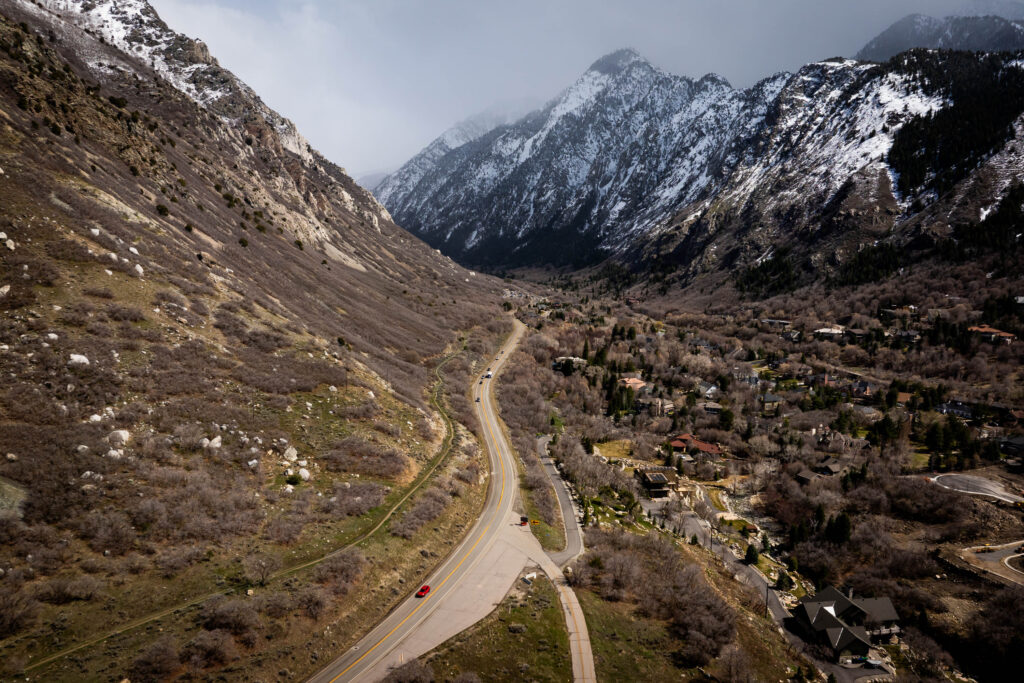

The mouth of Little Cottonwood Canyon is pictured on Sunday, March 31, 2024. (Photo by Spenser Heaps for Utah News Dispatch)
This year, as locals head into the Central Wasatch Mountains to plant and picnic for Arbor Day, they carry with them a 16th century Spanish tradition that inspired Don Ramón Vacas Roxo, the priest at Villanueva de La Sierra in Cáceres, Spain. In 1805, Don Ramón was so “convinced of the importance of trees for health, hygiene, decoration, nature, environment and customs,” that he led the first modern Arbor Day celebration with a three-day tree planting festival. In our modern landscape, his conviction remains vital. Thriving forests and community health are linked by a fundamental, universal thread: food.
Across the country and the world, food access is a paradoxical crisis. Migrant food service and production workers — the very community members feeding the globe — are frequently those with the highest levels of food insecurity. The Central Wasatch encompasses several ski resorts that temporarily employ South American immigrants via the J-1 and H-2B visa programs. These workers are more often positioned in food service roles than as ski and snowboarding instructors. In Park City, many rely on humanitarian services provided by the Christian Center of Park City to acquire sufficient food for their pantries.
However, food service employment presents a reductionist view of Hispanic and Latino relationships with our beloved Central Wasatch. For many, these mountains are a sanctuary for celebrating heritage while sharing a meal.
In oral history interviews conducted by Olivia Juarez, Community-Practitioner-In-Residence with the University of Utah Environmental Humanities program, participants often recounted the importance of food in forest outings. One participant who grew up in Salt Lake City’s Glendale neighborhood fondly recalled carne asada, sliced watermelon, macaroni salad, tortillas, meat, rice, salsas, queso fresco, and elote (corn) on a Millcreek Canyon picnic table during a family outing. He also described the food he brings backpacking:
“It’s so elaborate. And I carry that with me today. I go backpacking quite a bit with friends in the Uintas and they’re always laughing with the amount of, like, (intricate) food that I bring. Like they have the typical freeze-dried (foods) and I’ll have literally carne asada and, like, tortillas. And I’ll have a stovetop cooker and they’d be like, ‘Woah, that’s like a lot of weight to bring up.’ And I’m like, ‘It’s worth it…’ You should eat good when you’re out.”
Another ultra-marathon-running oral history participant highlighted a Millcreek Canyon gathering:
“Some of us went running and some went hiking. But at the end, we all met to eat and have a barbecue. It was like a potluck so everybody brought something. Yeah, it was actually one of my favorite memories… There was a lot of food. And everybody brought food from their country or (the) city where they’re from. It was delicious… Everybody, they asked me questions about the food I brought. I asked questions and (had a) learning experience through food … I was in charge of making the carne asada that day. I took the meat … I love cooking for others … I think I’m known in the Wasatch Trails Collective for cooking more than running.”
Whether in the mountain backcountry or at a day-use site, food, friendship, and outdoor heritage are inseparable. Especially when traditional foods become a point of connection. An exemplary instance of this is the Indigenous Central American farming method of cultivating corn, beans and squash with other produce within La Milpa. The products of this time-tested technique are at the center of many national forest picnic tables.
This agricultural heritage interacts with another matter of Central Wasatch Mountain gatherings: food access. Food deserts exist within Salt Lake City and the Central Wasatch region where healthy, affordable, fresh produce is unavailable. As an agency of the U.S. Department of Agriculture, the Forest Service’s mandate should extend beyond timber and trails to augment healthy, affordable food access in mountain communities.
Most of us support the Forest Service’s role in maintaining accessible forests for all. We know that the stakes are high for a Forest Service that should optimize community well-being. Recent agency restructuring ordered by USDA Secretary Brooke Rollins, will shutter Ogden’s Intermountain Region office, Logan’s Forestry Sciences Laboratory, and Cedar City’s Rocky Mountain Research Station. How this will affect Forest Service operations is yet unknown but the danger is clear: if we lose our national forest infrastructure — our picnic tables, fire rings, and grills — we lose a seat at the table.
This Arbor Day, Don Ramón’s 1805 sentiment remains increasingly relevant. For local outdoor recreation and traditions to continue, the Forest Service must remain a steward of inclusive, accessible spaces while enhancing healthy, affordable, and culturally-sustaining food availability.