
Utah News Dispatch
Was the Utah House’s release of a Supreme Court justice complaint ‘unlawful’?

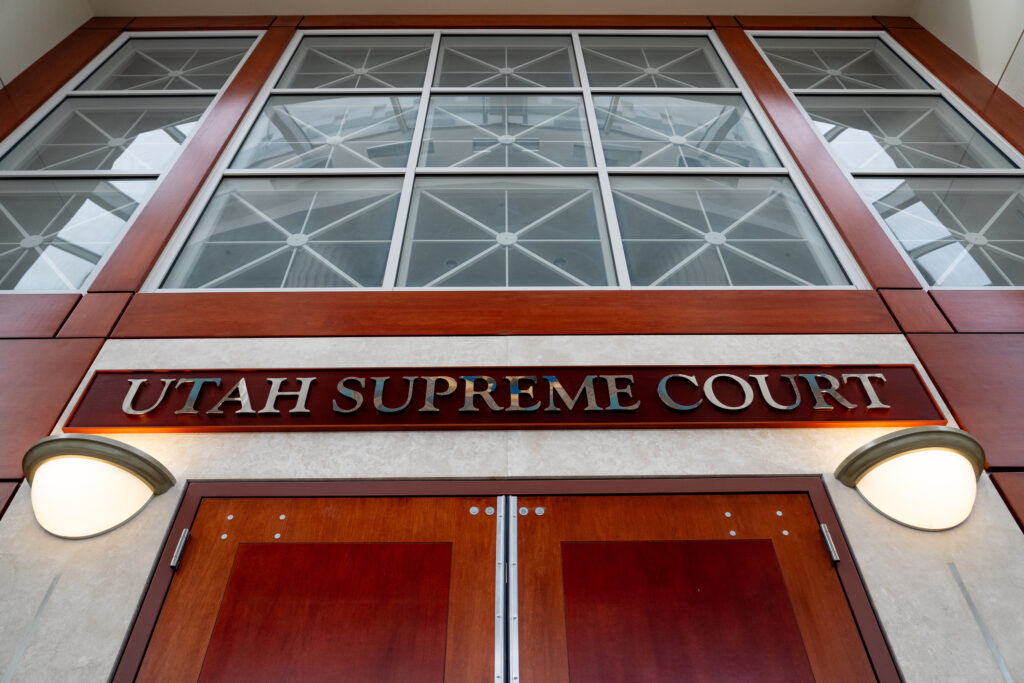

The entrance to the Utah Supreme Court inside the Matheson Courthouse in Salt Lake City is pictured on Wednesday, January 3, 2024. (Photo by Spenser Heaps for Utah News Dispatch)
A transparency dispute looms over a scandal that rocked Utah politics last week when one of the state’s news sites, KSL, obtained and published previously investigated and dismissed allegations that Utah Supreme Court Justice Diana Hagen had an affair with an attorney involved in the state’s high-profile redistricting lawsuit.
Should those records — which included a preliminary investigative report on allegations that the Judicial Conduct Commission later voted to dismiss and not pursue a full investigation — have been released in the first place?
The Utah Supreme Court and Utah House Speaker Mike Schultz are at odds over the answer. In a statement issued Friday, the Utah Supreme Court said the records were “inappropriately released to the public.” In response, Schultz said through a prepared statement that his office “followed the statute in releasing these records.”
Utah Supreme Court says affair allegations against justice were ‘inappropriately’ released
The aftermath of the unveiled allegations is still taking shape, and the dust is far from settled. In a joint statement, Utah’s top Republican leaders — Gov. Spencer Cox, Senate President Stuart Adams and Schultz — announced they would be moving forward with an “independent investigation to ensure the facts are fully examined.”
It’s not yet clear what that independent investigation will entail and who specifically will carry it out. The governor, the speaker and the Senate president on Monday did not respond to questions seeking specifics, and a House spokesperson said they’re still working through the details of what the investigation will look like.
But on top of that outstanding question, there’s also the matter of whether the Utah House violated the law when it released those preliminary records to not just KSL, but also to other news outlets, including Utah News Dispatch, that requested the same records the morning after the story broke.
Under Utah law, complaints to the Judicial Conduct Commission and its proceedings are confidential, the Utah Supreme Court said, while noting the Judicial Conduct Commission didn’t release the records. In denying an open records request, Alex Peterson, the commission’s executive director, told The Salt Lake Tribune that “The JCC disapproves of any unlawful release of records.”
“As to any records released by the Utah Legislature, the JCC legal position is that those records are and remain protected and confidential,” Peterson told the outlet. “The JCC was not consulted prior to their release.”
Schultz argues that release was in accordance with the law.
But that raises the question of how the House came to possess the records in the first place.
At least one lawmaker uses his legislative email for JCC matters
A spokesperson for Schultz’s office did not answer multiple questions around how the House ended up with the confidential Judicial Conduct Commission records. But based on interviews with lawmakers on Monday, it’s possible that the records could have come from emails exchanged between legislators who also sit on that commission, through their legislative email accounts.
Sen. Brady Brammer, R-Pleasant Grove, told Utah News Dispatch he didn’t actively provide the House the records — but he also said he uses his legislative email for Judicial Conduct Commission matters. He said he had used that email to converse with the other legislators who sit on the commission about the allegations involving Hagen.
“I have emailed the House members about these issues, but not House members outside the JCC,” he said.
The other three legislators who sit on the Judicial Conduct Commission include Sen. Jen Plumb, D-Salt Lake City, Rep. Grant Miller, D-Salt Lake City, and Rep. Jordan Teuscher, R-South Jordan.

“It was, ‘Here’s what we’re talking about, I have concerns.’ So I emailed them about my concerns,” Brammer said. He emphasized that’s “totally permissible” as long as the commission members don’t hold a quorum.
However, Brammer said he doesn’t know the process by which the House records officer searched for and captured the records to respond to KSL’s public records request.
“I don’t know what they were looking at and what their considerations were,” he said. “They could have pulled it from anyone who sent or received an email. And sending or receiving emails among JCC members, you know, you have to send emails and communicate. … But as far as how they pulled it or whose they pulled, I don’t know how they did that in this instance.”
Brammer added that the Judicial Conduct Commission “doesn’t have a protected email system of their own.”
“They could have gotten it through any of the JCC member emails,” he said.
The Judicial Conduct Commission is an independent body made up of two members of the House of Representatives appointed by the House speaker, two members of the Senate appointed by the Senate president, three people appointed by the governor, two members of the Utah State Bar, and two judges appointed by the Utah Supreme Court.

In response to a request for an interview with Miller on Monday, a House Minority staffer pointed to a statement shared by House and Senate Democrats on Friday saying they “trust the work of the Judicial Conduct Commission and the process it followed as it previously investigated and addressed this matter.”
That statement also said Republican legislative leadership’s efforts to independently investigate a member of the judiciary was “a part of a broader pattern of overstepping judicial independence and sets an incredibly dangerous precedent.”
A staffer for the Senate Democrats said Plumb wasn’t available for an interview, and she didn’t respond to questions about whether the records could have come from her emails.
Tesucher, however, told Utah News Dispatch in an interview Monday that he uses his personal email for Judicial Conduct Commission matters. And he said he did not provide the records to the House.
“No,” he said. “Absolutely not.”
However, Teuscher said “unfortunately I think the statute is super ambiguous” when it comes to what Judicial Conduct Commission records are protected versus public.
Utah law is restrictive for JCC, but not for House — until May 6
Current Utah law specifies that the commission, specifically, can’t release complaints except under certain circumstances, including until the Utah Supreme Court issues a final order on the matter. But it doesn’t specifically say whether it’s unlawful for other state bodies, including the House of Representatives, to release the records.
Teuscher said that’s why he and Brammer ran a bill this year, HB186, which specifically listed Judicial Conduct Commission investigation records under the state’s definition of “protected records.” That bill passed and was signed by the governor — but it doesn’t become law until May 6.
SUBSCRIBE: GET THE MORNING HEADLINES DELIVERED TO YOUR INBOX
“After May 6, I think what the Supreme Court is saying is likely true, that you couldn’t release it,” Teuscher said. “But today there is no prohibition. It doesn’t fit into the definition of a protected record under the GRAMA code.”
Teuscher said in his experience, House staff “do their very best to comply with the law” when responding to all GRAMA requests.
Asked whether he’s supportive of an independent investigation into Hagen, Teuscher said: “generally, a good practice is that sunlight is the best disinfectant.”
Both Brammer and Teuscher declined to say how they voted as Judicial Conduct Commission members on whether the body should pursue a full investigation into the allegations against Hagen. Both said that vote was confidential because it took place in a closed session, so they weren’t sure if they could legally comment about it publicly.
‘Not a great look’
Sen. Todd Weiler, R-Woods Cross — who also chairs the Senate Judiciary, Law Enforcement and Criminal Justice Committee — told Utah News Dispatch on Monday that he’s “100%” supportive” of an independent investigation into the allegations against Hagen.
He argued that the Judicial Conduct Commission’s preliminary investigation wasn’t enough, and that rather than voting to dismiss the allegations it should have voted to hold a full investigation.
He noted that the Judicial Conduct Commission’s chair, Cheylynn Hayman, is a friend of Hagen and works with Reymann. Even though she recused herself from the JCC vote, Weiler said “that’s not a great look” to the public.

Weiler noted that during Hagen’s confirmation hearing, he voted in favor of her. He called her a “very talented lawyer” with a “brilliant mind,” and he said he supported her “because I thought she was qualified and she’d do a good job.”
“I think it’s unfortunate that some of her private life has become, you know, fodder for the media. … So I think all of this is tragic,” he said. “But I also think the public deserves a full inquiry. … It’s unfortunate for everybody, but I think if we sweep this under the rug, it’s going to do more damage than good.”
Given the Judicial Conduct Commission’s preliminary investigation and recommendations to dismiss the allegations as lacking sufficient evidence, Utah News Dispatch pressed Weiler on whether that makes the case that these records should have remained private and not been released.
“The records should absolutely be private,” he said, but he added that “if a mistake was made” and the records ended up in a House legislators’ email, which is subject to open records requests, that put the House in a “catch 22.”
“It’s kind of a ‘darned if you do, darned if you don’t’ situation,” he said.
Weiler added that even though the Utah Supreme Court has issued rulings that have upset legislators, including in the redistricting case, he doesn’t believe its members “have it in for the Legislature,” but rather they have a “difficult job (with) difficult questions that they have to answer.”
“I just feel bad for all of the people that have been caught up in this,” he said.
Hagen’s response to allegations
According to the preliminary investigative report and a letter from Hagen to the JCC that was released by the House, Hagen said that in the spring of 2025, she was “struggling with the breakdown of my thirty-year marriage,” and she “reconnected with a number of old friends, including the attorney in question, for emotional support during this difficult time.”
That attorney was David Reymann, who has represented the League of Women Voters and other plaintiffs in the anti-gerrymandering lawsuit that resulted in a court-ordered congressional map that Republican state leaders, especially Schultz and Adams, have vehemently fought and criticized.
Reymann has also worked on behalf of news outlets and the state’s media coalition, including Utah News Dispatch. In response to a request for comment Friday, Reymann told Utah News Dispatch that “the allegations are false.”

Hagen, in a written declaration to the Judicial Conduct Commission under penalty of perjury, said she told her husband in September 2024 that she wanted a divorce, but “at his urging” she delayed filing the divorce petition so they could attend couple’s therapy. In February, however, she wrote that she “decided our marriage could not be saved” and she discontinued couple’s therapy.
“During that difficult period in my life, I reconnected with a number of old friends,” including Reymann, Hagen wrote, “and began spending more time with them.” She said her ex-husband “misinterpreted my interactions” with Reymann “as evidence of adultery,” and she denied having sex with him. She said she left her ex-husband on April 12, and “we have been separated ever since.”
“I was faithful to my ex-husband for more than thirty years. I never engaged in extramarital sex with anyone prior to our separation,” she wrote. “After our separation, my ex-husband used the threat of exposing the alleged affair as leverage to extract a favorable divorce settlement.”
Their divorce, Hagen wrote, was finalized on Nov. 10, 2025.
After she renewed her friendship with Reymann, Hagen wrote that she recused herself from all cases involving Reymann. The last time she was involved in a ruling related to the redistricting case was in October 2024, when she authored the court’s unanimous opinion upholding a district court decision voiding Amendment D, which if approved by voters, would have solidified the Legislature’s ability to change ballot initiatives.
In a prepared statement issued last week, Hagen said she “never operated under a conflict of interest while performing my judicial duties.”
“I took prompt, prudent, and transparent steps in response to the allegations made by my ex-husband, including reporting them myself to the Judicial Conduct Commission and submitting a sworn statement,” Hagen said. “The Judicial Conduct Commission recently reviewed the matter, dismissed the complaint, and closed the case. I remain committed to upholding the highest standards of judicial ethics, integrity, and impartiality.”