Utah News Dispatch
Congressional race is energizing Utah Democrats ahead of state convention, but chaos keeps emerging

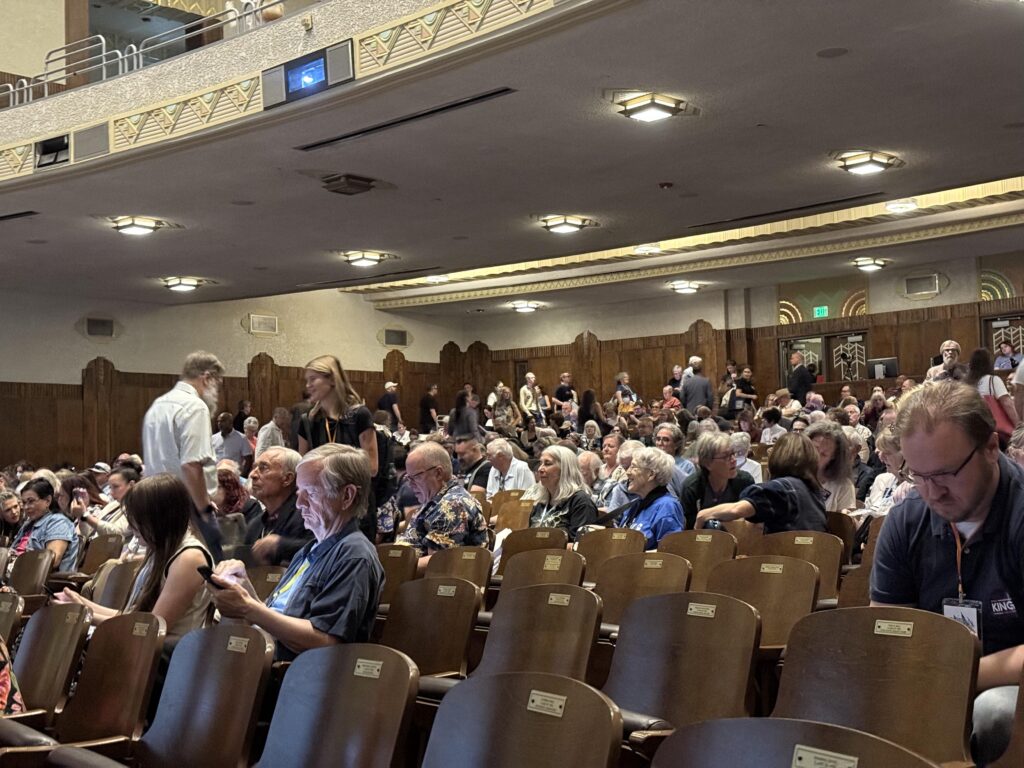

Utah Democratic Party delegates receive their ballots during the party’s organizing convention at Ogden High School on May 31, 2025. (Alixel Cabrera/Utah News Dispatch)
Key points
- Utah Democrats are energized ahead of their state nominating convention after a judge’s ruling in a yearslong redistricting lawsuit has drawn a congressional district around northern Salt Lake County that is likely to go blue.
- The race for the new 1st Congressional District has brought out several prominent Democrats competing in the primary, but some are now facing allegations of past problematic behavior.
- Some political strategists say the Utah Democratic Party is wasting a rare opportunity to bring more people into the party by holding an open primary rather than an election limited to registered Democrats.
After a tumultuous redistricting process that left the 1st Congressional District on a likely path to turn blue, Utah Democrats are set to convene in their statewide convention this weekend amid a chaotic race.
State Democrats, who haven’t been in the U.S. House roster since Ben McAdams’ end of term in 2021, are especially energized this year ahead of the delegates’ vote Saturday afternoon. Organizers expect between 2,000 to 2,500 people to show up, the largest convention since the COVID-19 pandemic, Jade Velazquez, executive director of the Utah Democratic Party said.
“The vibes are really strong, and we have the metrics to back it up. So for the first time in at least 10 years, we have over 200 candidates that are running across the state. We’re contesting over 90% of the top races,” Velazquez said. That’s up from the 52% and 54% the party saw in 2022 and 2024.
SUBSCRIBE: GET THE MORNING HEADLINES DELIVERED TO YOUR INBOX
With a new court-ordered congressional map born out of a yearslong anti-gerrymandering lawsuit, the state’s 1st Congressional District is now a compact area around northern Salt Lake County, which leans Democratic. It’s a major shakeup for Republicans, who have occupied all federal offices in recent years. And it has led to a particularly crowded race among Democrats in CD1.
While more candidates are throwing their hat in the ring for federal office, some political strategists see with disappointment what they are calling a wasted generational opportunity for Democrats in deep red Utah. That’s because after the convention is said and done, the party is set to hold a primary open to all voters regardless of their party affiliation.
Taylor Morgan, a partner at Morgan & May Public Affairs, who has consulted for different Republican and Democratic campaigns, said that ultimately, he believes the Saturday results won’t matter because the party will allow outside voters to make the final decision.
Utah Supreme Court rejects Legislature’s redistricting appeal; court-ordered map still stands
“When the Democratic Party suddenly has a very, very compelling, very exciting primary, they should close their primary because now they have a reason for voters to choose to be a part of the Utah Democratic Party and have a voice in the Utah Democratic Party,” Morgan said. “What is the point of having a political party if they are not asking voters to affiliate with their party?”
The Democratic Party has 246,000 active members in Utah, according to voter registration statistics, a small number compared to the Republican Party, which has 922,000, and 500,000 unaffiliated voters, all of which are eligible to vote in the primary.
“And they’re also doing a huge disservice, frankly, to the candidates, because the candidates won’t know who their voters are,” Morgan said. “Candidates will have no way to know what issues and what messages persuade Utah Democratic voters.”
However, Velazquez would contest that, arguing that a lot of unaffiliated and independent voters tend to believe in the party messaging.
“I don’t think this dilutes the Democratic voice. I think it strengthens it, because more people can participate. Instead of swearing a party loyalty oath, we are open and allow anybody to participate,” he said.
A chaos-filled CD1 race
Six candidates are vying for the 1st Congressional District Democratic nomination, a race filled with many announcements on fundraising and endorsements, but also controversy over allegations of candidates’ past problematic behavior.
State Sen. Nate Blouin has been in hot water during his congressional campaign after Punchbowl News revealed comments the senator had posted on online forums between 2009 and 2015 making jokes about sexual assault, using slurs and denigrating The Church of Jesus Christ of Latter-day Saints, Utah’s predominant religion, and its members.
Blouin has since apologized for the comments, saying in a statement they were “vulgar, stupid, and reflect a version of me in my early twenties that I’m ashamed of and have thankfully evolved past.”
And, on Wednesday, four people, including three elected officials, accused Salt Lake City Council member Eva Lopez Chavez of restraining them during what they described as unwanted sexual advances, according to The Salt Lake Tribune. An attorney for Lopez Chavez said she is “shocked by the allegations” and vowed to “address them in any forum,” including a polygraph test, if requested.
While the polemics have shaken the race, both hopefuls are continuing their campaigns. And there’s still a long way to go on the trail.
Blouin, former Rep. Ben McAdams, and Michael Farrell, a tax attorney, have gathered enough signatures to qualify for the primary ballot, so the race will ultimately be decided in the June 23 election.
If the race were to be decided by fundraising efforts, McAdams would be in the lead, having amassed $1.5 million, according to the Federal Election Commission, followed by Blouin, who raised $525,700, and Farrell, who gathered over $245,000.
Liban Mohamed, a newcomer to the political scene who has worked on tech companies’ public policy teams, has raised $121,200 and Lopez Chavez, almost $50,000. Luis Villarreal hasn’t raised any money. None of them have gathered enough signatures to qualify for the ballot, so their only chance of remaining in the race is by winning delegates’ votes at the convention.
What else to expect
While money won’t define the winner, if Morgan had to pinpoint a leader among all hopefuls, it would be McAdams, he said. Again, because of Democrats’ open primary system.
“Ben McAdams in the past, he has always won between about 20% and 27% of the Republicans, and actually he’s won about 60% to 70% of unaffiliated voters in previous congressional races,” Morgan said. “And so Ben McAdams stands uniquely as a candidate to benefit from winning a disproportionate share of voters in an open primary.”
That’d be a “disappointing” outcome, Morgan said. While he’s a Republican, he believes in the value of competitive elections, and in parties putting forward candidates who best reflect their voters.
“By holding this open primary, they think they’re telling voters that everyone is welcome, when in reality, the only thing they’re telling voters is ‘we don’t have a party worth affiliating with,’” he argued.
Still, the process has generated a lot of interest among party members. About 1,800 delegates are expected to show up at Jordan High School for the convention to vote not only on candidates for federal office, but also multi-county races for statewide offices.
The call to order is at 1 p.m., but caucus meetings on different issues will begin at 9 a.m.
“We’re also expecting a lot of guests, and you don’t have to be a Democrat or a delegate to participate. Being an open party means that Republicans, unaffiliated, anybody else, can come and hang out with us too,” Velazquez said.
Other races delegates will consider
Apart from the most coveted ticket of the year for Utah Democrats, delegates will also pick nominees to run in the remaining three, deep red congressional districts and for other contested spots for the state Legislature. Here are some of the noteworthy races:
2nd Congressional District: Four Democrats are vying to become the party nominee for the 2nd Congressional District — Ian Parrish, Tyler Farnsworth, Peter Crosby and Jarom Gillins. None of them gathered enough signatures to qualify for the ballot and are relying on the delegates’ support.
3rd Congressional District: Steven Merrill and Kent Udell are running for the 3rd Congressional District Democratic nomination.
4th Congressional District: Archie Williams and Jonny Larsen are running for the 4th Congressional District Democratic nomination.
State Senate District 19: Shana Anderson and Salvador Giove are running for a spot on the ballot to compete against Senate Majority Leader Kirk Cullimore, R-Sandy.
State Senate District 5: Dakota Wurth and “CJ” Christina Hernandez are vying for the Democratic nomination to compete against Republican Jill Koford, who retired from the Utah House to pursue a Senate seat vacated by Sen. Ann Millner, R-Ogden.
State House District 4: Zeppelin Zeerip and Zane Woolstenhulme are running for the Democratic nomination for House District 4 currently represented by Rep. Tiara Auxier, R-Morgan.
State House District 59: Micah Kagan and Celeste Johnson are hoping for the Democratic nomination for House District 59, a seat just vacated by Midway Republican Rep. Mike Kohler, who isn’t running for reelection.