
Utah News Dispatch
Utah voter group is ‘determined to act as a firewall’ against Trump’s DOJ

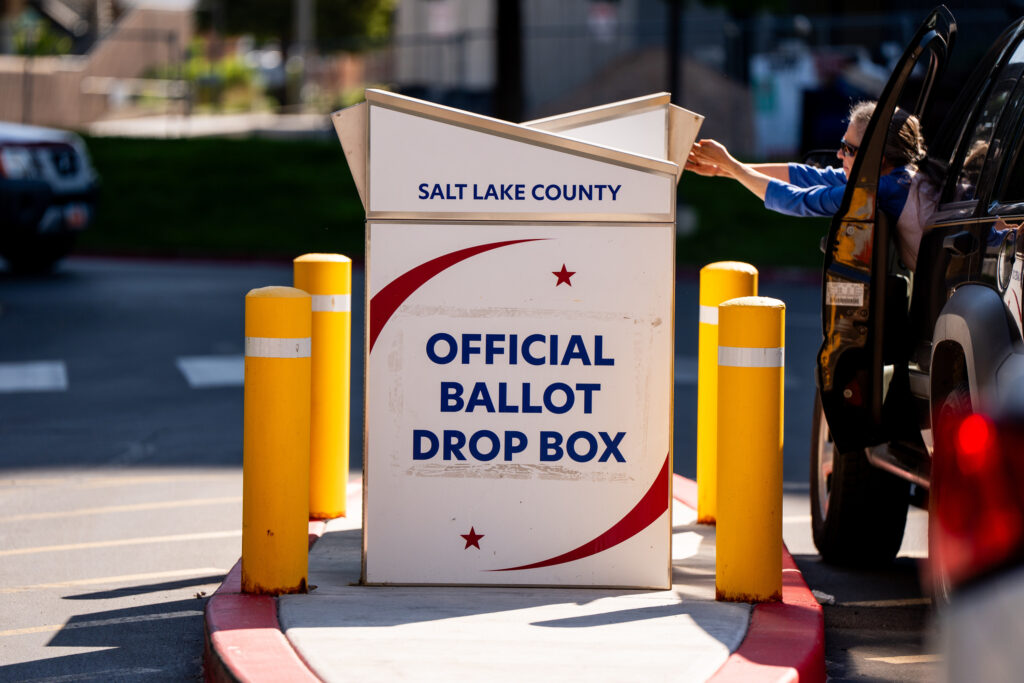

A voter drops off their ballot at the Salt Lake County Government Center in Salt Lake City as votes are cast in Utah’s primary election on Tuesday, June 25, 2024. (Photo by Spenser Heaps for Utah News Dispatch)
A Utah voting rights group is asking a federal judge to dismiss the Trump administration’s lawsuit seeking detailed Utah voter data, including dates of birth, Social Security numbers and driver’s license numbers.
The U.S. Department of Justice maintains it needs the sensitive information for election integrity efforts and to ensure only U.S. citizens vote. But Utah’s top elections officer, and now its branch of the League of Women Voters, say the department is not entitled to that information and election fraud issues are not widespread.
SUBSCRIBE: GET THE MORNING HEADLINES DELIVERED TO YOUR INBOX
Attorneys for the League of Women Voters of Utah, which intervened in the lawsuit in recent weeks, moved Wednesday to dismiss the suit against Lt. Gov. Deidre Henderson, a Republican. The Utah case is one of more than 30 similar lawsuits across the country.
“We are determined to act as a firewall against the Trump administration’s aggressive effort to gain access to the sensitive data of millions of Utah voters,” the group said in a news release. “There is no lawful or legitimate reason to hand over sensitive voter information to federal agencies to interfere with state election administration.”
Voting rights groups seek to join lawsuit to block Trump’s DOJ from sensitive Utah voter data
Attorneys with the ACLU of Utah, representing the League of Women Voters, allege the Trump administration is seeking “to create tools for unlawfully mass-challenging voters and interfering with states’ democratic processes.”
They contend the data will be used to disenfranchise voters, including immigrants who became naturalized citizens and those with felony convictions who couldn’t vote while incarcerated but are now eligible to do so.
Raising similar concerns, the Democratic National Committee filed a friend-of-the-court brief earlier this month arguing the case against Henderson should be dismissed and condemning what the party sees as the “DOJ’s refusal to be forthright with state officials about the intended use of sensitive personal information.”
The Justice Department has said it needs the information to ensure people who aren’t eligible to vote are kept off state voter rolls and that only citizens are voting. When the department filed its case in February, Assistant U.S. Attorney General Harmeet Dhillon told Utah News Dispatch that officials in many states “are choosing to fight us in court rather than show their work. We will not be deterred, regardless of party affiliation, from carrying out critical election integrity legal duties.”
Henderson’s office released findings earlier this year that more than 99.9% of Utah’s 2 million registered voters are U.S. citizens, while just five were not and were removed from the roles. Less than 500 registered voters had incomplete information that election officials weren’t able to immediately verify.
The motion comes two days after other voting rights groups sued in Washington, D.C. to block the Justice Department from getting ahold of state voter lists, alleging the department is creating a centralized national voter list ahead of November’s midterm elections, States Newsroom reported.
DOJ attorneys have denied that the agency is building a nationwide voter list, but they have said voter data is already being shared with the U.S. Department of Homeland Security to be compared to a database containing immigration and naturalization information.