
Utah News Dispatch
Cox calls Justice Hagen allegations ‘serious,’ but it’s unclear what new investigation will entail

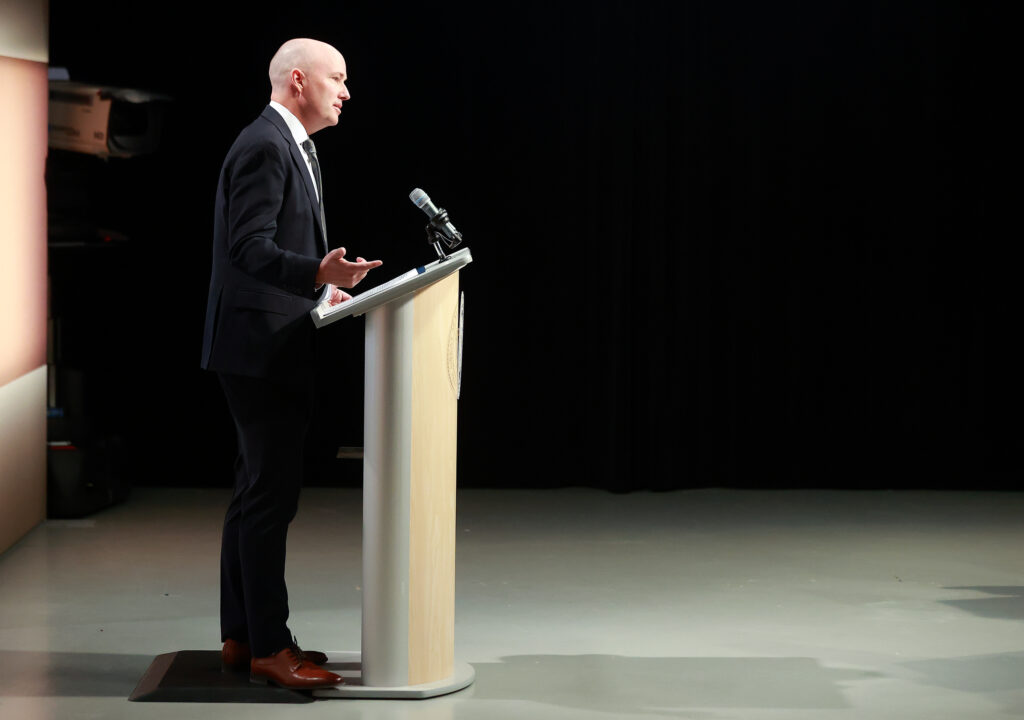

Gov. Spencer Cox speaks at the PBS Utah Governor’s Monthly News Conference at the Eccles Broadcast Center in Salt Lake City on Thursday, April 30, 2026. (Pool photo by Kristin Murphy/Deseret News)
Utah Gov. Spencer Cox on Thursday reinforced his support of an independent investigation into previously dismissed allegations that Utah Supreme Court Justice Diana Hagen had an affair with an attorney involved in the state’s high-profile redistricting lawsuit.
Cox, during a news conference broadcast by PBS Utah, told reporters that it’s not yet clear what that independent investigation — also supported by Senate President Stuart Adams and House Speaker Mike Schutlz — could entail.
“I don’t know what that looks like yet,” Cox said. “What I can say is, I think if there is an investigation it should be an independent investigation.”
The Judicial Conduct Commission had already looked into and dismissed the allegations against Hagen by voting not to pursue a full investigation after a preliminary investigator said the complaint against her lacked credibility.
To concerns that Republican state leaders could be politicizing the investigation into Hagen because they disagreed with her previous redistricting rulings, Cox said “that’s very fair,” but it’s “why an independent investigation is so important.”
“Because the allegations are serious,” he said. “What would be bad for the Legislature is to have this look just like a witch hunt. That’s not good for the Legislature and it’s not good for the judiciary.”
Cox nominated Hagen to the Utah Supreme Court in 2022, and the Utah Senate confirmed her appointment.
Hagen recused herself from cases involving the attorney after she said she rekindled a friendship with him as her marriage broke down in spring 2025. The last time she was involved in a ruling related to the redistricting case was in October 2024, when she authored the court’s unanimous opinion upholding a district court decision voiding Amendment D, which if approved by voters, would have solidified the Legislature’s ability to change ballot initiatives.
Asked about her recusal and whether it was appropriate for the Judicial Conduct Commission to investigate a personal matter, Cox said “the allegations are more serious than that” and “timing is part of the question.”
Utah Supreme Court says affair allegations against justice were ‘inappropriately’ released
“Look, when you sign up to be a judge in this state, you get held to a higher standard, period,” the governor said. “Everyone knows this. This is part of the deal. If you want your personal life to always be personal, then don’t be a judge.”
Cox added “there are lots of questions out there” and that he worries “that people aren’t taking these allegations seriously enough.”
“We expect our judges to not do things like that,” Cox said, though he didn’t specify which allegations warranted more investigation.
“I don’t know what’s real or what’s not real,” he said. “But I do know that these allegations are very serious, and I think again, that we’ve got to do everything we can to protect the judiciary and make sure that we’re holding the judiciary to a higher standard.”
Cox said that he, as “maybe the only governor in our state’s history who has worked in all three branches of government,” cares “deeply” about the judicial branch and he wants “to make sure that we’re doing everything right.”
The governor said there will “always” be tension between the branches of government, but he acknowledged that right now there’s “immense tension” between the Legislature and the judiciary.
“Some of that for good reason, some of it maybe not for good reason,” he said. “But what does matter is that if there are investigations, and these are very serious allegations, that the people can trust those in such an investigation.”
SUBSCRIBE: GET THE MORNING HEADLINES DELIVERED TO YOUR INBOX
Cox also said he doesn’t know when the independent investigation would start or what it would entail, but he noted three entities under Utah law can open an investigation into a sitting Utah Supreme Court justice: the Judicial Conduct Commission, the Utah attorney general (if there are criminal charges) and the Utah House.
For example, he noted a Utah House special investigative committee opened an investigation into former Utah Attorney General John Swallow back in 2013.
What are the allegations?
According to a preliminary investigation conducted by a Judicial Conduct Commission investigator, there was “insufficient evidence” to support the allegation that Hagen engaged in an extramarital affair — and the Judicial Conduct Commission voted not to open a full investigation in accordance with the investigator’s recommendations.
The investigator also reported that information provided by Hagen’s ex-husband during an interview was “drastically different than what is alleged” in the complaint.
“The allegations as presented in the complaint are speculative, overstated, and misleading,” the investigator wrote. “There is very little credibility to this complaint.”
That’s according to documents released by the Utah House in response to an open records request, first obtained and reported by KSL earlier this month. The day after, the Utah Supreme Court issued a statement saying documents detailing the allegations against Hagen were confidential and “inappropriately released to the public.” The House speaker, in response, argued that his office followed Utah law when releasing the records.
Was the Utah House’s release of a Supreme Court justice complaint ‘unlawful’?
According to that preliminary investigative report, the alleged code violations included the following judicial code of conduct rules:
- “A judge should act at all times in a manner that promotes — and shall not undermine — public confidence in the independence, integrity, and impartiality of the judiciary and shall avoid impropriety and the appearance of impropriety.”
- “A judge shall not permit family, social, political, financial, or other interests or relationships to influence the judge’s judicial conduct or judgement.”
- “A judge shall disqualify himself or herself in any proceeding in which the judge’s impartiality might reasonably be questioned, including but not limited to the following circumstances: The judge has a personal bias or prejudice concerning a party or a party’s lawyer, or personal knowledge of facts that are in dispute in the proceeding.”
Hagen, in a letter to the Judicial Conduct Commission, said her “ex-husband’s accusations of adultery are false,” and that “the insinuation that I was ethically compromised while carrying out my official duties is patently false.”
Hagen told the Judicial Conduct Commission that her marriage broke down in the spring of 2025, and during that time she reconnected with several old friends for emotional support, including attorney David Reymann.
Reymann has represented the League of Women Voters and other plaintiffs in the anti-gerrymandering lawsuit that resulted in a court-ordered congressional map, which Republican state leaders, especially Schultz and Adams, have vehemently fought and criticized. He has also represented media clients in the state, including Utah News News Dispatch.

Hagen wrote that her ex-husband “misinterpreted my interactions” with Reymann “as evidence of adultery,” and on April 10, 2025, her ex-husband confronted her and accused her of having sex with Reymann a week earlier. “I denied the accusation because it’s not true,” she wrote.
Hagen and her husband then “separated” two days later, on April 12, 2025, she wrote.
“I was faithful to my ex-husband for more than thirty years. I never engaged in extramarital sex with anyone prior to our separation,” she wrote. “After our separation, my ex-husband used the threat of exposing the alleged affair as leverage to extract a favorable divorce settlement.”
Their divorce, Hagen wrote, was finalized on Nov. 10, 2025.
Governor weighs in on upcoming retention election
Hagen — along with another Utah Supreme Court Justice, Jill Pohlman — are both up for retention in the upcoming November election.
During the Utah Republican Party’s nominating convention Saturday, Utah GOP Chair Rob Axson announced the party would be launching a campaign to encourage Utah voters to vote against retaining both Hagen and Pohlman due to their roles in the rulings against the Legislature in an anti-gerrymandering lawsuit that led to a court-ordered map that turned one of Utah’s four red congressional districts blue.
When asked about that, Cox told reporters he supports Utahns voting against retaining the justices based on if they disagree with their rulings.
“Yes, if people don’t like decisions that are coming out of our Supreme Court or any court for that matter, the appropriate way to deal with that is to vote against those judges in retention elections,” he said.
Asked how he’ll vote in the judicial retention elections, Cox said he hasn’t “made that decision yet,” and that he’d like to see the investigation into Hagen play out.
Earlier this week, the Utah State Bar issued a news release urging Utahns to rely on the Utah Judicial Performance Evaluation Commission when evaluating how to vote on judges.
“Utah is nationally recognized for the strength and integrity of its judiciary,” Bar President Kim Cordova said in a prepared statement. “Judges are not elected through partisan campaigns. They are chosen through a rigorous process that includes application, screening, and vetting for qualifications, experience, and temperament.”
The commission’s evaluations are made publicly available and can help voters decide whether to retain a judge based on merit.
“Judges are bound by ethical obligations to apply the law as written, even when doing so may be unpopular,” Bar Executive Director Elizabeth Wright said. “Disagreement with a specific ruling should not be the basis for removal. A fair court system depends on judges who apply the law consistently for all, without being swayed by public or political pressure.”
Cox argued that he and the Utah Republican Party believe the justices didn’t adhere to the Utah Constitution when they ruled against the Legislature in the redistricting lawsuit, and that’s reason enough to vote against them in the retention election.
“This idea of judicial independence is important … but that doesn’t mean that the judiciary isn’t responsible, that we don’t have any checks on the judiciary,” he said. “We do have checks on the judiciary, and this retention election is one of them.”