
Utah News Dispatch
Massive Box Elder County data center could increase Utah’s carbon emissions by 50%

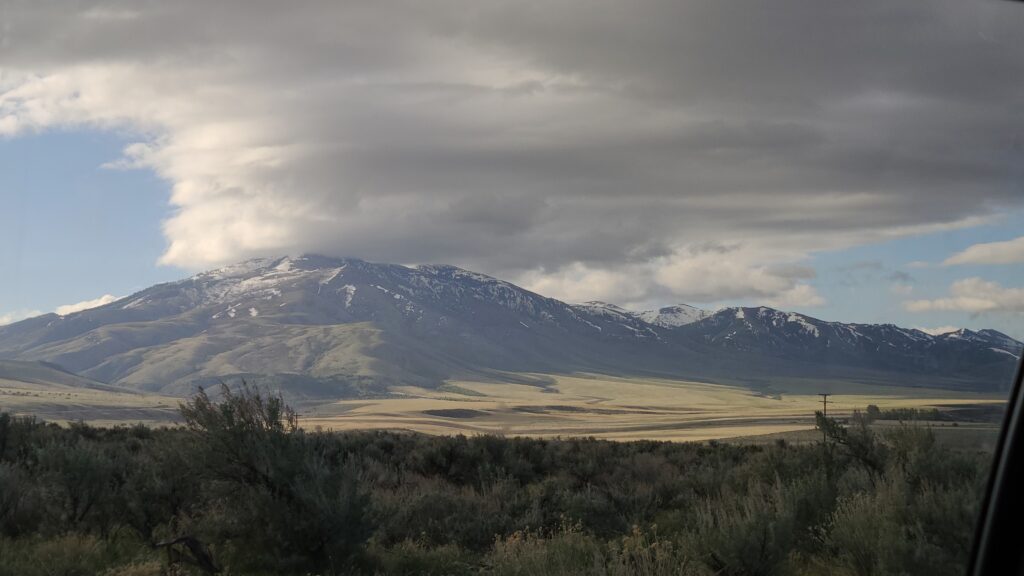

Mountains are pictured in Box Elder County, Utah. A massive data center proposal has stirred commotion among community members worrying about the environmental impact of such a project. (Angie Stephens-Morrison/Getty Images)
If Stratos project developers are able to finalize their vision for an unincorporated Box Elder County site, not only will Utah see its largest data center to date, but also the construction of a natural gas power plant capable of producing double the electricity the entire state consumes in a year.
The project, which is planned to be built in multiple phases across decades, is expected to generate 9 gigawatts of energy when completed, more than double the about 4 gigawatts the state as a whole consumes. The campus won’t impact the power grid and won’t have any impacts on utility bills, developers say. Still, concerns about the project’s environmental impact linger among community members.
There isn’t a definitive environmental impact analysis available to the public, and there are many unknowns about the specific equipment the data center will use. However, according to estimates by Kevin Perry, a professor of atmospheric sciences at the University of Utah, the impact in the atmosphere won’t go unnoticed.
SUBSCRIBE: GET THE MORNING HEADLINES DELIVERED TO YOUR INBOX
“If they built that out to 9 gigawatts and used natural gas, it would increase the carbon dioxide emissions for the state of Utah by more than 50%,” he said. “So there’s a huge climate footprint associated with that proposal.”
That’s an upper estimate, assuming that the power plant will run 24 hours a day, seven days a week, he said. Utah emitted about 55 million metric tons of carbon dioxide in 2023. A nonstop plant generating 9 gigawatts could generate about 34 million metric tons of carbon dioxide.
Carbon dioxide contributes to the global burden of greenhouse gases in the atmosphere, which exacerbates climate change, Perry said.
“This would more than double the amount of electricity generation in the state, and they would all be fossil fuels,” he said. “There are other options that they could use for generating electricity that doesn’t have such a huge climate footprint, but I haven’t heard anything about whether or not other options were even considered.”
Also, assuming that the developers will install the best available control technology for smokestack pollutants, the plant could increase the state’s nitrogen oxide concentrations by about a little over 1%, and PM2.5 emissions by about 2% to 3%, Perry said.
“And those emissions are going up a smokestack and going up high in the atmosphere where they get diluted, so I don’t anticipate that it would have significant air quality implications locally,” he said.
A quick ‘Wonder Valley’
The fast nature of the approval process for the 40,000-acre data center campus has stirred up commotion among northern Utah residents, who have packed Box Elder County Commission meetings discussing the project. Many interrupted a special meeting on Monday, asking questions about how the state’s natural resources will be used.
While it’s a massive and unprecedented project for the state, up until a few weeks ago, most Utahns didn’t know about it. Kevin O’Leary, a celebrity investor featured in the reality TV hit “Shark Tank” who’s sponsoring the proposal, also calls it “Wonder Valley,” also the name of a similar project being built in Canada, a $70-billion, 7.5-gigawatt campus, according to CBC news.
Stratos District Project Area Map
The approval process for the center isn’t like any other request. It is going through the Military Installation Development Authority, or MIDA, an entity created by the Utah Legislature to advance economic development with a military focus.
MIDA has received the consent of all private landowners of the 40,000 acres, mostly between Locomotive Valley and Hansel Valley. But the authority still needs the nod from county commissioners to move forward with the development
Paul Morris, executive director and general counsel for MIDA, said in an April county commission meeting that Box Elder County “could be one of the best places in the entire country to locate something like this,” citing the site’s proximity to the Ruby natural gas pipeline and redundant fiber availability.
While data centers get a bad reputation, Morris said in his presentation, this one will generate all of its own energy and its water use will be minimal with a closed-loop system.
“This is one of those once in a generational opportunities that we have. I happen to know of two states that would rather us not do it, that rather us go slow and not figure it out,” Morris told commissioners.
The commissioners didn’t make up their minds this week and delayed their vote until next Monday, moving their meeting to the Box Elder County Fairgrounds Fine Arts Building to accommodate more people from the public. A demonstration is being planned.
‘We can’t build anything in this country anymore’
Utah Gov. Spencer Cox said on Thursday, during his monthly news conference broadcast by PBS Utah, that at the rate in which machine learning and artificial intelligence is changing, building data centers has become a national security issue.
“We have an obligation, I think every state has an obligation, when it comes to this space, to allow for these types of data centers to be built in their states,” Cox said. “We have to do this. We can’t just say ‘no’ and shut the doors and go home and let China win this, this technology race, so that just can’t be an option.”
Data centers can’t be installed everywhere, and the government should be careful with its resources, but this site may be able to fulfill environmental standards and won’t be someone’s nextdoor neighbor, Cox said.

“If you can’t put this here, then we can’t put them anywhere,” Cox said.
He also fiercely disputed that the approval process has been rushed.
“I’m so tired of our country taking years to get stuff done. It’s the dumbest thing ever. We think that taking time makes things better or safer, it absolutely does not,” he said. “You get a chance to give your feedback, and then decisions get made. That’s how we have to do stuff in this country and in this state.”
The state denies many requests because of feedback, but it can’t say no to everything, Cox said.
“We’ve let the people against virtually everything, destroy our country, destroy our industrial base, destroy our mining base, destroy our housing base, because we can’t build anything in this country anymore,” he said. “And those days are over. We’re done with that.”