Utah News Dispatch
Utah proposal requiring proof of citizenship to vote moves forward

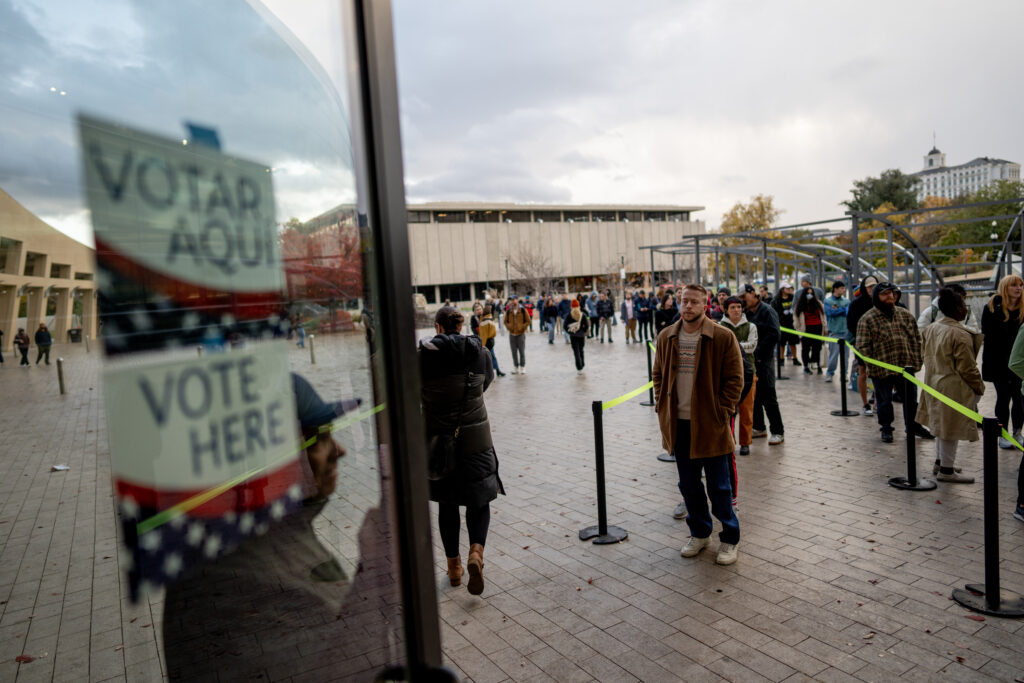

People wait in lines to vote at the Main Library in Salt Lake City on Election Day, Tuesday, Nov. 5, 2024. (Photo by Spenser Heaps for Utah News Dispatch)
A bill seeking to further restrict non-U.S. citizens from voting in state and local elections advanced on Utah’s Capitol Hill on Wednesday despite concerns it could disenfranchise voters.
Citizenship is already required to vote nationally and in Utah, and the state has identified just a handful of cases where non-citizens successfully registered to vote. By contrast, more than 1.5 million people in Utah cast ballots in the 2024 presidential election.
“It doesn’t matter if it was just a few or there was a whole bunch,” bill sponsor Rep. Cory Maloy, R-Lehi, told members of the House Government Operations Committee. “That still eliminates trust.”
Utah Director of Elections Ryan Cowley said his office has identified five people who successfully registered to vote despite not being citizens. Some voted at least once, he told the panel. He did not give a time frame for the cases.
The committee approved HB209 in a party-line vote of 9-3, with Democrats voting no.
SUBSCRIBE: GET THE MORNING HEADLINES DELIVERED TO YOUR INBOX
“I just want to remind people, if somebody is aspiring to be a citizen, why would they vote in an election knowing that if they vote and they’re not allowed to, that’s probably going to ruin any prospect of becoming a citizen?” said House Minority Leader Angela Romero, D-Salt Lake City.
To become a citizen, the U.S. government requires applicants to demonstrate they have good moral character. Criminal conduct can make them ineligible.
It’s a misdemeanor crime in Utah for people to vote when they knew or should have known they’re not eligible for voter registration. A conviction carries up to a year in jail and a $2,500 fine.

Davis County Clerk Brian McKenzie told Utah News Dispatch the bill “does strengthen the integrity of our elections, not that there’s a significant problem.”
Asked to describe what kind of a change the bill would make for most Utahns, McKenzie replied, “zero impact.”
He said the bill requires a vetting process that he and other county election officials already follow, using resources including a driver’s license database to verify who’s confirmed to be a U.S. citizen and who isn’t.
Under existing law, a small number of people whose citizenship status isn’t clear are allowed to register to vote based on their affidavits swearing they’re citizens — unless election officials find evidence to the contrary, McKenzie said. Under the new proposal, they would have to provide proof of citizenship, such as a birth certificate or naturalization documents.
“Really, it is that very small percentage that we can’t verify through some other means,” McKenzie said.
Opponents raised concerns the move could invite racial profiling and even remove U.S. citizens from voter rolls if they don’t have access to certain documents. Lisa Xochimitl of Saratoga Springs urged the panel to vote no, saying she’s faced prejudice based on her last name.
“I’ve grown up in Provo, Utah, and have had issues with being discriminated against, and I get nervous about what that would look like,” Xochimitl said.
Mormon Women for Ethical Government and the Utah League of Women Voters oppose the bill, noting early laws requiring proof of registration in Arizona and Kansas cost those states millions of dollars in administrative costs and lawsuit payouts.
Cambria Cantrell with the lieutenant governor’s office, which oversees elections in Utah, praised the bill for allowing multiple ways to verify citizenship. She said an experience Lt. Gov. Deidre Henderson had in the past illuminated why that’s important.
“A few years ago, the lieutenant governor, while in office, was removed from the voter rolls because someone looked at her registration,” Cantrell said. “She didn’t have naturalization information, but she was born in another country. She was born a citizen on the military base. We absolutely do not want that to happen.”
The measure advances to the full House of Representatives. Outside of Utah, New Hampshire and Louisiana passed proof-of-citizenship bills in 2024, and Wyoming followed last year, according to the National Conference of State Legislatures.