Utah News Dispatch
Utah homeless board looks at data — and cost — of ‘super high utilizers’ on shelters, jails

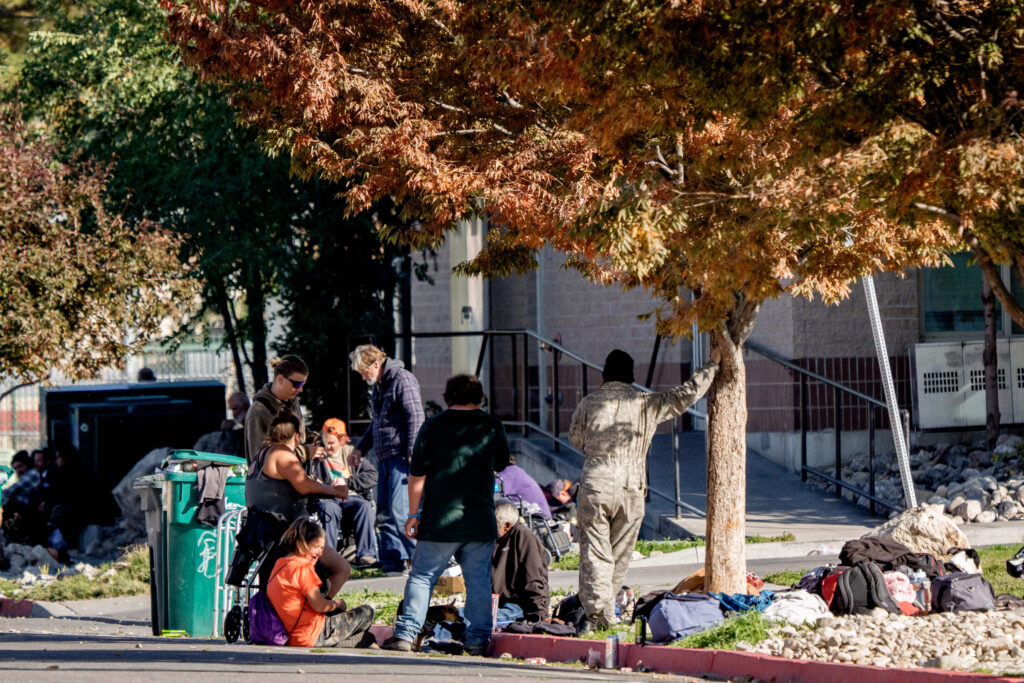

People congregate outside the Lantern House homeless shelter in Ogden on Thursday, Oct. 23, 2025. (Photo by Spenser Heaps for Utah News Dispatch)
Focusing on the relatively small core of people who put the most strain on courts, police, hospitals and homeless services will be an important part of getting people off the street, a Utah Office of Homeless Services staffer told the state’s Homeless Services Board on Tuesday.
As state officials look to shape their strategy on how to spend about $45 million approved by the 2026 Utah Legislature meant to improve the state’s homeless system, the board looked at the impact of “high utilizers,” or people who cycle in and out of homeless shelters, have frequent run-ins with police, and repeatedly need emergency medical help.
The report by Nate Meinzer — assistant director of external operations for Utah’s Office of Homeless Services and a former Salt Lake City Police Department sergeant — used Salt Lake City arrest data and the state’s homeless services database to zero in on the people who could benefit from more intensive and consistent case management to keep them from returning to shelters or jails.
Utah homeless leaders look to focus funding on ‘high utilizers’ while not ‘backing away’ from campus
Meinzer found that 1,021 people in Salt Lake City have been arrested four or more times within a year — and accounted for about $51.1 million in annual costs on shelters, police, courts and emergency medical costs.
Of those, Meinzer said 783 (or more than 75%) are also experiencing homelessness.
“We’re trying to find a better way to really help these individuals kind of break that cycle,” he said.
While diving deeper into the numbers, Meinzer said he learned that about 255 are what he called “super high utilizers.” He said they make up the top 25% of the 1,021 people with a high number of arrests, accounting for about 50% of all arrests within the group by averaging 11 arrests per person per year.
Those 255 alone, he said, account for about $16.1 million in yearly shelter, medical, court and police costs.
The board didn’t take action yet on a proposal for what to do about the “high utilizers,” but board members applauded Meinzer for his report, saying it could be crucial in helping shape next steps.
“It’s almost thrilling for us to be focusing on the most in-need and the most potent impact … on the system we’re trying to assist here,” Salt Lake City Mayor Erin Mendenhall said.
Meinzer highlighted an effort already happening in Salt Lake City called Project CONNECT, which is a program focused on the city’s 50 most-arrested people that the city has described as a “cross-agency initiative to divert high utilizers of the justice system into treatment to relieve strain on resources.”
State opens new 50-bed ‘microshelter’ community for homeless under freeway overpasses
It’s possible state leaders could look to replicate a form of Project CONNECT into a statewide program, but that remains to be seen.
However, Meinzer said that state officials have already started taking steps to help, including by reserving 12 of the state’s microshelter beds for Project CONNECT clients to provide them housing while they also receive supportive services.
“So we’re really trying to (piece together) the different resources out there to try and support what we can for these individuals,” he said.
To “paint a good picture of who a high utilizer is,” Meinzer told a story from his days as a police officer, when he said he arrested a man over and over again for a variety of different crimes.
“I never really felt like I could help him, you know?” he told Utah News Dispatch in an interview ahead of Tuesday’s board meeting. “I thought to myself, ‘How can I try something different?’”
So Meinzer said he decided to start working with a case manager who knew how to best support the man to get him on a better track. He said he consistently contacted that case manager each time the man had a run-in with law enforcement.
“And eventually it worked,” he said. “He ended up deciding that he wanted to try treatment. And when he ended up graduating from (substance abuse) treatment, he had actually reconnected with his daughter, who he hadn’t talked to in many years. He ended up getting his housing lined up. He was on the fast track out from shelter.”
SUBSCRIBE: GET THE MORNING HEADLINES DELIVERED TO YOUR INBOX
When the day came that he could move into housing last year, Meinzer said the man even asked the police officers who had repeatedly arrested him to come “help him move into his new place.”
“That’s what success looks like when we talk about a high utilizer,” he said. “That’s the whole picture.”
The key, Meinzer said, was consistent case management every single time police officers were called, no matter how big or small the incident.
“Being able to look at the totality of him as a human instead of just an isolated criminal incident and being able to talk to people that are advocating for him and know him at a much deeper level than I did, that’s what it took,” he said.
If the state’s homeless system can replicate that same approach for other “high utilizers,” he said it could make a huge difference not only to improve the system, but also help people recover and improve their lives.
Moe Egan, a member of the Utah Homeless Services Board that represents people who have experienced homelessness, said Meinzer’s report “reinforces” the idea that “we can no longer just make a little bit of contact with folks on the street” and simply encourage them to find services on their own.
“We have to assume that this person needs somebody to hold their hand and walk them through this entire process,” he said. “People are longing for connection. People are longing for you to look them in the face and say, ‘You know what, I see you.’”