
Utah News Dispatch
Utah chief justice delivers letter to lawmakers to oppose bill threatening judicial independence


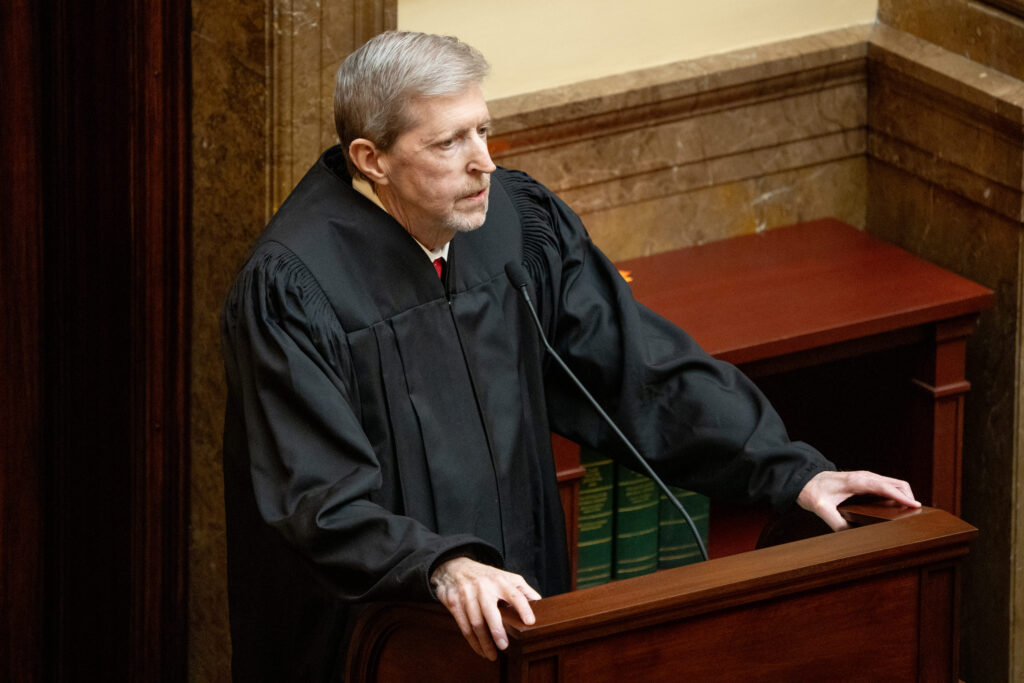


Utah Supreme Court Justice Matthew Durrant speaks to a joint session of the House and Senate at the Capitol in Salt Lake City on the first day of the legislative session, Tuesday, Jan. 21, 2025. (Photo by Spenser Heaps for Utah News Dispatch)
This story has been updated.
Utah Supreme Court Chief Justice Matthew Durrant came to the Utah Capitol on Thursday to sit down with the state’s top Republican legislators and hand deliver a letter addressing one bill in particular that’s been opposed by the Utah Judicial Council.
In the letter — obtained by Utah News Dispatch shortly after Durrant met with House Speaker Mike Schultz and Senate President Stuart Adams on Thursday — Durrant outlines his concerns with legislative efforts that could potentially undermine the “independence and integrity” of the judiciary, but he only specifically called out one bill: HB512.
Despite experts’ warnings, bill to give Utah lawmakers a say in judge elections advances
That bill, sponsored by a member of GOP House leadership, House Majority Whip Karianne Lisonbee, R-Clearfield, would allow a committee of lawmakers to review judges based on no set standard and allow that committee to place a recommendation directly on the ballot, next to the judge’s name, indicating whether lawmakers believe they should be retained or not.
“By creating a joint legislative committee on judicial performance and empowering that committee to provide recommendations as to whether individual judges should be retained for another term, HB 512 introduces partisan politics directly into the work of the Judiciary,” Durrant wrote in the letter.
“This unprecedented approach is not only dangerous but also detrimental to the public’s trust in a fair and impartial judicial system and ultimately harmful to the citizens,” he added.
Durrant referred back to his State of the Judiciary speech on the first day of the 2025 legislative session last month, when he quoted former U.S. Supreme Court Justice Anthony Kennedy, saying “judicial independence is not conferred so that judges can do as they please, it is conferred so they can do as they must.”
By opposing HB512 “and other bills that may have the impact of undermining the independence and integrity of the Judiciary,” Durrant wrote that the Judicial Council “is not suggesting otherwise” about the fact that the Utah Constitution does allow the Legislature to make policy decisions impacting the judiciary.
“Rather, the Judicial Council asserts that HB512 goes too far by intervening in the core functions of the Judiciary and poses a substantial threat to the Judiciary’s ability to fulfill its constitutional responsibilities,” Durrant wrote.
Putting a recommendation from a legislative committee on the ballot on whether a judge should be retained or not “will inevitably be viewed as a partisan recommendation,” he said.
“It is simply impossible to separate the partisan politics associated with legislative decisions from such a recommendation,” Durrant wrote.
He warned HB512 “will erode public trust and confidence in the decisions of the judiciary,” no matter the intentions of any of the legislators that sit on that committee.
“The possibility of a negative recommendation from the committee will be viewed by the public as an incentive for judges to make politically palatable decisions rather than decisions that are required by the law,” Durrant wrote. “It will be viewed as an incentive for judges to act in their own self-interest, rather than upholding the rule of law.”
Utah Supreme Court disputes lawmakers’ allegations that it’s not productive enough
As he warned in his State of the Judiciary address — when he urged lawmakers to “respect” the judiciary as a matter of public trust — Durrant wrote that a “loss of trust is particularly damaging to the Judiciary.”
“Possessing neither the sword nor the purse, the Judiciary can fulfill its constitutional role only when the public trusts its impartiality and commitment to the rule of law,” Durrant wrote.
Durrant also addressed arguments that HB512 would help provide voters more information to know how to vote in judicial retention elections — something both Lisonbee and Schultz have previously argued. He said voters “already have more objective information about judges than any other person on the ballot.”
He pointed to the existing Judicial Performance Evaluation Commission (JPEC), which already puts judges through a “thorough, rigorous, unbiased review of their performance,” and it posts detailed reports about all of the judges on its website, which voters can access by searching judges’ names.
“No other public officials in Utah are subject to a more thorough, objective, and public evaluation than judges,” Durrant wrote. “If there are specific problems or deficiencies with judicial performance evaluations, they should be addressed through improvements to JPEC’s process — not through HB512.”
Durrant concluded his letter by saying Utahns “deserve a Judiciary that is guided by the rule of law, not by political considerations.”
“By introducing partisan influence — whether real or perceived — HB 512 threatens to undermine judicial independence and public confidence in the Judiciary’s role as a neutral arbiter of legal disputes,” Durrant wrote. “For these reasons, the Judicial Council opposes HB512.”
After Durrant’s meeting with Schultz and Adams on Thursday, the letter was also emailed to all legislators on Capitol Hill, according to a Utah State Courts spokesperson.
‘A broad attack’: Utah’s judiciary fights bills threatening its independence
The letter comes after Utah Supreme Court Justice Paige Petersen expressed frustrations with another bill, SB296, which would give the governor the responsibility of picking the Utah Supreme Court’s chief justice, subject to advice and consent of the Senate — and subject to reappointment every four years.
“My preference is kill this silly bill. There’s absolutely no reason for (the governor and lawmakers) to be meddling in how we pick the chief justice,” Petersen said during Monday’s Judicial Council meeting. Durrant, though he took a more tempered tone in that meeting, said he agreed that lawmakers appeared to be waging a “broad attack on the independence of the judiciary.”
Durrant’s letter didn’t acknowledge SB296 specifically, but Michael Drechsel, assistant state court administrator at the Administrative Office of the Courts, told lawmakers during a committee hearing Tuesday the judiciary is opposed to the bill.
It’s unclear whether Durrant’s meeting or the letter will have an impact as lawmakers enter their final week of the 2025 session, which must end before midnight on March 7.
Republican legislative leaders respond
Adams, R-Layton, in a prepared statement issued later Thursday, said lawmakers have “immense respect for our justices who ensure the law is fairly administered, interpreted and applied.”
However, Adams also argued that “exercising legislative authority is not interference — it is the fulfillment of the responsibilities entrusted to us by the Utah Constitution.”
“Respecting judicial independence does not preclude the Legislature from performing its rightful role in shaping the framework of our justice system.” Adams said. “We are dedicated to preserving the integrity of the Utah Constitution to ensure a proper balance of power that protects our state and its people.”
Adams added that legislators have a goal to pass “good policy, which happens when 104 lawmakers, stakeholders and constituents voice their opinions and provide feedback on proposed legislation.”
“Policy discussions are not a threat to democracy; they represent an opportunity for open and constructive dialogue that leads to the creation of the best policies,” Adams continued. “Engaging in these discussions is key to shaping policies that will benefit Utahns for generations. Utah is known for our collaborative spirit, and I appreciate hearing all perspectives, including Chief Justice Durrant. This is what makes Utah the best state in the nation.”
Schultz, R-Hooper, in a media availability with reporters Thursday, made similar comments, defending the Legislature’s “authority” in the Utah Constitution. He also continued to say lawmakers remain concerned about voters not knowing how to vote in judicial retention elections — but he also left the door open to possible changes to HB512.
“That’s what HB512 is an attempt to do. Is that the right pathway? We’re going to have that discussion. Let’s see what it looks like as it moves through the process,” Schultz said. “Maybe it is, maybe it’s not. But I’m confident that by the time we make it through the process, we will have a better pathway for citizens to have more information about the judges when it comes time to vote.”
Contributing: Kyle Dunphey
Read Durrant’s letter below.
Judicial Council letter on HB 512
YOU MAKE OUR WORK POSSIBLE.