
Utah News Dispatch
Utah bill to speed up timeline on death penalty cases moves forward


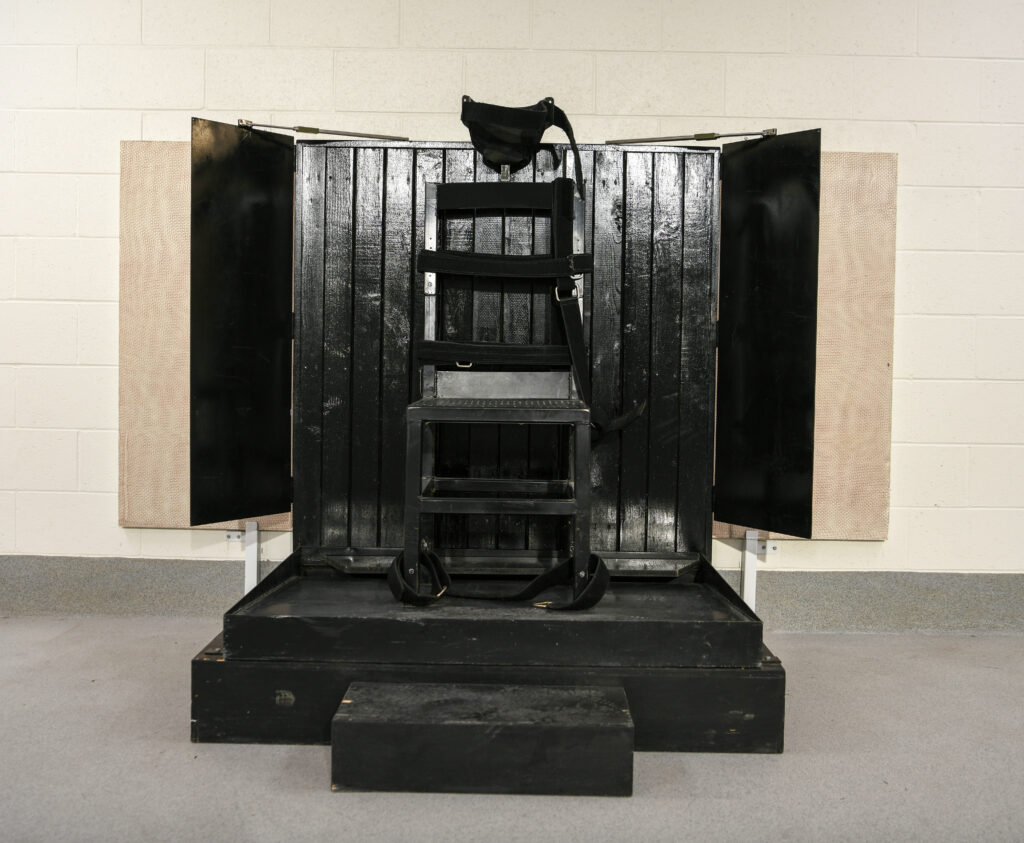


The chair used for firing squad executions is shown in the execution chamber at the Utah State Correctional Facility. (Courtesy of the Utah State Department of Corrections)
Lawmakers are scrutinizing the death penalty in Utah, looking at how decades of appeals prolong suffering for grieving families and run up excessive legal bills at taxpayers’ expense.
Republicans cited those factors when they unsuccessfully pushed to end capital punishment in Utah just a few years ago. Now a state lawmaker says the costs show why Utah needs to speed up the process, and she’s pushing past criticism that her plan could end in an unconstitutional execution.
Rep. Candice Pierucci, R-Herriman, said the attorney general’s office got in touch with her after Ralph Menzies died last year of natural causes in a Utah hospital rather than an execution chamber. He had spent more than 37 years on death row for the murder of Maurine Hunsaker.
SUBSCRIBE: GET THE MORNING HEADLINES DELIVERED TO YOUR INBOX
“One of the things in Utah that we pride ourselves on doing best is being efficient and proficient in how we handle things, and trying to be fair and balanced,” Pierucci told a Senate legislative committee on Tuesday. “And I would tell you, based off of my review, hearing and working with different attorneys right now, what we have is very much broken.”
The committee’s six Republican members voted to advance HB495 to its final stop in the Senate, with three Democrats absent.
The proposal would limit when and how Utahns can argue they’re not mentally fit to be put to death or make a case that their attorneys were so ineffective that they didn’t get a fair trial. At 21 days before an execution, the bill stipulates it’s too late for defense attorneys’ to move for an evaluation of their client’s legal competency, unless a doctor signs an affidavit to demonstrate the review is critical, Pierucci said.
To keep death penalty cases moving through the system, the move would place those appeals at the top of the docket in the state courts, among other changes.


Pierucci said it would cut down the timeline from an average of 34 years in Utah to about 20 years, while preserving the rights of those facing a death sentence.
Several defense attorneys who represented Menzies said the bill would backfire by putting Utah at risk of carrying out an unconstitutional execution under a new system that’s too rigid. They said it would effectively offload many appeals from state courts to the federal justice system, where the measure wouldn’t apply. They also noted the federal courts move slower and would prove more expensive.
“This bill will not make Utah’s capital punishment system more efficient,” said attorney Lindsay Layer.
Sen. Brady Brammer, R-Highland, said he’s not always in favor of the death penalty. As an attorney, he said he has personal experience working on appeals cases involving Utahns on death row. Brammer said in his view, defense attorneys perceive delays as a win. He pressed Layer on why she opposes the bill if it would in fact drag out the cases.
Layer replied that most men on Utah’s death row had “truly terrible representation, both at the trial level and in post-conviction proceedings,” and don’t want to wait to make that case to a judge.
She and her colleagues said the lengthy delays in cases like Menzies’ date to a bygone era of litigation when attorneys on both sides of cases made numerous errors. They said the U.S. Supreme Court has since raised standards for attorneys working on capital punishment cases.
“I would submit to members of this committee that those cases are outlier cases and that the system is not broken, as has been claimed,” said Mark Moffat with the Utah Defense Lawyers Association.

The defense attorneys said the bill would enact a double standard allowing the attorney general’s office to appeal findings that someone has an intellectual disability or is not legally competent, meaning they can’t be executed. But it would not afford the defense the opportunity to contest an opposite determination, they said.
The conservative Utah Legislative Watch and the Statewide Association of Prosecutors supported the bill. Carl Hollan, executive director of the prosecutor association, said under the current system Utah has the death penalty on the books but not in practice. He noted Troy Kell has also been on death row for decades but has not been put to death for the racially motivated murder of Lonnie Blackmon in 1994.
“The reality is that these lengthy delays in death penalty proceedings result in a system where prosecutors are unable to use the death penalty,” Hollan said.
Utah is among 27 states currently allowing capital punishment, according to the nonprofit Death Penalty Information Center. Governors in three of those states — California, Oregon and Pennsylvania — have placed holds on executions, while Ohio Gov. Mike DeWine has kept in place an unofficial moratorium.