
Utah News Dispatch
Three men, three warnings: Why Utah must end the death penalty


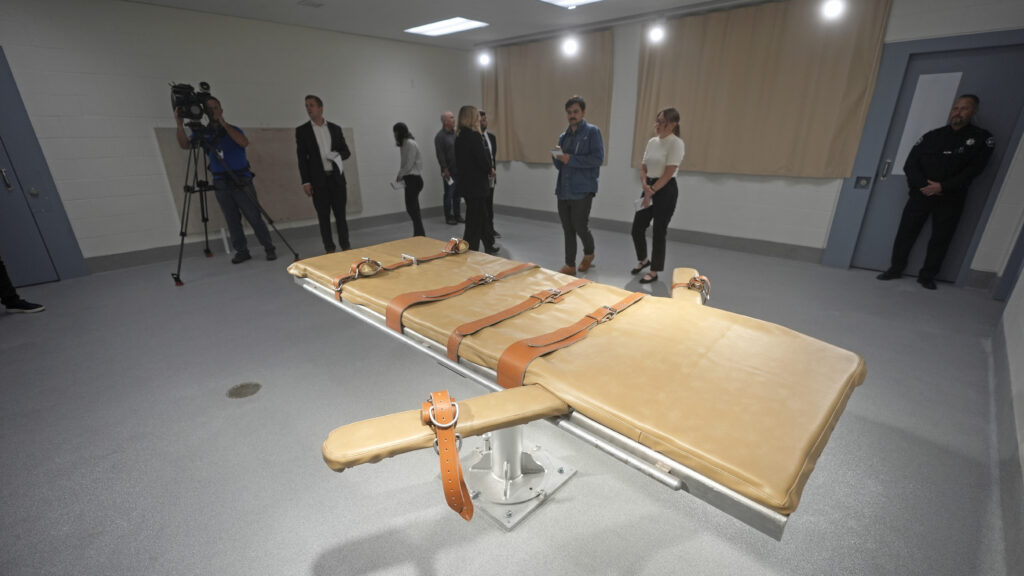


Media witnesses look at the lethal injection table in the execution chamber at the Utah State Correctional Facility after the Taberon Honie execution Thursday, Aug. 8, 2024, in Salt Lake City. (Pool photo by Rick Bowmer/AP)
In the last three years, Utah has tried to kill three men. One execution went forward. One was stopped only by the condemned man’s own death. And one conviction has collapsed as new DNA evidence now points away from the man the state has spent forty years trying to execute. Taken together, the cases of Taberon Honie, Ralph Menzies, and Douglas Carter are not isolated failures. They are a portrait of a failed system that cannot be trusted with the power to kill.
Start with Mr. Honie. In August 2024, Utah carried out its first execution in 14 years, putting Mr. Honie to death by lethal injection for the 1998 murder of Claudia Benn. The cost to Utah taxpayers, just for the execution, was nearly $300,000. Mr. Honie never disputed his guilt. But his case still exposed the death penalty’s cracks. He likely suffered from fetal alcohol syndrome and had sustained traumatic brain injuries as a child. During the sentencing phase of his trial, the prosecutor made “impermissible” racially insensitive remarks that the court had to disavow. Yet the state executed Mr. Honie anyway. A system willing to execute someone with that history, after that kind of taint in his original sentencing, is not exercising careful judgment. It is running on momentum.
Then came Ralph Menzies. Convicted in 1988 of murdering Maurine Hunsaker, Mr. Menzies spent 37 years on death row before Utah scheduled him to die by firing squad in September 2025. By then he had advanced vascular dementia, used a wheelchair, was tethered to an oxygen tank, and, according to a state medical evaluator, no longer had a rational understanding of why he was being executed. Picture what the state was prepared to do: wheel a disoriented, oxygen-dependent 67-year-old into a chamber and shoot him. The Utah Supreme Court halted the execution a week before it was set to happen, ordering a new competency review. Mr. Menzies never got that hearing. He died in a hospital of natural causes that November, sparing Utah the spectacle it had been building toward.
Rather than reckon with what nearly happened, the legislature reacted by trying to make executions move faster. Lawmakers passed HB495, which aims to shrink Utah’s average time from sentencing to execution by nearly half.
This leads to the third person Utah has sought to execute, Douglas Carter.
Mr. Carter has been on Utah’s death row since 1985 for the murder of Eva Olesen, a case built not on physical evidence but on a disputed confession and testimony from two witnesses who, decades later, said police and a prosecutor coached them to lie and threatened them with deportation. And the witnesses came forward after decades only after their son made it known they wanted to unburden themselves. In May 2025, the Utah Supreme Court unanimously held that prosecutors and police had suppressed evidence, induced perjury, and knowingly let false testimony stand, and the court ordered a new trial. The state pursued Mr. Carter again anyway. Then, just last week, a newly developed DNA profile from the crime scene appears not to match Mr. Carter. His attorney says the finding exonerates him. Prosecutors still are not ready to stop their pursuit of this man’s life.
Whatever the final word on Mr. Carter’s case, one fact should stop every Utahn cold: it took 40 years, a finding of intentional misconduct — that the state did not try to dispute before our Supreme Court — and a DNA breakthrough only possible through advances in testing, to begin unwinding what looks like a wrongful death sentence.
Some people will argue this is an example of the system working. It is not. Mr. Carter this far has been saved despite the system. If Mr. Carter is eventually spared execution, it will be only because of developments after Utah moved to compress the process into a tighter timeline.
These three cases don’t begin to reveal all the flaws with capital punishment, but they reveal enough. Executing Mr. Honie did not make Utah safer. Mr. Menzies’ near-execution offered his victim’s family no more justice than his death from natural causes did. And the decades Mr. Carter has spent in a cell, however this ends, can never be given back. The death penalty does not reliably capture the “worst of the worst.” Instead, it arbitrarily captures who had the least effective defense, the most compromised trial, the fewest resources to fight back.
Utah must stop pretending that any set of safeguards, no matter how carefully drafted, can ever eliminate the risk of executing an innocent person, especially when the state is hastily pursuing executions. We have an unusually cruel punishment that is unnecessary and must be abolished permanently.