Utah News Dispatch
The politics behind the SAVE Act


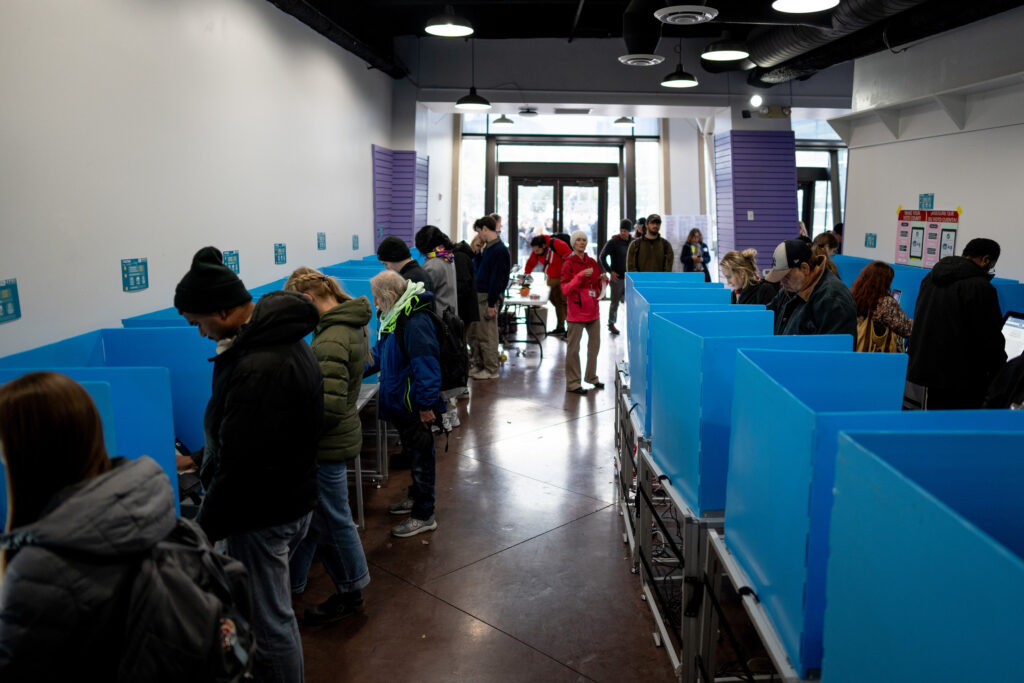


People vote at the Main Library in Salt Lake City on Election Day, Tuesday, Nov. 5, 2024. (Photo by Spenser Heaps for Utah News Dispatch)
Utah Congressman Mike Kennedy recently argued that Americans must show ID to do things like drive a car, board an airplane, or cash a paycheck. Those activities involve proving identity in a single transaction. Voting, however, works differently. Elections operate through a registration system where voter qualifications are already established.
In democratic systems, the responsibility for confirming eligibility generally rests with the state, not voters. Many democracies maintain population registries allowing election officials to automatically maintain voter rolls. These systems tend to produce higher participation and increased confidence in elections. They also help maintain a level playing field, because obtaining specific documents can be straightforward for some people but difficult for others. The SAVE Act would shift the responsibility from the state to citizens.
Despite its popularity with voters, vote-by-mail has faced repeated efforts to restrict or modify it. The Salt Lake County Clerk recently explained that Utah’s system includes multiple safeguards, including a serialized envelope code, the last four digits of a state ID or Social Security number, and the voter’s signature. My husband and son share the same name and once accidentally mixed up their ballots. Both were rejected because the signatures didn’t match the voter records.
Some supporters of the SAVE Act argue that these safeguards are not enough. They describe obtaining the required documents as a simple “no-brainer.” But the SAVE Act is not simply about identity. It would require documentary proof of citizenship such as a passport or certified birth certificate. Women who changed their names after marriage must provide additional documentation, such as a marriage certificate, linking their current legal name to earlier records. All documents must be presented in person when registering to vote or updating voter registration after moving or a legal name change.
For some citizens, obtaining these records is easy. For others, it is more complicated. For example, the birth certificate my mother gave me—the one I had always assumed was official—is not legally valid proof of citizenship. To obtain a certified copy, I would need to request it from the state, pay a fee, and wait for processing, hopefully in time to register. Elderly citizens, people born at home decades ago, rural residents, and low-income individuals may not have ready access to formal records or passports.
Even when documents exist, obtaining them can require fees, travel expenses, and lost income from time away from work. A U.S. passport costs $165. For families already struggling to cover rent, groceries, and utilities, these expenses can be significant. For rural residents, the nearest passport or vital records office may be hours away, while for elderly or disabled citizens, travel itself can be difficult or impossible.
I remember navigating the passport process myself while caring for small children. When I left the building, I sat down on the lawn and cried. Even with resources and documentation, the process was time-consuming and stressful. For citizens with fewer resources or greater constraints, the barriers are far more impactful.
As noted earlier, citizenship is already verified through the voter registration process: applicants attest under penalty of perjury, and voter information is checked against government records. Voting illegally carries serious legal risk and virtually no reward. It is not surprising, then, that research across many election cycles has found voter fraud, particularly by noncitizens, to be extremely rare.
The SAVE Act emerges in a political climate shaped by continued claims that the 2020 election was stolen, despite a lack of evidence. Narratives about threatening “outsiders,” such as immigrants portrayed as voting illegally, have long been used to shape public bias and political ideology.
Recent statements illustrate how that dynamic is shaping the debate around the SAVE Act. Donald Trump has said he will not sign legislation unless the bill includes provisions targeting transgender people and limiting mail-in voting. He has argued the law could prevent Democrats from winning elections for 50 years. Statements like these suggest that the SAVE Act is not simply about election security. Framing political problems around vulnerable “outsider” groups such as immigrants and transgender people redirects scrutiny away from the broader political and economic forces shaping people’s frustrations. That should concern us all. Fear remains one of the most powerful tools in politics. Ironically, some analysts warn the strategy may backfire. As turnout patterns shift, restrictions intended to screen out certain voters could ultimately hurt the very coalition promoting the SAVE Act.
Voting is the foundation of democratic self-government. That right should not depend on a citizen’s ability to navigate complex bureaucratic processes, locate decades-old documents, or overcome financial and logistical barriers.
Election integrity matters. So does access. A secure system must protect both. The greater challenge facing our democracy is not widespread illegal voting, but ensuring that eligible citizens can vote — and that they participate.