
Utah News Dispatch
Special session for Amendment D 2.0? Lawmakers still eyeing their power over ballot initiatives


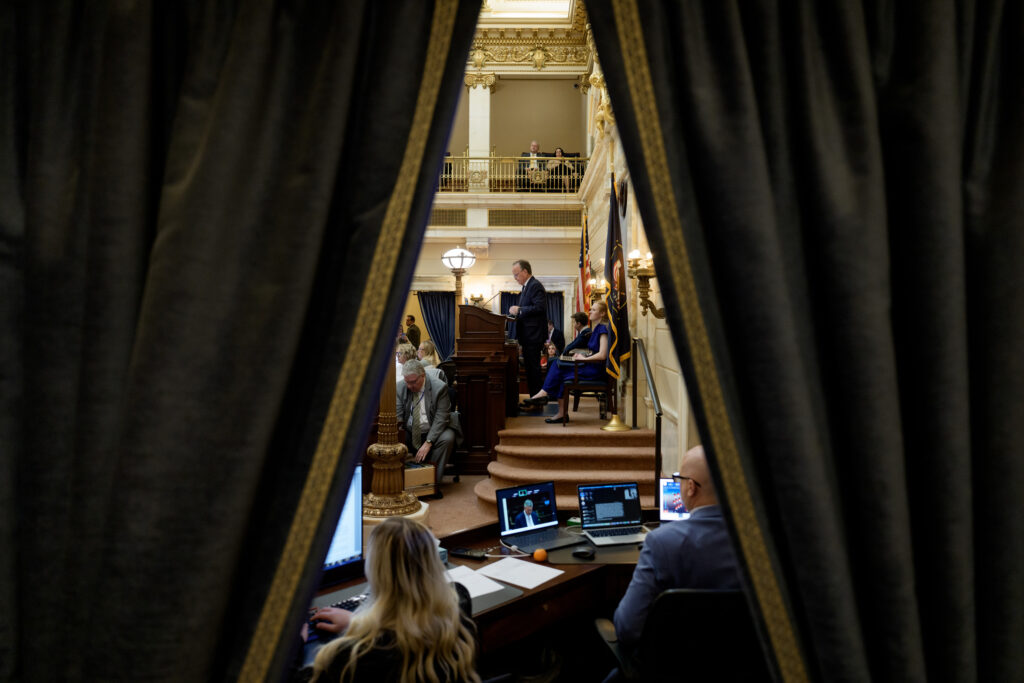


Senate President Stuart Adams, R-Layton, oversees work in the Senate Chamber at the Capitol in Salt Lake City on the final night of the legislative session, Friday, March 6, 2026. (Photo by Spenser Heaps for Utah News Dispatch)
The 2026 Utah Legislature’s general session came and went, and by the time the clock struck midnight on Friday and lawmakers adjourned, there was still at least one outstanding issue legislators didn’t deal with.
All through the session, Senate President Stuart Adams, R-Layton, said at some point lawmakers would be considering a proposed constitutional amendment — subject to Utah voter approval — that would make clear lawmakers can change voter-approved laws enacted by ballot initiative.
But as the days passed, the proposed amendment never went public. When asked repeatedly about it, Adams told reporters that lawmakers were taking their time to get its language just right. And he hinted that it was an issue lawmakers could tackle in a special session sometime later this year.
Amendment D ballot language was misleading to voters, Utah Supreme Court affirms
“When it happens, (it) will be when we are ready, when we think we have the language right,” Adams said on the final night of the session, Friday. “We want to make sure we do it right.”
Asked whether he’ll be calling a special session for a constitutional amendment to change the force of voters’ ballot initiatives, Cox told reporters, “It’s very possible that we will do that.”
“Certainly, we’ve had those discussions. We’re still early in that process,” the governor said.
Cox acknowledged that lawmakers’ last attempt in 2024 — known as Amendment D — never materialized because the courts ruled the Legislature failed to meet constitutional publication requirements and because its language (written by Utah’s top legislative leaders) was misleading to voters.
“Obviously that attempt failed,” Cox said. “We want to make sure that we get this one right, that we get the language right. So we’ll be working very closely with the Legislature, assuming they want to move forward.”
It’s not yet certain that lawmakers will officially convene for a special session to tackle this second iteration of Amendment D, but if it’s a question they want voters to weigh in on this November, it will likely need to happen in coming months.
Why do legislative leaders want to change the Utah Constitution?
Utah’s top Republican legislators’ appetite to try again to change the Utah Constitution to assert the Legislature’s power over ballot initiatives comes after a groundbreaking Utah Supreme Court ruling in 2024, which made clear that the Legislature’s power over “government reform” ballot initiatives has limits.
That ruling in an anti-gerrymandering lawsuit that successfully challenged the state’s 2021 congressional boundaries was key in subsequent district court rulings that have since established a court-ordered map to govern the state’s 2026 elections. That map, to Republicans’ dismay, turned one of the state’s four previously solid red districts blue.
Utah Democrats likely to win congressional seat in 2026 if judge’s map order stands
In a ruling that voided the state’s 2021 congressional map, 3rd District Judge Dianna Gibson found the Utah Legislature violated the state’s constitution when it repealed and replaced a 2018 voter-approved law known as Proposition 4, which banned partisan gerrymandering and created an independent redistricting process.
The Utah Supreme Court’s interpretation of the constitution frustrated Republican legislative leaders, including Adams, who has said the justices have disrupted a long-held belief that the Legislature has always had the ability to change laws, including ballot initiatives.
So with Amendment D, Utah lawmakers tried to sidestep that ruling and rewrite the Utah Constitution last year. Had it been approved by voters, it would have enshrined the Legislature’s unfettered constitutional power to repeal or alter any type of ballot initiative, including Proposition 4.
‘Chaos’
In an interview with Utah News Dispatch ahead of the 2026 legislative session, Adams said that the Utah Supreme Court’s ruling that says the Legislature must satisfy “strict scrutiny” or assert a compelling government interest in order to change “government reform” ballot initiatives was too ambiguous and left the door open to a flood of ballot initiatives that lawmakers can’t change, calling them “super laws.” That, he argues, could doom Utah’s future.
“The Supreme Court ruling will destroy Utah. It’s basically changed our entire form of government,” he said at the time. “We live in a republic. … (U.S.) Supreme Court (Justice Thurgood) Marshall said the difference between a democracy and a republic is order and chaos. We have chaos right now.”
Utah Supreme Court hands big win to plaintiffs in anti-gerrymandering lawsuit
Throughout the session — especially when discussing legal challenges to the state’s court-ordered map — Adams reiterated that Utah was in a state of “chaos,” which is why lawmakers should do something to solidify their ability to change ballot initiatives.
But even though it’s a stated priority, the specifics of the proposed constitutional amendment or its language were never discussed publicly. Adams has said, however, that the aim is to make clear that laws passed by the Legislature and enacted by ballot initiative are on a “level playing field” or “co-equal.”
When asked about it again during the final night of the session last week, Adams said lawmakers are “absolutely” still looking to put the proposed amendment on the ballot.
The question that remains, however, is when.
“Whether we do it now or post session,” Adams said, “if I have anything to do with it, we will have … a constitutional amendment on the ballot.”
A referendum on Supreme Court rulings?
With HB600, a bill that was filed during the 2026 general session (but never progressed because it was drafted late) Rep. Matt MacPherson, R-West Valley City, wanted to tackle the issue from a different angle.
That bill would have created a “referendum process” for voters to decide whether to affirm or reject opinions from the Utah Supreme Court on whether laws are unconstitutional or not.
MacPherson, in an interview with Utah News Dispatch last month, acknowledged the bill likely wouldn’t win approval from the 2026 Utah Legislature, but he still filed it as “a message” to “hold a mirror up to the Supreme Court.”
In Utah redistricting case, judge explains why she ruled against Legislature
“They have altered the landscape. A constitutional amendment is warranted — I hope we put it on the ballot, and I hope it gets voted in. That would certainly put things back to the way they were,” MacPherson said.
But if that doesn’t happen, he said Utahns and lawmakers should mull the implications of the state’s new political rules and whether there should be a check on the Utah Supreme Court in the same way voters can check the Legislature with referendums on laws they don’t like.
“I don’t think that the right policy in our form of government is direct democracy,” MacPherson said, acknowledging that his own bill could cause problems and invite more “chaos.” But he argued recent court rulings have changed the landscape and “invited more of a direct democracy process” that lawmakers need to figure out how to address.
MacPherson said he’d rather see voters pass a constitutional amendment to address this problem so he wouldn’t need to run a similar bill in the future.
“I would like to see us go back to a representative form of government, like we have been,” he said, “since our founding.”