
Utah News Dispatch
Faced with more lawsuits, Utah lawmakers move to change their new ‘constitutional court’


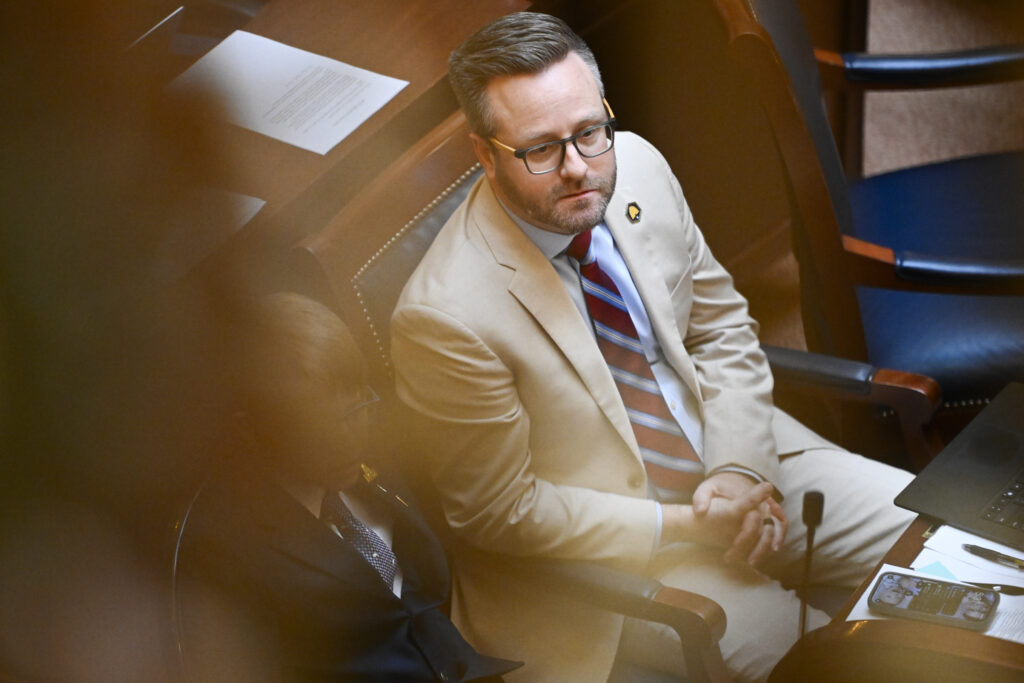


Sen. Brady Brammer, R-Pleasant Grove, looks on at the Utah State Capitol on the last day of the legislative session, Friday, March 7, 2025. (Photo by Alex Goodlett for Utah News Dispatch)
Already faced with a wave of legal complaints alleging their new district court panel — created to hear constitutional challenges to state laws — is itself unconstitutional, Utah lawmakers are moving to sidestep those suits by changing the law they had just passed.
By approving HB392 last month, the Utah Legislature created a randomly selected three-judge district court panel to hear lawsuits challenging laws as unconstitutional — including Utah’s ongoing anti-gerrymandering lawsuit. Gov. Spencer Cox swiftly signed the bill hours after it hit his desk without publicly weighing in.
Soon after, attorneys for the Legislature filed a notice to move Utah’s redistricting lawsuit away from 3rd District Judge Dianna Gibson’s courtroom (a judge they’ve repeatedly expressed frustrations with over her rulings in the case) and in front of that three-judge panel.
Utah governor swiftly signs bill to create 3-judge ‘constitutional court’ to hear challenges to laws
They also did the same in three other ongoing lawsuits — one that has temporarily blocked Utah’s near-total abortion ban, one that accuses state officials of not doing enough to save the Great Salt Lake, and one filed by a group of Utah teens that accuses state leaders of harming their health through fossil fuel policies.
Plaintiffs in the state’s ongoing redistricting lawsuit quickly filed a complaint seeking to block that new “constitutional court” panel. They allege the new law violates the Utah Constitution for several reasons, including that it only allows state officials to access the three-judge panel, not other parties. It’s an issue that lawmakers were warned about in public hearings before passing the bill.
The plaintiffs in the other suits have filed similar complaints.
Now faced with at least four legal challenges seeking to block the new court, Republican lawmakers are moving to dodge those complaints by shoehorning a change into a different bill, HB366, in a new version that won approval from the Senate on Thursday with a 23-6 vote.
Later Thursday evening, the House gave it final legislative approval on a 55-18 vote. It now goes to the governor’s desk.
The new version would allow any party to a lawsuit to seek the three-judge panel. However, it also includes a trigger provision that only takes effect if a court invalidates or blocks the panel.
If that happens, the bill would enact a provision that creates a whole new court structure, a “Constitutional Court” that would have “exclusive jurisdiction” over lawsuits challenging the constitutionality of state laws, with judges chosen by a seven-member Constitutional Court Nominating Commission, each appointed by the governor for a four-year term.
In Utah redistricting fight, plaintiffs ask judge to block Legislature’s new ‘constitutional court’
“If this is, for any reason, enjoined from being used by the court, then we’re just going to create the original idea, which was the Constitutional Court,” said the bill’s Senate sponsor, Sen. Brady Brammer, R-Pleasant Grove.
The original bill would have created the new, separate court structure, but as the initial bill was debated, Brammer said lawmakers listened to concerns from the courts “that we not form a new court, but we do it as (a court) made up of district court judges.”
Additionally, Brammer said “there were concerns that too many people would file into the court and it would bog down the system,” so that’s why lawmakers crafted the bill to make the three-judge panel only accessible to state actors like the governor or the attorney general.
“There have been legal challenges on those two bases,” Brammer said. “And so what this does is it addresses that any party may file. It narrows the scope to constitutional issues as well as issues related to injunctive relief.”
If the state’s original law is overturned by litigation, Brammer’s bill would create the originally envisioned and separately structured Constitutional Court. That would come with a price tag of about $1.2 million in one-time money and nearly $2.3 million in ongoing money starting in 2027 to pay for the court’s three new judges, six judicial assistants, two law clerks, and IT infrastructure, according to the bill’s fiscal note.
The Utah State Bar on Wednesday issued a news release expressing concerns to the final-hour changes to HB366, saying it would “threaten judicial stability” by reviving the originally proposed Constitutional Court concept.
SUBSCRIBE: GET THE MORNING HEADLINES DELIVERED TO YOUR INBOX
The Bar warned that by requiring a $1,500 filing fee for the new court to be used, that “creates a direct financial hurdle for families or small businesses involved in constitutional litigation.”
The Bar also warned that the fallback Constitutional Court would also have an “unconstitutional structure” because the Utah Constitution doesn’t authorize that type of new court structure.
And the Bar echoed concerns that the new law would create “forum shopping” concerns by allowing state leaders to “bypass judges who have issued unfavorable rulings in high-profile cases,” as well as worries of “lack of oversight” because the bill would “make the transfer of cases immune to legal challenge, which violates the separation of powers and denies due process.”
“Utah families and businesses rely on predictable, impartial courts,” Bar President Kim Cordova said in a statement. “Allowing those decisions to be revisited through a political process could delay resolution of constitutional questions and create instability in the rule of law.”
The “constitutional court” proposal comes as Utah’s Republican lawmakers have focused on a suite of bills this year making changes to the courts, including one to expand the Utah Supreme Court from five to seven justices.
GOP lawmakers have repeatedly expressed frustration with the courts for their rulings checking the Legislature’s laws on a variety of fronts, including redistricting, abortion and school choice.
Also earlier this week, the Utah House passed a resolution condemning a district court judge for comments he made in a child pornography case — an issue that has caught the ire of one of Utah’s most powerful Republican lawmakers, House Speaker Mike Schultz.
Utah lawmakers have until midnight on Friday before their 2026 legislative session must come to an end.