
Utah News Dispatch
As Utah moves to lower gas prices and produce more fuel, Idaho agrees to protect shared water supply


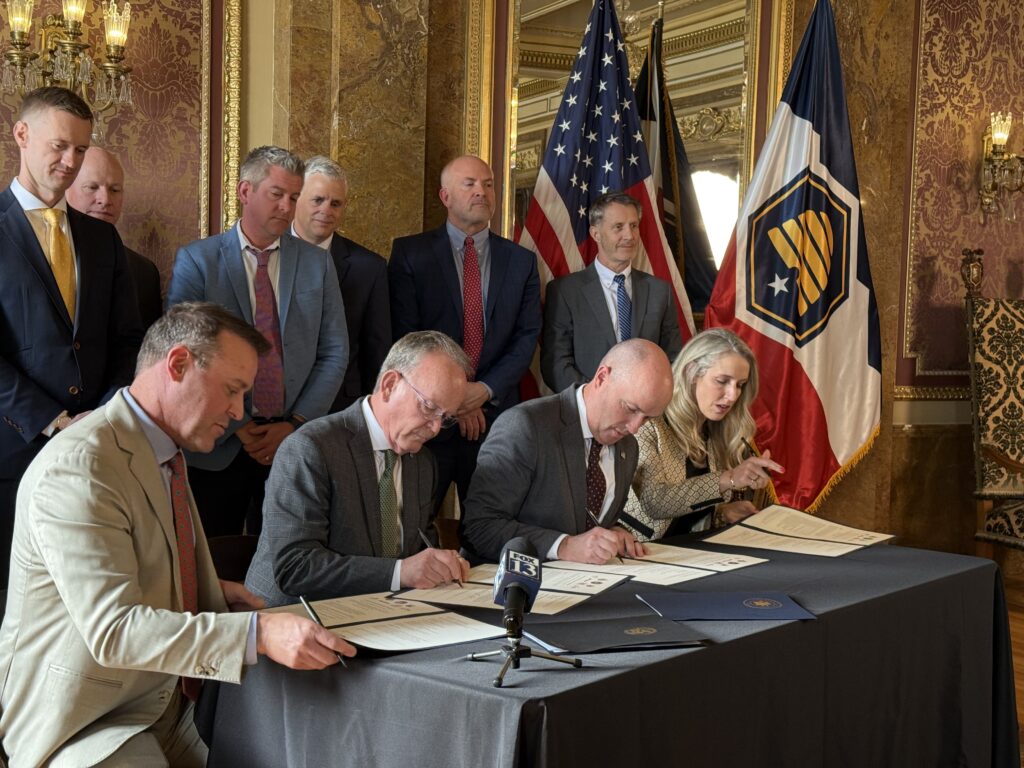


House Speaker Mike Schultz; Senate president Stuart Adams; Gov. Spencer Cox and president of Utah Petroleum Association Rikki Hrenko-Browning sign an agreement to increase fuel production in Utah on Feb. 23, 2026 (Alixel Cabrera/Utah News Dispatch)
Utah refineries committed to increasing their production by 23,500 barrels a day within the next five years as part of the state’s deal with the petroleum industry and Idaho to lower gas prices and to avoid an interstate clash.
The announcement comes a week after a Utah House bill became public revealing the state’s short- and long-term plans to increase its gas supply, notably deleting an initially proposed provision that would have canceled a longstanding tax break for refineries exporting fuel out of state.
SUBSCRIBE: GET THE MORNING HEADLINES DELIVERED TO YOUR INBOX
The move to end the export tax break was ultimately deleted after the Idaho Legislature expressed dismay and suggested it could block water flow to the ailing Great Salt Lake to put pressure on Utah, according to FOX 13 and Idaho News 6.
Utah and Idaho’s dispute over gas tax may fizzle with new bill to lower fuel prices
The new plan is a “bold goal” that Gov. Spencer Cox said during a signing ceremony at the Utah State Capitol on Monday “not only benefits Utahns, but it will benefit the entire Intermountain Region.”
“We’re protecting the reliability of our energy supply for long-term economic growth and security across the state,” Cox said during the event. “Utah invites bold engagement so we can control our own destiny, rather than letting outside forces dictate it.”
That was a nod to California, a state that Republican leaders have blamed for ballooning prices at the pump. It’s all about “simple economics,” said Utah House Speaker Mike Schultz, R-Hooper. Increasing supply will help lower prices.
“Utah doesn’t operate in a vacuum because of the crazy, crazy regulatory environment in California being pushed by Democrats, refineries are shutting down, and it’s tightening supply across the entire region, and when supply tightens, prices go up,” Schultz said Monday.
Amid California’s commitment to step away from fossil fuels and to expand its clean energy sources, refineries within the state have shut down, a trend the state says is happening globally. Utah has instead passed legislation in recent years that would make it harder to shut down energy sources deemed to be reliable, which often includes fossil fuels.
Utah is uniquely positioned to increase supply, Schultz said. The state already has the infrastructure and expertise to do so in the Uinta Basin and refineries in North Salt Lake.
In the short term, if the Utah Legislature approves the legislation sponsored by Draper Republican Rep. Cal Roberts, the state will temporarily lower the gas tax Utahns pay at the pump by 15%, going from the current $0.379 per gallon to $0.319 per gallon beginning on July 1 and ending on Dec. 31.
But, eventually, legislative leaders hope the policy streamlines permitting for new pipelines and directs strategic investment in storage to allow refineries to work at full capacity year-round.
After many comments from Utah House leadership criticizing petroleum industry lobbyists for being obstacles on the original legislative proposal and providing inaccurate information to Idaho, Rikki Hrenko-Browning, president of Utah Petroleum Association, was at the table signing the agreement with state leaders.
“We are an industry of problem-solvers. We have a demonstrated track record of working together with the state on critical challenges,” Hrenko-Browning said, referring to a state mandate to convert to cleaner, Tier 3 gas.
“Just as we committed to Tier 3 and major emission reductions a decade ago, today, we are excited to announce the statement of economic prosperity and a goal to grow our finished product supply,” she said.
And, equally as important, Schultz said, it’s legislation that Idaho agrees on.
“We’ve secured something even bigger. Because Idaho wanted to be part of the discussion,” Schultz said laughing, “it forced important conversations, conversations that ultimately brought people to the table and are going to help us secure additional water protections and resources for the people of Utah.”
The governor and legislative leaders agreed to sign a memorandum of understanding with Idaho to secure long-term water supply on the Bear River system.
The states are now poised to honor past Bear River agreements, to maintain existing storage water delivery commitments from Bear Lake, and to continue investing in advanced cloud seeding in the river. After many ups and downs in the negotiations, executive director of the Utah Department of Natural Resources Joel Ferry praised the outcome.
“This agreement is designed to protect your water security for tomorrow,” Ferry said. “We’re doubling down on our joint investment in things like cloud seeding. This is all about that abundance mindset, using technology to actually increase the amount of water available to agriculture, to municipal and industrial users.”