Utah News Dispatch
What increased education funding could mean for intergenerational poverty in Utah


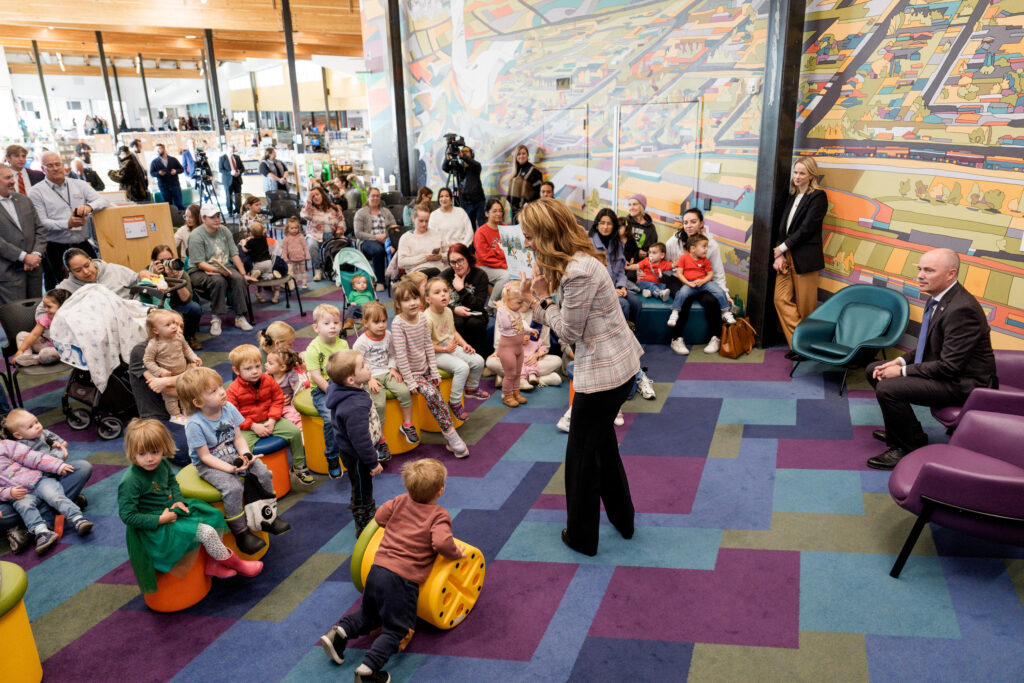


First lady Abby Cox reads to children gathered for a story hour after she and Gov. Spencer Cox held a press conference to present his budget proposal at the Salt Lake County Library in Kearns on Wednesday, Dec. 3, 2025. (Photo by Spenser Heaps for Utah News Dispatch)
There is a tragedy unfolding right before our eyes, every single day. It may not make the headlines, but it affects thousands of Utah residents. For many, it will define the course of the rest of their lives. What is this tragedy? It is the fact that thousands of impoverished children are growing up without the benefits of an education. Intergenerational poverty trends show that, unfortunately, many of these will go on to raise their own families in poverty.
These children deserve better, and their future children deserve better. Education is among the most important influences in the development of a child. Receiving an education is the most effective way to escape intergenerational poverty, and a quality education provides children with support and resources that have a huge impact on not only their economic trajectory, but their moral character as well.
Now, I don’t think anyone will argue against the fact that an education is important. In fact, I think most people would agree that it is one of the most crucial elements of childhood. But if that’s true, then why do we, as a society, make it such a low priority? Why does Utah consistently score in the bottom of the nation for per-pupil education spending?
Maybe the problem is that we just aren’t aware of why increased funding for schools is important. Maybe we tend to think that schools already receive enough funding. I mean, it’s not like kids are being turned away at the doors because the school just can’t afford to take them in, right?
The problem isn’t that children don’t have access to education, the problem is whether they are really benefitting from that education. For kids who come from affluent households, this isn’t much of an issue. When they go home, they have the full support of their parents.
For children raised in poverty, it is far less likely that they are receiving the support they need. They may only have the support of one single parent, who has to work long hours or multiple jobs and, by no fault of their own, barely has the time and resources to provide the necessities.
For these kids, it may not matter that they are going to school, they simply aren’t receiving the benefits. When a child grows up in poverty or other adverse situations, their cognitive development is slowed, and they fall behind in school early on. Research shows that a student who is not a proficient reader by the third grade is four times as likely to drop out of high school.
This is where school funding comes in. Increased funding can support a host of areas — these may not be so crucial for affluent families, but they have the potential to make a huge difference for impoverished families.
More funding could allow for greater intervention for underprivileged students, picking up the slack for hard-working parents and resolving the issue of delayed brain development. More funding could go toward improving the quality of overall education, or it could mean increasing the pay of teachers, bringing more teachers to Utah.
More funding would also allow for greater amount and quality of extracurricular activities. This would address another issue that stems from living in poverty: lack of social capital. Social capital refers to connections that improve financial, social, and emotional aspects of life.
Participation in extracurricular activities provides the opportunity for mentors and positive role models, as well as lasting connections with peers. Social capital is very useful for escaping intergenerational poverty, and a boost to extracurriculars could have a huge positive impact on impoverished children.
These are only a few examples of what an increase to school funding could mean. Hopefully you can see why this is such a big deal. So, what should be done? You may have heard that Gov. Spencer Cox’s budget proposal for 2027 includes $654.2 million for public education. This is a step in the right direction. Still, more positive change is needed. The Utah Education Association (UEA) asks that funding be increased to at least 2% above inflation in order to meet the needs of students and public educators.
Change requires the action of thousands of people just like you and me. Perhaps the most important step we can take, and one of the most overlooked, is to simply be an active participant in local government. I urge you to consider how you can do your part to support education, the children desperately need you.