Utah News Dispatch
Utah election officials eye Trump vote-by-mail order with uncertainty, concern


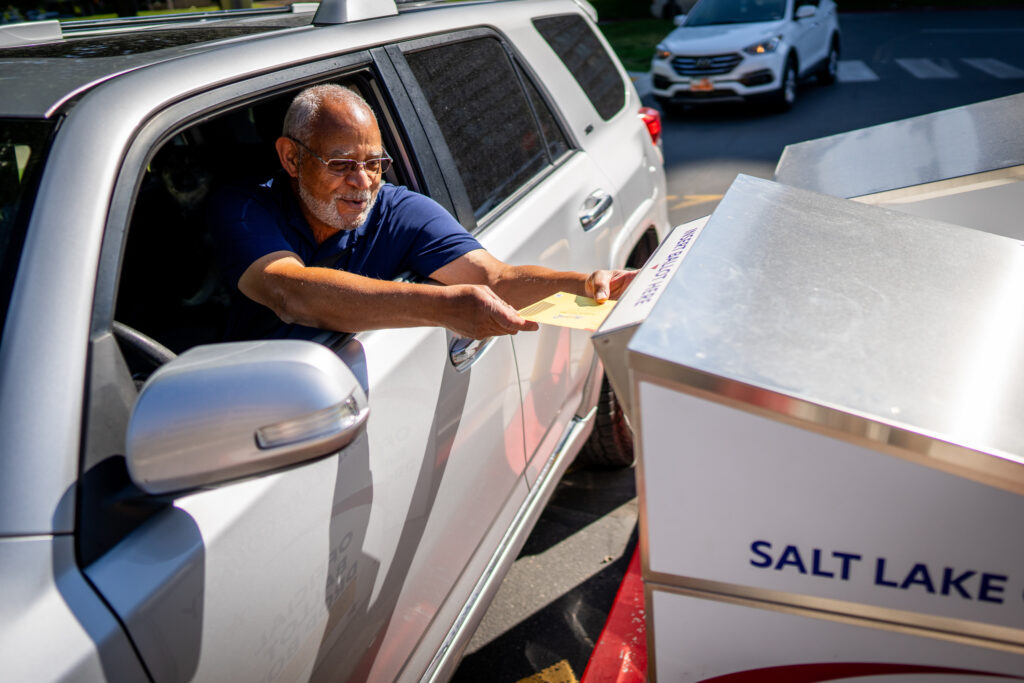


A voter drops off his ballot at the Salt Lake County Government Center in Salt Lake City as votes are cast in Utah’s primary election on Tuesday, June 25, 2024. (Photo by Spenser Heaps for Utah News Dispatch)
The day President Donald Trump signed a sweeping executive order that attempts to restrict mail-in voting, Utah’s top election official, Lt. Gov. Deidre Henderson reacted with a social media post expressing apparent exasperation.
In the post on Threads, Henderson — a Republican who has been critical of the SAVE Act that’s being pushed by Utah Sen. Mike Lee — compared the president’s executive order to a “nonsensical” play.
“POV: When the latest Executive Order reminds you of that time when you were a senior in high school and you performed in a one act play called ‘Jack or the Submission’ by absurdist playwright Eugene Ionesco and it was super weird and the script was full of nonsensical dialogue,” Henderson wrote in the post.
The order directs the U.S. Department of Homeland Security along with the Social Security Administration to compile a list of voting-age American citizens in each state and share it with state election officials. The order also requires the U.S. Postal Service to only send and receive ballots that include tracking barcodes.
View on Threads
Henderson’s office didn’t immediately return a request for comment Wednesday asking about the lieutenant governor’s response to the executive order or its impact on Utah.
Utah has embraced voting by mail, which has been its primary method of voting for more than a decade after the state first piloted all by-mail elections in 2012, long before the COVID-19 pandemic. Automatically receiving a ballot in the mail and either returning it with postage or at a drop box remains popular with Utah voters, though in recent years Republican legislators have moved to gradually restrict it.
A bill that would have required Utah voters to show a form of identification and return their ballots in person at a staffed drop box stalled during the state’s most recent legislative session. Instead, lawmakers commissioned a Utah Valley University study on “the security of in-person voting versus voting by mail” and “best practices” for ID requirements.
In an interview with Utah News Dispatch on Wednesday, Weber County Clerk Auditor Ricky Hatch, a Republican, reacted to the president’s executive order with uncertainty and concern. He said it’s still far too early to know all of the potential ramifications for Utah, but he noted the order is likely headed toward legal challenges.
“There’s the whole question of the authority of the president over elections, which is not mentioned anywhere in the Constitution,” Hatch said. He also noted: “There are a lot of groups that are poised to challenge this executive order in court.”
Utah lieutenant governor says SAVE Act would ‘hurt Utah voters’ as Sen. Lee leads its charge
Democratic election officials from states including Colorado, Arizona, Nevada and Maine and other opponents of Trump’s executive order were preparing on Wednesday to challenge the directive, saying it constitutes an extraordinary and illegal attempt by Trump to intervene in the voting process. The Campaign Legal Center also said it would challenge the order with its partners, the Democracy Defenders Fund, the League of United Latin American Citizens and other organizations, States Newsroom reported.
Based on how Trump’s previous executive orders have fared in the courts, that “doesn’t bode well for the president to be able to get this implemented,” Hatch said.
As for Utah clerks, Hatch said right now they’re focused on preparing for the upcoming June 23 primary. But the timing of the executive order itself, he said, poses its own problems.
“The timing is quite challenging,” he said, noting that the new requirements for the U.S. Postal Service would have to be implemented within 120 days of the executive order.
“To create a massive database like that, that’s crazy,” Hatch said, “as well as the state citizenship list that the Department of Homeland Security would have to create. That would have a 90-day window. These are massive undertakings that you don’t want to rush.”
Hatch also raised concerns about the order enacting requirements on the Postal Service. By forcing the Postal Service to “start making decisions on what voters can and cannot receive … (that) seems a bit clunky to me,” he said, while conflicting with the mission of the post office to collect, process and deliver mail.
SUBSCRIBE: GET THE MORNING HEADLINES DELIVERED TO YOUR INBOX
“This clearly inserts them into the process in that they would become a decision-maker (about) who can and cannot (receive ballots),” he said.
Hatch also pointed out that all counties in Utah already put barcodes on by-mail ballots — which he called a best practice — but he noted that not all jurisdictions have the resources to do that. He said cities, towns and service districts can administer their own elections, “and they certainly would struggle with some of the requirements” in the order, and it would likely force them to have to contract with a county.
Hatch, however, said there are some provisions within the executive order “that seem like they struck a pretty decent balance, like regarding citizenship.”
“That section seems like it could be helpful and isn’t overly restrictive,” he said. “As election officials, we always welcome additional, quality tools that can help us verify citizenship.”
Hatch also noted that Utah election officials already verify citizenship, “and we have a pretty darn good system,” he said. “But, it never hurts to have additional tools, as long as the tools don’t create, you know, a horrific number of false positives.”
‘Not a widespread problem’: Lt. gov. releases early findings from voter citizenship review
In January, Henderson’s office reported that an ongoing review of Utah’s voter rolls hasn’t found any cases of noncitizens voting in a Utah election. That most recent review resulted in the removal of one noncitizen registered voter, in addition to four that were found last year.
Hatch added that as an individual and not necessarily in his role as a clerk, he does worry about aggregating a federal database.
“Aggregating that much personal data into one location seems like a risky thing to me,” he said. “As a citizen, I don’t know if I like that. But from an administration standpoint, yeah, if they can give us another tool by which we can verify citizenship, that’s great.”
However, Hatch said he worries about the executive order also calling on federal leaders to prioritize investigation and prosecution of election officials who send ballots to ineligible voters. That doesn’t just include clerks, but also “it’s the printers who print the envelopes, it’s the Postal Service, it’s anybody who touches or processes or helps with the creation of or processing of ballots,” he said.
“My concern is this is going to cause a hyper overprotection that could lead to disenfranchisement,” he said. “Is this going to cause an election official to err on the side of disenfranchisement? And does that align well with what the founders believed?”