
Utah News Dispatch
For the first time, Utah has 2 unaffiliated legislators. Who are they and who will they caucus with?

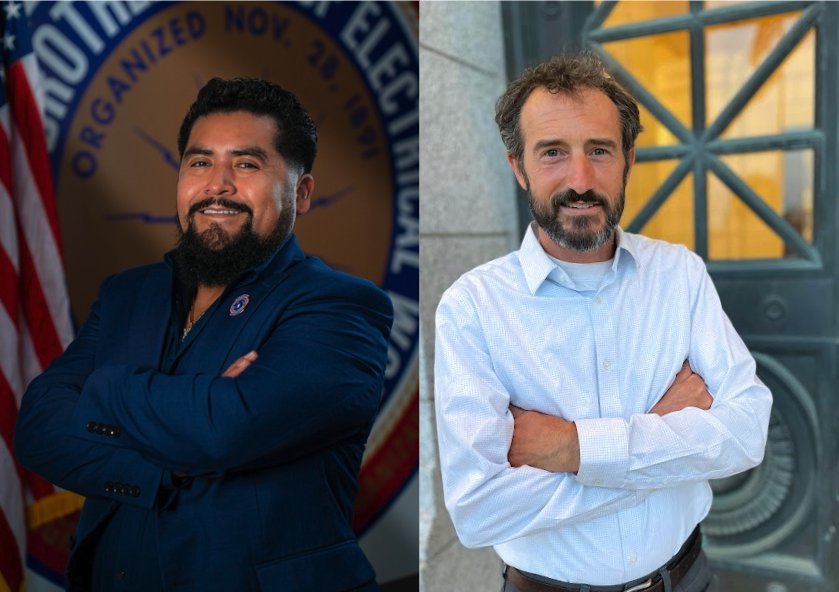

Sergio Sotelo (left) and Patrick Belmont won election to the Utah House as the state’s first unaffiliated legislators. (Photos courtesy of Sergio Sotelo and Patrick Belmont)
For the first time in Utah’s modern history, two unaffiliated legislators will be taking up seats in the Utah House next year.
They come from very different backgrounds. Patrick Belmont is a water, earth and climate professor at Utah State University in Logan. Sergio Sotelo, of West Jordan, is an electrician and longtime labor union member and organizer.
For both, it’s not yet clear whether they’ll caucus with Republicans, Democrats or neither. That means they could act as political wildcards in a 75-member chamber where this year’s blue wave election flipped 18 Republican legislative seats — doubling Democrats’ caucus from 14 to 28 and shattering Republicans’ two-thirds supermajority for the first time in more than 30 years.
When the Utah Legislature’s session starts in January and the new slate of lawmakers are sworn in, House Republicans will have lost 16 seats to 14 Democrats, Belmont and Sotelo, slashing the GOP ranks from 61 to 45 members.
Utah’s 2026 election results are certified, solidifying Democrats’ gains in the Legislature
In the Senate, Republicans lost two seats, so they’ll still hold a supermajority in that chamber, while House Republicans will hold a simple majority.
However, newly elected GOP legislative leaders from both chambers have said they’re listening to voters’ rebuke of their party, and they have promised to work collaboratively rather than combatively with the stronger Democratic caucus.
Knowing that they could play a role in helping certain legislative efforts to cross the finish line — or stop them in their tracks — Belmont and Sotelo both say they want to focus on solutions that matter for Utahns, like housing affordability, living wages, and sustainable water policy for the Great Salt Lake.
What they don’t want is more divisive, two-party politicking.
Belmont said he’s worried about the possibility that Republicans and Democrats will “dig their heels in harder” and become even more polarized under the Legislature’s new makeup, but he said “I will be doing everything I can to make it more collaborative.”
“I really do deeply believe that that is the only way forward,” Belmont said. “Having honest conversations that span ideologies.”
Both Belmont and Sotelo said they haven’t decided who they’ll caucus with when the session starts on Jan. 19. Belmont floated the possibility of “engaging with people, perhaps as a third caucus” that includes members from both parties. But that remains to be seen.
Sotelo said he and Belmont “both need to be very cautious on how to carry ourselves up there” on Capitol Hill.
Analyzing Utah’s blue wave: Many Republicans didn’t turn out; others crossed over to vote blue
“I think we’re both aligned on the same thing, that the one thing we’re going to do is prioritize our constituents, prioritize our communities and caucus to favor and benefit those constituents and those communities that put us there,” Sotelo said. “What’s going to be best for them.”
While it’s common for independent and third-party candidates to run for legislative office, Belmont and Sotelo’s wins are the first unaffiliated candidates to be elected to the Legislature in the state’s recorded history. The state’s only third-party legislator, Sen. Emily Buss, a Forward Party member, narrowly lost her seat to Republican Brooks Benson.
Belmont and Sotelo’s elections came during a year when unaffiliated Utah voter registrations ticked upward. This year, the state’s active unaffiliated voters rose to 519,252, up 41,275 from 477,977 in November 2025, according to state records.
Republicans still make up the majority of the state’s active voter registrations with 912,989, but that’s down slightly from 926,455 in 2025. Democrats have 260,867 voters, up from 241,063 last year.
The increase in unaffiliated voter registration could have been a small factor in helping Belmont and Sotelo. However, both candidates mostly attributed their success to hard work knocking doors — but also a growing sentiment among voters frustrated with the status quo.
“There’s probably a lot of people out there who feel the same way that I do, that partisan politics is just not going to get us where we need to go,” Belmont said. There isn’t a single party that has all the answers. We have to get back to a place where we’re having real conversations.”
While the blue wave clearly helped them this election, Sotelo said he saw it more as a working class wave — propelled by people who “voted with their pockets.”
“When I was out knocking doors, I was knocking on independent doors, Democrat doors, Republican doors, and you know what? They’re all working families,” Sotelo said. “They all need to put food on the table. They all need to go out, work, and earn a living.”

Who is Patrick Belmont?
Belmont won the House District 3 seat this year by a wide margin, beating Republican incumbent Rep. Jason Thompson with more than 59% of the vote, according to certified election results.
Belmont’s race this year wasn’t his first foray in politics. Rather, it was his third time running for the seat after two previous unsuccessful campaigns in 2022 and 2024.
On election night, Belmont had hosted about 20 of his closest campaign volunteers for a home-cooked, Thanksgiving-style feast — with a big turkey — at his house in downtown Logan.
As they waited for results, Belmont said he had “nothing but good feelings and deep gratitude” for his campaign. He had lost before, but he said he felt like they ran a strong campaign.
Utah House Democrats shake up leadership after the blue wave doubled their caucus
But when the results came out, the room “erupted,” he said.
“We were not expecting to be ahead with that kind of margin,” he said.
His lead not only held, but grew as more ballots were tallied.
“It was just overwhelming. … I’m an ultra marathoner. I run a lot of really, absurdly long races. And this felt like a whole different level.”
After five years and multiple campaigns, Belmont said it felt like the work finally paid off.
Belmont said he’s been an independent most of his life, but in 2022, he ran as a Democrat because “I thought I needed a party behind me.” But that year, he said “people immediately kind of put me in a box, and it just shut off a lot of conversations.”
So when he decided to run again in 2024, Belmont opted to run as an independent, “and it felt so much better, so much more authentic to me and who I am, and it just opened up so many more conversations.” That also meant some Republicans also decided to support him that year.
“I’m an independent because I am accountable to evidence, my conscience, and my constituents,” he said. “That’s what I really want to be accountable to, and that’s the way I’m going to work in the Legislature.”
The 48-year-old water scientist and professor at Utah State University was born in Chicago but moved to St. Louis when he was young. He lived in Texas, Pennsylvania and Minnesota while earning his undergraduate, graduate and postdoctoral degrees before moving to Logan, Utah. He’s lived there for 17 years.
Belmont said he decided to run for public office out of a desire to maintain Utah’s quality of life while also becoming frustrated that “when science is asking something hard of us, it gets ignored or — worse — buried.”
Utah Gov. Cox: Republicans ‘suffered a historic defeat.’ Now, he says they have to ‘listen’
“It was the harder lessons from science that were not making its way into management policy in a way that I think they need to,” he said.
As an example, he pointed to the shrinking Great Salt Lake.
“The science has been done for a long time. We know what we need to do there. We’ve thrown over $1 billion at the lake now, passed two dozen bills, and it’s worse off than we started seven years ago,” he said. “And it’s because a lot of the people in elected office right now don’t want to have the harder conversation.”
Belmont said he’ll be pushing a “conservation first” strategy when it comes to water policy. He said he’d like to see the conversation shift away from “how can we create more supply to how can we save water,” and he said he wants to ensure “excessive” water users actually pay for their use.
Water in Utah, one of the driest states in the country, is far too cheap, he said.
“We’re the second-driest state in the country. We have the highest per-capita water use in the country. It’s absolutely bizarre,” he said. “And any economist would look at that and be like, ‘Well, of course, you’re basically giving it away for free. What do you expect?’”

Who is Sergio Sotelo?
Sotelo was taking out the trash from his election night watch party when results were posted. When he came back inside, he said everyone was cheering.
The 43-year-old, who lives in West Jordan with his wife and two children, said he never doubted that he would win, even though some told him he was crazy to run for House District 38, expected to be firmly red.
“We never had any doubt that we were going to pull this off because we worked so hard,” Sotelo said of his campaign. But like Belmont, he was caught off guard by the margin. Sotelo won with more than 56% of the vote to Republican Chris McConnehey’s nearly 44%.
Utah House Democrats’ wins come with mixed feelings over loss of some moderate Republicans
Sotelo said as he and his campaign workers would knock doors, they’d come back surprised by how many people were excited to engage with his campaign — not just because they liked his message as a blue collar worker and union supporter, but also because they felt like sitting politicians hadn’t campaigned in their neighborhoods for years.
“Instead of telling me to go pound sand and kick rocks, they’d say, ‘Hey, you want a water? Want a gatorade? Thanks for coming by,’” he said.
Sotelo grew up in Chicago after his parents immigrated there from Mexico. He said he moved to Utah in the early 2000s. He worked for more than 15 years as an electrician, both working in the trade and representing workers through a local chapter of the International Brotherhood of Electrical Workers. He currently serves as treasurer of that chapter and runs a small accounting business with his family.
Sotelo said his involvement in politics dates back to his early days with the union, helping track bills and advocate for labor-friendly policies.
He said the Utah Legislature has had a long history of anti-union legislation. But the controversial bill banning collective bargaining for public unions that lawmakers passed in 2025 — only to repeal it soon after amidst a successful referendum effort — was the final straw that prompted him to run for the Legislature.
Utah Legislature approves repeal of anti-collective bargaining law
The sponsors of that bill — Senate Majority Leader Kirk Cullimore and Rep. Jordan Teuscher, R-South Jordan — both lost re-election this year to Democrats.
While his margins surprised him, Sotelo said frustrations had brewed for a long time — and this was the year where people had enough.
“The Republican party got way too comfortable with that supermajority,” he said.
While he said some of his progressive ideals align with the Democratic party, Sotelo said he chose to run as an unaffiliated candidate because he sees himself as an advocate for the working class, which spans all political stripes.
“They don’t care if it’s red; they don’t care if it’s blue … they vote with their pockets,” he said.
Polling data showed his campaign that “people were upset with both parties,” he said, “so we needed to let the people know that there was an alternative.”
“We can have different solutions and not just rhetoric of switching the ball from one court to another,” he said. “Just the constant bickering and blaming, it’s just like, let’s stop that. Let’s just have conversations on solutions.”