Utah News Dispatch
Utah dismisses criminal charges against Kalshi after the company blocks bets in the state

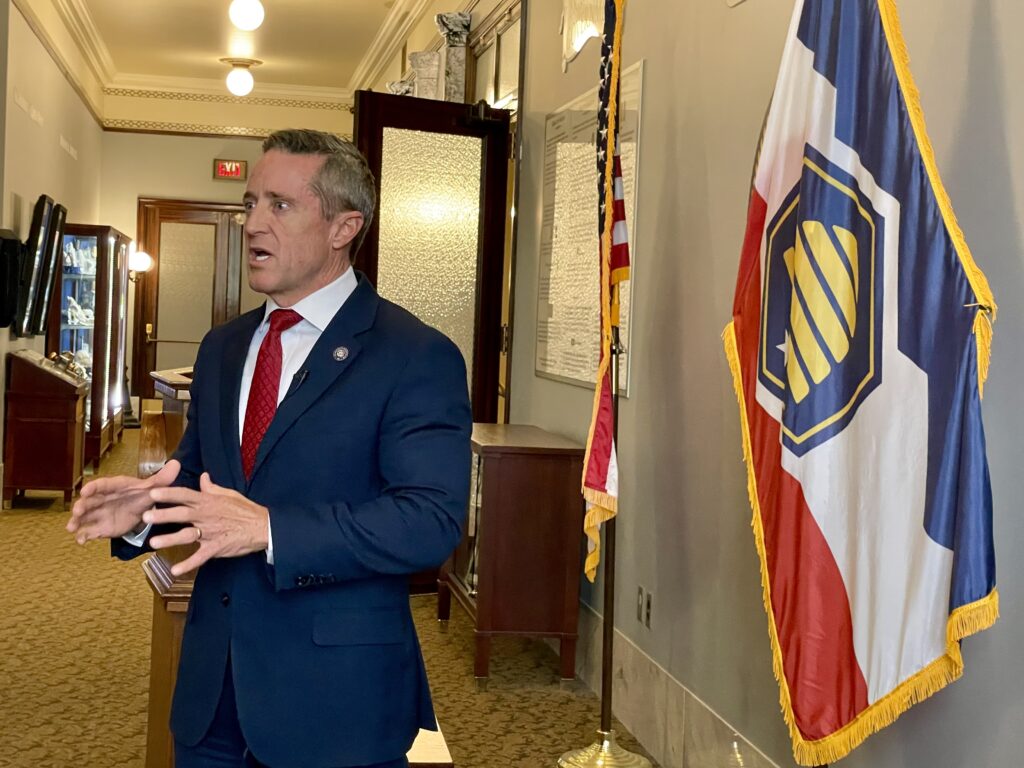

Utah Attorney General Derek Brown speaks to reporters after a news conference announcing Utah’s lawsuit against Kalshi at the Utah Capitol in Salt Lake City on Oct. 20, 2026. (Katie McKellar/Utah News Dispatch)
Utah’s Attorney General Office announced on Tuesday it moved to dismiss all 14 criminal charges against the prediction market platform Kalshi, a day after the company confirmed it had blocked its operations in Utah.
The office last month filed 12 online gambling promotion felony charges, one count of pattern of unlawful activity, also a felony, and a misdemeanor charge for general gambling promotion against Kalshi and its founders, Tarek Mansour and Luana Lopes Lara.
Before the dismissal, the charges followed a civil lawsuit the state filed against the platform, which is still pending in court.
SUBSCRIBE: GET THE MORNING HEADLINES DELIVERED TO YOUR INBOX.
“The motion does not change the Office’s position: Utah law prohibits gambling, and Utah considers prediction markets gambling,” the Attorney General’s Office said in a news release. “Utah’s Constitution bars any form of gambling, and state criminal law makes gambling a crime.”
The Attorney General’s Office filed to dismiss the case after Kalshi geofenced Utah. However, the office can still refile the charges if the company resumes operations in the state, the release says.
“Utah does not allow gambling, and prediction markets are gambling,” Attorney General Derek Brown said in a statement. “Kalshi has pulled out of Utah, and if it returns, so will the charges. Every company in this space should take note. If they promote, support, or enable gambling, we will hold them accountable.”
Kalshi’s attorney Yaakov Roth said in a social media post company leaders were pleased with the move to dismiss criminal charges while proceeding with civil litigation.
“Good faith jurisdictional disagreements should never be criminalized,” Roth wrote. “We stand ready to work with State AGs on reasonable interim measures until courts resolve the dispute over who regulates prediction markets.”
Utah has been fighting in court to enforce its anti-gambling policies since the state legislature passed a law in 2026 including proposition bets in the definition of the state’s constitutional gambling ban.
That law has been the center of legal disputes, including one from the Commodity Futures Trading Commission, which argues that the federal government has the authority to regulate derivatives markets and has asked a court for a relief “holding that Utah gambling laws are preempted and unenforceable,” according to the complaint.
The list of legal challenges is still long as other states aim to regulate proposition betting within their boundaries. In Utah, a federal judge ruled in August the state may enforce its anti-gambling laws, even if they include bans of proposition betting. Kalshi unsuccessfully appealed that decision. But, criminal charges in other states, like Arizona, have also been blocked.