Utah News Dispatch
Feds look to the Great Salt Lake in push to produce critical minerals


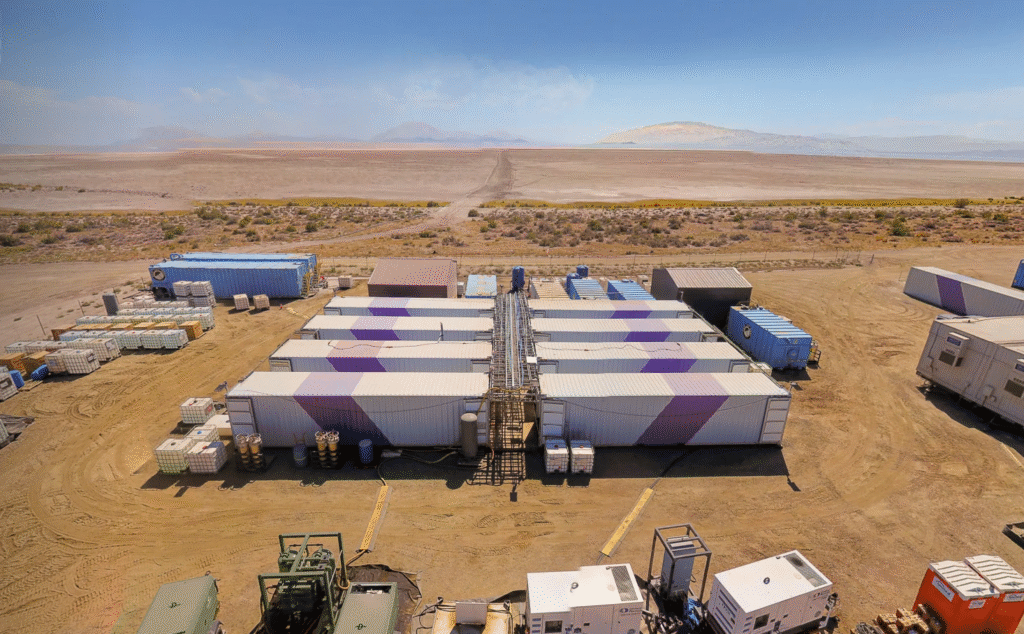


Lilac Solutions’ lithium extraction pilot program near the Great Salt Lake is pictured in August 2025. (Photo courtesy of Lilac Solutions)
The Trump administration wants to ramp up production of critical minerals without relying on other countries, and it’s looking to Utah for help.
A company extracting lithium from the Great Salt Lake was awarded a $100 million grant from the U.S. Department of Energy Thursday, with the money dedicated for construction of a new large-scale operation on the north arm of the lake. In all, the department is distributing $500 million between seven projects across the country.
Lilac Solutions, a California-based company, says most every drop of water it pulls from the lake goes right back in through a process using manufactured “beads” similar to grains of rice that pull lithium from brackish water as it flows through a container. They’re made in Nevada, with the rest of the process taking place at the company’s site on the lake, he said.
It’s a much different process than typical methods relying on expansive evaporative ponds or, increasingly, on mining hard rock that ends up in China for processing, said the company’s CEO Raef Sully.
“So it’s really about breaking that supply chain stranglehold that the Chinese have on it,” Sully told Utah News Dispatch.
Federal administrators with the U.S. Department of Energy and the Environmental Protection Agency touched down in Utah this week, in part to speak in closed meetings with heads of mining companies, along with state lawmakers and other elected officials.
When it comes to critical minerals, Deputy Energy Secretary James Danly told reporters at the state Capitol Thursday that “the overall plan and strategy is deceptively simple, which is to try to onshore as much of the critical minerals extraction, processing, and commercial availability as possible in the United States.”
The Beehive State factors into the push for two reasons.
One has to do with its natural riches. Danly said 80% of listed critical minerals — deemed to serve essential functions in technology, with a high risk of supply chain disruption — are found in the state. The other reason is that state leaders are enthusiastic about developing a workforce and technical pilot programs, he said.
Utah aims to host critical minerals lab, hoping for federal recognition — and funding
“I think Utah is likely to be one of the leaders in critical mineral efforts simply because of the natural resources and the willingness of the state to partner with the federal government,” Danly said during the news conference.
After running a smaller-scale pilot program, the lithium project at the Great Salt Lake is awaiting state approvals in a permitting process that Sully said has been rigorous.
Conservationists are weighing in, with Friends of the Great Salt Lake saying they’re not opposed to the project but want to see careful monitoring for chemicals used to treat the water before sending it back to the lake.
The company has “validated their technology,” said Rob Dubuc, general counsel for Friends of the Great Salt Lake. “Whether it can work at scale, well, there’s only one way to find that out, right? Which is to build a plant.”
Lilac Solutions plans to conduct sampling on a daily basis for internal use and weekly for the state, and didn’t detect those compounds in testing during its pilot program, said project director Steve Morrey.


The company has laid out a plan to produce 5,000 metric tons of lithium carbonate each year by 2028, then ramp up to 20,000 tonnes per year in a second phase. It’s not just used in electric car batteries, Sully said, but for storage for wind and solar power and to keep data centers humming. To help meet the demand, the water the operation pulls from the lake and sends back won’t be the only source it uses.
“What I like to tell people is, if you had an irrigated farm there, you would be using about the same amount of fresh water as we do for our industrial process,” Sully said.
The Great Salt Lake is sliding back toward a historic low water level after prolonged drought and diversion of water, primarily for farming, but also for cities and industrial use. Asked during Thursday’s news conference about Utahns’ concerns for the lake’s health, EPA Deputy Administrator David Fotouhi noted the federal government has contributed to programs getting more water to the lake and monitoring the hazardous dust kicking up from its dry lake bed.
“So it’s an ongoing discussion, and the federal government is standing with the state to address these issues directly,” Fotouhi said.