
Utah News Dispatch
Cox orders ‘higher bar’ for data centers, says public input ‘absolutely matters’


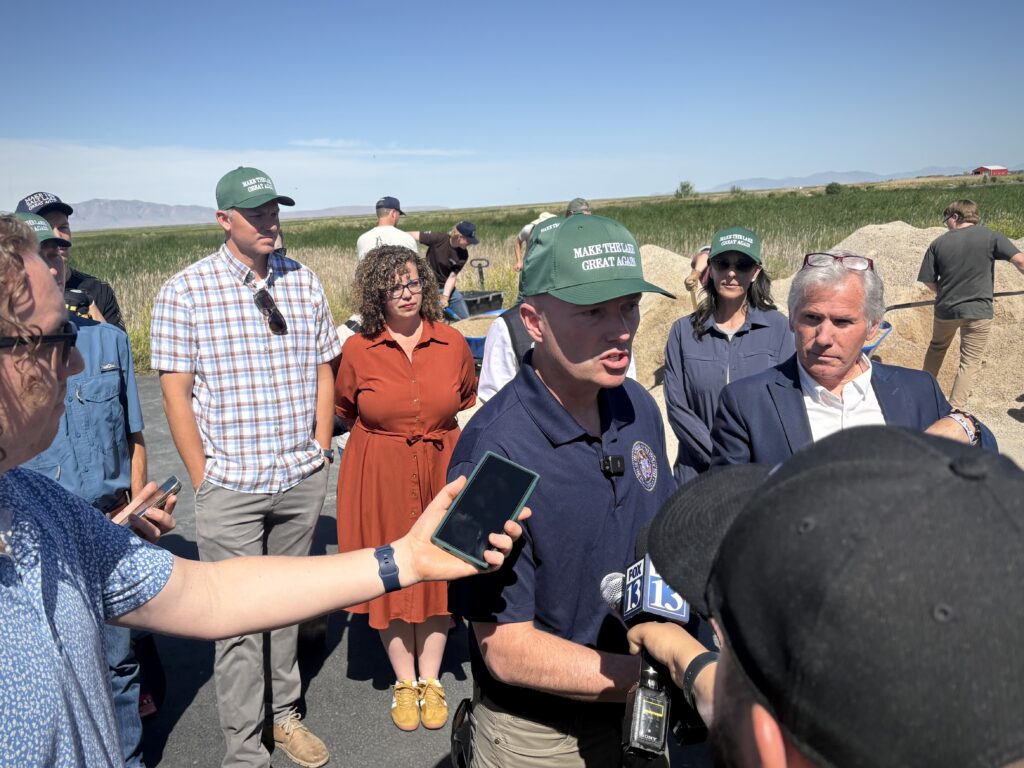


Gov. Spencer Cox speaks to reporters about data centers and the Great Salt Lake at the Eccles Wildlife Education Center at Farmington Bay on Friday, May 29, 2026 as Utah Representatives Blake Moore and Celeste Maloy look on. (Annie Knox, Utah News Dispatch)
Facing public outcry from across the state and intense pushback from communities closest to a massive proposed data center in northern Utah, Gov. Spencer Cox on Friday said the health of the Great Salt Lake and safeguards to Utah’s air and water quality must come first.
In an executive order, Cox directed state agencies making decisions about data centers to prioritize those factors, among others. He said the move was “certainly” a response to public feedback, although he does not agree with criticism that the Stratos project backed by celebrity investor Kevin O’Leary would harm the drying lake.
“But the public has brought up some concerns that some of us didn’t think about that are important, and that matters. I mean it absolutely matters,” Cox said, without elaborating on the issues brought to light by Utahns.
The governor’s comments Friday reflected the shock waves the project sent through Utah, generating large protests at the Capitol and a push from Box Elder County residents to stop it via voter referendum.


Cox’s remarks were a reversal from the fervent, exasperated tone he used at a news conference in April when asked about opposition to the Stratos project, initially billed as a 9-gigawatt project that Cox recently said in its first phase would top out at about 1 gigawatt of energy generated by a natural gas power plant.
“I’m so tired of our country taking years to get stuff done. It’s the dumbest thing ever. We think that taking time makes things better or safer, it absolutely does not,” he said at the news conference. “You get a chance to give your feedback, and then decisions get made. That’s how we have to do stuff in this country and in this state.”
The following week, he said those comments “did not meet the expectations I have for myself. I seek to do better” and announced a phased approach for the proposed project.
On Friday, Cox said he would be a “terrible” person and public servant if he didn’t care about the public’s response. In a prepared, written statement, he added that the new framework creates a “higher bar for how these projects are evaluated and ensures that economic strength and environmental stewardship go hand in hand.”
SUBSCRIBE: GET THE MORNING HEADLINES DELIVERED TO YOUR INBOX.
Some conservationists appreciated Cox’s comments Friday but criticized the order, saying it lacks teeth and they don’t see it changing much on a practical level.
“What I worry about is he still thinks this is a good project and that this executive order is designed to diffuse public concern and make people think this isn’t a problem anymore when in fact it very much is,” said Deeda Seed with the Center for Biological Diversity.
She said Utah’s air and water supply are already in bad shape, and “even in the best case scenario, it’s going to add to the crisis.”
The independent Military Installation Development Authority (MIDA) that gave initial approval for the project and is working with its developers isn’t subject to the governor’s directive. But Cox’s order requires state agencies to “communicate and coordinate frequently” with MIDA, other authorities and local governments.
The governor said MIDA issued a decision about land use, but when it comes to air quality, the project’s backers have “a very long process that they have to go through” overseen by the Department of Environmental Quality.
Cox acknowledged his order doesn’t give any extra authority to executive agencies such as the departments of natural resources and environmental quality that review permits and applications from data center developers. Rather, he said it doubles down on his previous directive barring any new water rights in northern Utah, a move designed to keep already low stream and river flows to the lake from shrinking further.
The other priorities Cox laid out include promoting job growth and the economy, limiting effects on wildlife and Utahns’ utility bills, providing “transparent, meaningful and thorough opportunities for public comment” and leading out on “pro-human AI development in Utah.”
The governor said Senate President Stuart Adams approves of the new parameters and the two had a long conversation about them. Adams is a longtime member of MIDA’s board, in addition to his role as a state lawmaker.
“Usually legislators don’t like executive orders,” Cox said. “This is the exact opposite.”

He answered questions for roughly eight minutes at the Eccles Wildlife Education Center in Farmington after holding a meeting there with a broad array of state leaders, federal officials and prominent business executives like Gail Miller and Josh Romney.
He said the meeting, closed to the news media, was the second in an ongoing series to coordinate efforts to restore the lake and discuss President Donald Trump’s proposal to set aside $1 billion to help.
Wearing a ballcap that read “make the lake great again,” Cox picked up a shovel to help crews haul and lay down gravel at the wildlife center.
Reps. Blake Moore and Celeste Maloy — who are both running for reelection this year — stood behind Cox during the news conference and pitched in afterward, using rakes to spread the gravel over a pathway.
In an interview, Moore, whose congressional district includes Box Elder County, said he doesn’t believe the Stratos development goes against efforts to save the Great Salt Lake.
He said he’s encouraged by the public scrutiny of the project and the governor’s order in response.
“Those are all the ways this is supposed to work,” Moore said.
Read Cox’s executive order below: