Utah News Dispatch
Is Utah short behavioral health beds? ‘Word on the street’ is yes, but audit says state lacks data

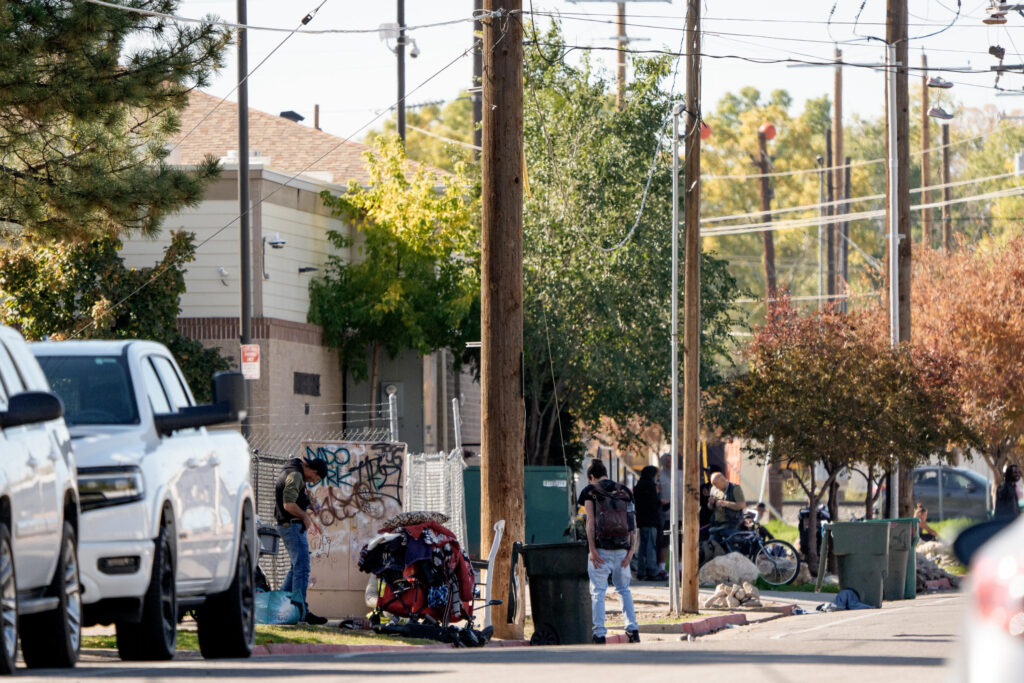

People congregate outside the Lantern House homeless shelter in Ogden on Thursday, Oct. 23, 2025. (Photo by Spenser Heaps for Utah News Dispatch)

As Utah state and local leaders continue to look for ways to improve services for Utahns in need, a panel of lawmakers on Thursday reviewed a legislative audit focused on one piece of the puzzle: behavioral health.
Even though legislative auditors set out to answer the simple question of whether Utah has enough behavioral health beds to meet demand, they ran into a problem.
“Unfortunately, we found that no one could actually answer that question,” Madison Hoover, an audit supervisor with the Office of the Legislative Auditor General, told the Legislative Management Committee.
Utah homeless leaders look to focus funding on ‘high utilizers’ while not ‘backing away’ from campus
She said there’s no one entity responsible for collecting that information from all the various facilities across the state — including between the private and public sectors — so there’s no comprehensive information available on how many beds exist, how often they’re available, or where capacity may fall short.
So, the audit report released Thursday instead declared “Utah does not know its behavioral health bed needs.” To fix that problem, auditors recommended lawmakers focus on creating a statewide bed registry to show where needs are or aren’t met, and to designate a “central authority” to better coordinate the system and its varying types of behavioral health facilities.
“This lack of information is really important, because behavioral health beds are the mechanism that allow patients to move through the system,” Hoover said. “And when patients can’t access the appropriate level of care — whether that’s in a residential treatment facility like First Step House or an acute care wing of an Intermountain hospital — congestion builds, and those ripple effects are really seen across the continuum.”
Hoover said auditors tried their best to contact all 600 facilities across the state that offer some type of behavioral health services “because we wanted to at least work to start assembling as much of that picture as we could,” but they could only get information from some of them.
“That exercise itself exposed, again, the core issue here. Without authority, coordination and standardized reporting, understanding this system is extraordinarily difficult,” Hoover said.
However, “to show that systemwide visibility is actually possible,” she said auditors built a dashboard to showcase the information they were able to collect.
SUBSCRIBE: GET THE MORNING HEADLINES DELIVERED TO YOUR INBOX
That dashboard shows (based on available information) that Salt Lake County has the lion’s share of the state’s behavioral health beds, with at least 2,623. Utah County has 1,460; Davis County has 336; Weber County has 262; and Washington County has 390.
Leah Blevins, audit manager, said the dashboard isn’t updated in real time, so the numbers and availability can fluctuate, “but we do think it does show how important it is to have this information — for the hospitals … and especially for you as decision-makers.” And it reflects the “most complete information that anyone gathered to this point,” she said.
“The word on the street is there’s not enough beds, and we’re not questioning that,” Blevins said. “But we don’t have the data to back that up. So if the Legislature is deciding whether to spend more money on beds, it’s very difficult for policymakers to make those decisions based on the lacking information that we have.”
So Hoover said auditors aren’t issuing an immediate call to “add more beds,” but rather a call to “actually understand the system before we make additional investments.”
“Without the systemwide visibility, capacity, availability and demand, Utah is going to be making decisions with significant blind spots,” she said. “So understanding these resources across the continuum is a foundational step towards improving access, reducing delays, and ensuring public dollars are directed at the areas of greatest need.”
House Speaker Mike Schultz, R-Hooper, expressed support for the recommendation for a statewide bed registry, calling it a “really good option” for lawmakers to consider.
With funds for 670 homeless overflow beds running out, board OKs $1 million to ‘bridge’ the gap
Blevins also said the state’s already established Behavioral Health Commission is a “great first step” to help coordinate existing efforts, but the state lacks a final decision-maker, which is why auditors recommended a central authority to govern the system.
In response to the audit’s recommendations, Tonya Hales, deputy director of the Utah Department of Health and Human Services’s health care administration, said she thinks the DHHS is “in a really good position to be a central authority” over behavioral health for the state.
However, Hales said “one thing we lack right now is the ability to engage with the private sector,” so she suggested that’s one thing lawmakers could consider to help implement the audit’s recommendations.
Eric Tadehara, director of DHHS’s office of Substance Use and Mental Health, also told lawmakers that a challenge facing state officials is identifying what types of behavioral health beds are or aren’t needed.
“From a general perspective, I think we know that we are short on beds,” Tadehara said. “I think the level of bed is going to be where it’s hard to quantify.”
For example, he said there already have been recommendations to increase capacity at the Utah State Hospital, but there have been challenges determining what other types of beds are needed.
“Are we discussing specific residential beds for all populations? Are we talking specifically for youth, for adults, or for substance use and the like?” he said. “I think it’s very difficult to quantify, and this has been one of the challenges.”
Schultz pointed to lawmakers’ recent move to set aside $125 million to expand Utah’s prison capacity in Gunnison to help better meet the state’s growing population, and he applauded efforts to do something similar for behavioral health.
“Having a system in place for the Legislature to look at and work collaboratively with your agency to determine what that looks like going into the future would be very beneficial,” the House speaker said.
After reviewing the audit, the Legislative Management Committee voted to refer it to the Health and Human Services interim committee for further review and consideration.