
Utah News Dispatch
Cox talks data center — and says he’s not running for president — during wide-ranging interview

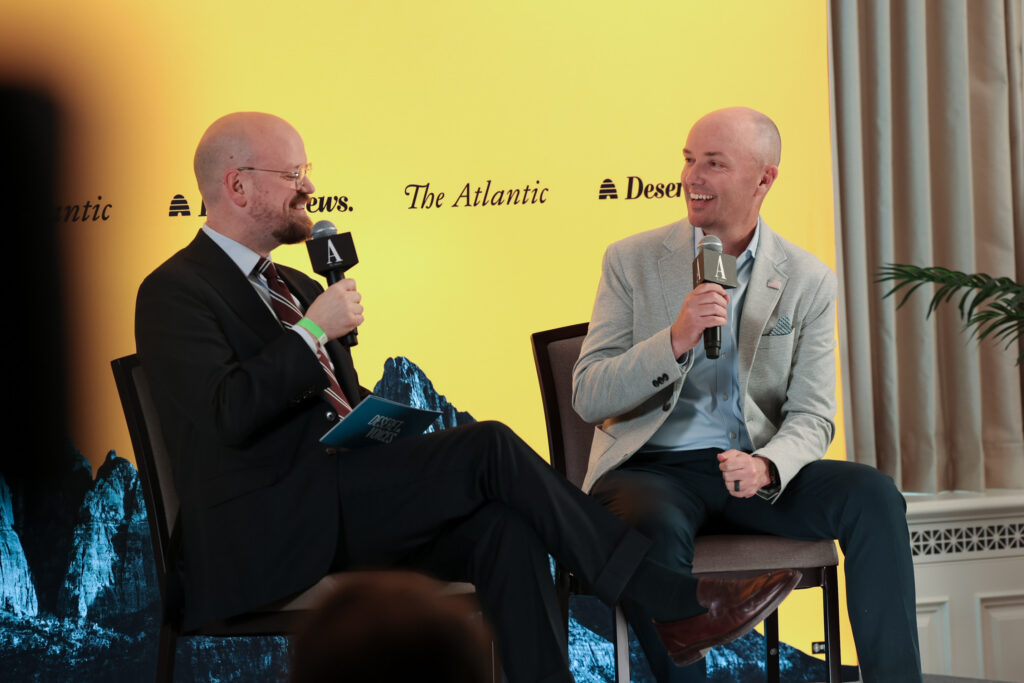

The Atlantic reporter McKay Coppins (left) and Utah Gov. Spencer Cox talk during an event hosted by The Atlantic and the Deseret News at the Joseph Smith Memorial Building in Salt Lake City on May 11, 2026. (Photo Courtesy of the Utah Governor’s Office)
When The Atlantic reporter McKay Coppins kicked off his on-stage conversation with Utah Gov. Spencer Cox on Monday, he started out with a joke asking the governor when he would be announcing his run for president.
Coppins, who also hosts a Deseret News podcast, pointed to Cox’s recently announced book, titled “Off Ramp: How to be a Peacemaker in An Age of Contempt” and quipped surely that must mean he’d be launching a bid for the White House “because that’s the only reason politicians write books.”
As he’s said before, a smiling Cox said he’s “obviously” not going to launch a presidential bid — noting that “literally the first line of the book is ‘I’m not running for president.’” Coppins, who repeatedly joked throughout his interview with Cox that a bid was imminent, said he “50% believes” the governor when he says he’s not going to run.
Cox’s book — focused on depolarization in politics — is based on an issue the governor said has been troubling him for more than a decade. “Contempt” in civic discourse has only gotten worse, he said, and he was spurred to finish the book after conservative activist Charlie Kirk was shot and killed at Utah Valley University eight months ago.
Since then Cox said there “certainly hasn’t” been “some grand awakening or unifying in our country,” but as he travels around the nation he’s sensed there are “pockets” where it’s changing, “and I’m more hopeful than I was nine months ago.”

“People are so tired. They really are exhausted,” Cox, a Republican, said, adding that there’s a growing sense of people feeling disconnected from both the Republican and Democratic parties.
Cox said the first party to figure out how to start catering to “normal” people again will be “wildly successful.”
“I think you’re going to see … a political party, I hope it’s my political party, that actually starts believing that there are some normal people out there and they want to make America normal again and just try to reach out to common sense middle America,” he said.
The interview, hosted by the Deseret News and The Atlantic for the outlet’s “Across America” tour at the Joseph Smith Memorial Building in Salt Lake City, spanned a wide variety of topics.
Among them was one of the biggest controversies Cox and other state leaders have seen in years — or maybe ever: the backlash over a proposal for a massive, 40,000-acre data center in Box Elder County.
Box Elder data center
At full scale, the project being sponsored by Kevin O’Leary, a celebrity investor featured in the reality TV hit “Shark Tank,” is expected to produce 9 gigawatts of energy — double of what the entire state consumes.
But last week, while responding to outrage, Cox posted a lengthy thread on X saying the public’s concerns are warranted, that the project will move forward in phases over the next 10-15 years, that the first phase is not to exceed 1.5 gigawatts of energy generation, and that future project permits “must be contingent on meeting clear metrics and expectations during this initial phase.”
‘I seek to do better,’ Cox says after heated comments on Box Elder County data center
Coppins, when asking Cox about the data center controversy, questioned why Cox would support a huge data center project while also being an outspoken critic against social media companies and unregulated artificial intelligence.
Before answering that question, however, Cox acknowledged the “tremendous amount of pushback” from Utahns and Box Elder residents, and he said “people are right to push back.”
The governor, in his posts on X last week, said his fiery comments during a news conference last month defending the project, didn’t “meet the expectations I have for myself. I seek to do better.”
Monday, he struck a collected tone, and said “we’re backing this way back, we’re focusing just on phase one, 1.5 gigawatts of power, only 1,000 acres of development. So really just right sizing this for this time because of the feedback we’ve gotten.”
In answer to Coppins’ question, Cox said even though social media and artificial intelligence has its problems, “this technology has the ability … to solve some of the world’s greatest problems.”
“The very things that we might need to save the Great Salt Lake, to cure cancer, to prevent China from winning this tech race … can come from these technologies,” he said. “You don’t stop the bad pieces of social media or artificial intelligence by saying you can’t build a data center (in Box Elder County). It’s going to be built somewhere else, if not (here).”
Like Utah legislators have tried to lead on regulating A.I. and social media, Cox said the state can “make sure that we’re building these data centers in the right places and in the right way so that we can do all the good things that can come from this.”
Cox also said there’s a national security interest in allowing large-scale data centers, saying he’s worried Americans don’t have “eyes as open as we should on this.” He pointed to a powerful — and potentially dangerous — A.I. tool known as Mythos developed by Anthropic, which The New York Times reported last month has triggered a global “scramble” because it’s “uncannily capable of finding and exploiting hidden flaws in the software that runs the world’s banks, power grids and governments.”
SUBSCRIBE: GET THE MORNING HEADLINES DELIVERED TO YOUR INBOX
Politico reported last week that several Chinese providers have recently stopped updating previously open A.I. models, potentially indicating that the companies are moving development into secrecy as they pursue a Mythos-like model.
“Mythos, for example,” Cox said. “If China had gotten that piece of technology first, that could exploit the vulnerabilities of almost every major company and government entity in our county, it’s over,” Cox said. “Like, we’re done folks. If China beats us to that, they lock us down and, I don’t know where we go from there. So there is a real national security piece of this that I think we have to understand, and we have to be a part of, and Utah is going to be part of those conversations.”
Coppins said he still empathizes “with the average American in a place like Box Elder County who feels like they have no say in this technology that, all of a sudden, … all the people in charge decided had to be shoved down their throats.” It’s an “arms race,” he said, that “nobody asked for.”
Cox said he not only hears that sentiment, “but I share it.”
“If it were up to me and I could snap my fingers and get rid of social media completely, get rid of smart phones completely, I would do it in a heart beat,” he said. “I would jettison every social media company into the sun if I could do that. But I can’t and I don’t get to make that decision.”
So now, he said, “I’m going to use the policy levers that I have to make sure that we have the right policies in place, that the government is working for us to make sure that we’re mitigating the problems, the downsides we see, while taking advantage of the upside we see.”