
Utah News Dispatch
‘I seek to do better,’ Cox says after heated comments on Box Elder County data center

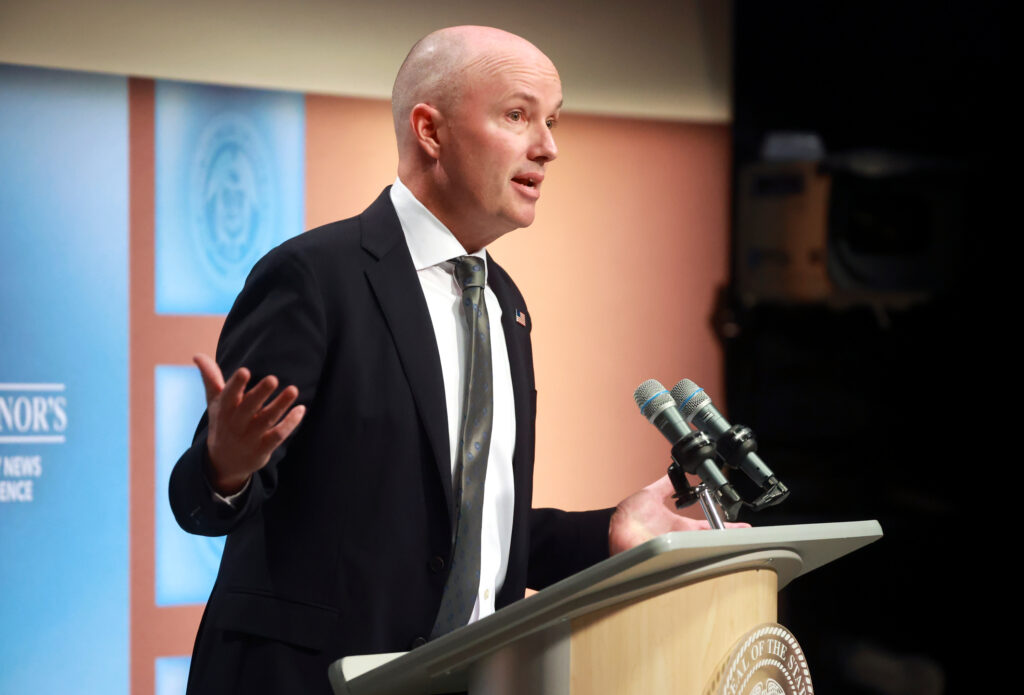

Gov. Spencer Cox speaks at the PBS Utah Governor’s Monthly News Conference at the Eccles Broadcast Center in Salt Lake City on Thursday, April 30, 2026. (Pool photo by Kristin Murphy/Deseret News)
After deep criticism over Gov. Spencer Cox’s past comments chastising opponents of a massive data center proposed in northern Utah, the governor made new accountability and environmental promises for the development — and said he’ll aim to live up to “disagree better” standards.
Thousands have actively protested the Stratos Project, a data center proposed on sites encompassing 40,000 acres of unincorporated Box Elder County land, arguing that the approval process led by the Military Installation Development Authority, or MIDA, has been too swift for its size. Now, after fiercely defending the project during his last regular news conference broadcast by PBS Utah, Cox vowed on a thread on X to do better.
“Utahns care deeply about our land, our water, our rural towns, and the future we leave to the next generation. Strong opinions are welcome. Healthy disagreement is part of good government,” Cox wrote. “But I know my own comments at a recent press conference did not meet the expectations I have for myself. I seek to do better.”
SUBSCRIBE: GET THE MORNING HEADLINES DELIVERED TO YOUR INBOX
During the news conference in late April, Cox said the state had an obligation to allow building data centers, arguing it was a matter of national security as China advances in the artificial intelligence space. He also disputed that the approval process had been rushed.
“I’m so tired of our country taking years to get stuff done. It’s the dumbest thing ever. We think that taking time makes things better or safer, it absolutely does not,” he said at the time. “You get a chance to give your feedback, and then decisions get made. That’s how we have to do stuff in this country and in this state.”
Massive Box Elder County data center could increase Utah’s carbon emissions by 50%
The governor’s latest comments come after officials tasked with the project’s approval faced explosive scrutiny this week. Box Elder County commissioners, who approved two resolutions waving in the development on Monday, have received death threats in the midst of the debate, according to KSL. And, there has been tension at the nursery owned by a MIDA board member after some in the community called to boycott the business, according to ABC4.
The project, sponsored by Kevin O’Leary, a celebrity investor featured in the reality TV hit “Shark Tank,” is expected to produce 9 gigawatts of energy — double of what the entire state consumes — to power its operations, and has applied to change the use of 1,900 acre-feet of water from irrigation to dedicate it to its power plant. But that application was withdrawn after thousands filed protests against the permit application citing several environmental concerns.
“Through all this, we cannot lose sight of our shared humanity. Public officials, community members, and project opponents — these people are our neighbors. Threats and personal attacks have no place in Utah,” Cox wrote Friday, adding that he believes “we can support economic strength while also protecting our land, air, water, and way of life.”

New promises
Utahns can expect clear standards and accountability on the project, Cox wrote while announcing actions the state is expected to take from now on and providing more details on how the center is planned to be developed.
The developer has agreed to work in phases, focusing proposals on phase one of the project “rather than focusing approvals on potential projects to be built 10-15 years down the road that could be as large as 9 GW,” Cox wrote. That first phase is not to exceed 1.5 gigawatts of energy generation and future project permits “must be contingent on meeting clear metrics and expectations during this initial phase.”
Hundreds cry out as Box Elder commissioners wave in massive data center
While the project has been explicitly tied to the Ruby natural gas pipeline, and MIDA officials have said the power plant envisioned for the project is meant to be fueled only by natural gas, the developers have now committed to pursue other resources, including renewables, energy storage and nuclear generation in addition to natural gas.
Phase one of the project will take less than 2,000 acres for the data center building, Cox said. Other operations, including the power plant and other infrastructure, can still be added during the initial stage. But, to add more to the data center building, the developer will need other approvals.
The project is also required to comply with state and federal air quality standards, water rights and other environmental reviews, the governor said. He also directed the Utah Department of Natural Resources to ensure the center uses “the most environmentally-sensitive cooling technology” to protect the ailing Great Salt Lake.
“I have requested that the project developer publish a publicly available water plan that demonstrates to Utah DNR officials that no degradation occurs to the Great Salt Lake,” he wrote. “All water use must be reported publicly, and in no event will the developer reduce water going to the Great Salt Lake.”
More information from the governor’s office can be found here.