
Utah News Dispatch
Why the Utah Cold War Victory Medal is a meaningful award


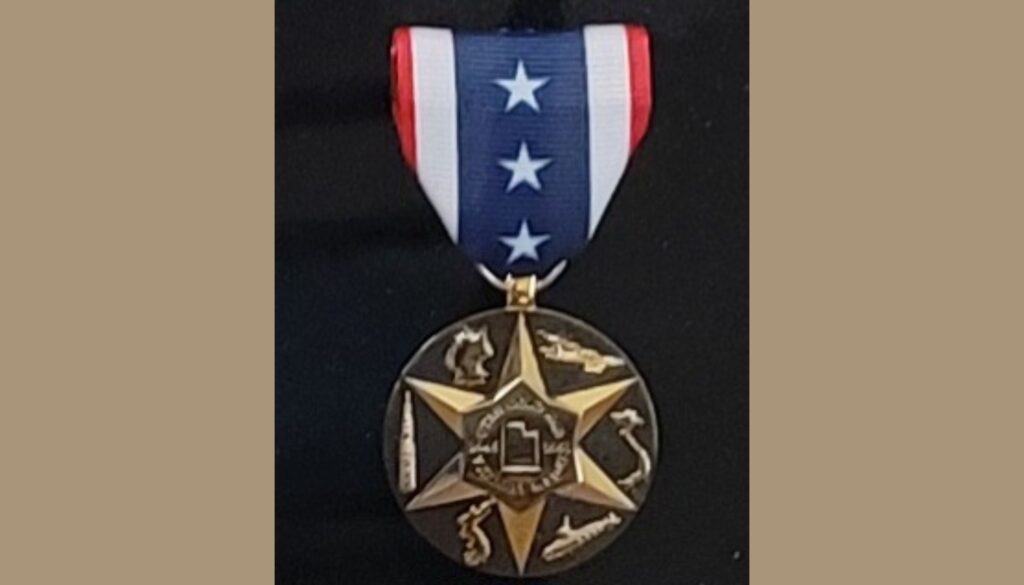


The Utah Cold War Victory Medal mounted in Nelson Thibault’s shadow box. (Photo courtesy of Nelson Thibault)
Utah Cold War Veterans Foundation pinning ceremonies always entail a certain degree of excitement. That emotional experience is thanks in part to passionate foundation members and what the Utah Cold War Victory Medal represents.
I decided to share this brief account for those in the Beehive State who know little or nothing about the Utah Cold War Veterans Foundation and the state’s Cold War Victory Medal.
Proudly and prominently displayed in a mahogany finished shadow box in my living room is a shiny gold Utah state medal awarded to me by the Utah Cold War Veterans Foundation a little over four years ago.
Flanked on either side by U.S. government medals, that special award is the Utah Cold War Victory Medal. Even though it’s a state-level award, that medal is no less meaningful to me than any of the other medals.
The significance of the Utah Cold War Victory Medal can be seen in the striking features of its symbolic design, including reminders of one of the most precarious eras in world history.
The more I have learned about the Utah Cold War Victory Medal over the past few years, the more my appreciation for it has increased. The award essentially filled a void that existed for more than a quarter of a century.
In 2001, both houses of the U.S. Congress passed legislation approving the creation of a medal to honor Cold War service and it was signed by President George W. Bush. The Department of Defense however, has yet to create such an award.
In the absence of a federal Cold War medal, a number of states have authorized the creation of the award. In 2017, Utah became the fourth state to do so. The medal was established by Utah HB220.
Three very insightful individuals designed the Utah Cold War Victory Medal and deserve a tremendous amount of credit for a fantastic job. Those individuals were Legionnaire Kent Blanco, VFW member Kraig Throne, and business owner Jon Brewer.
The colors of the medal’s ribbon represent the colors of Old Glory and the ribbon’s three stars symbolize the departments that comprise the U.S. Department of Defense — the department of the Army, the department of the Navy, and the department of the Air Force.
Centered in relief on the front of the medal is a star with six points, the outline of the Beehive State, the medal’s name, and the years 1945, when the Cold War began, and 1991, when the conflict came to its decisive end with the collapse of the Soviet Union.
In between the points of the star are images of key areas where conflicts occurred during the Cold War era (Germany, Korea and Vietnam), and components of the nuclear triad that helped deter nuclear war. Those include an intercontinental ballistic missile (ICBM), a B-52 bomber, and a nuclear-armed submarine.
Not long after the Utah Legislature created the medal, initial funding for the award ran out. To continue presenting the award to eligible veterans, a nonprofit organization called the Utah Cold War Veterans Alliance was established.
The Utah Cold War Veterans Alliance was founded by four individuals. They were Tom Montez, Kraig Throne, Jon Brewer and Larry Kerr. The organization eventually became the Utah Cold War Veterans Foundation with Larry Kerr as its chairman. Larry has remained in that position ever since.
I served in the U.S military at a time when America was on the brink of nuclear war with the Soviet Union. Subterranean silos with ICBMs were scattered around the country. Submarines armed with nuclear missiles patrolled the deep and B-52 bombers carrying nuclear bombs flew continuously in the sky.
These days, I am clearly reminded of that dangerous era each time I look at the gold-colored medal with Cold War symbolism and a red, white, and blue ribbon prominently displayed in my front room shadow box.