Utah News Dispatch
West-side Salt Lake City neighbors air fears of planned 1,300-bed homeless campus


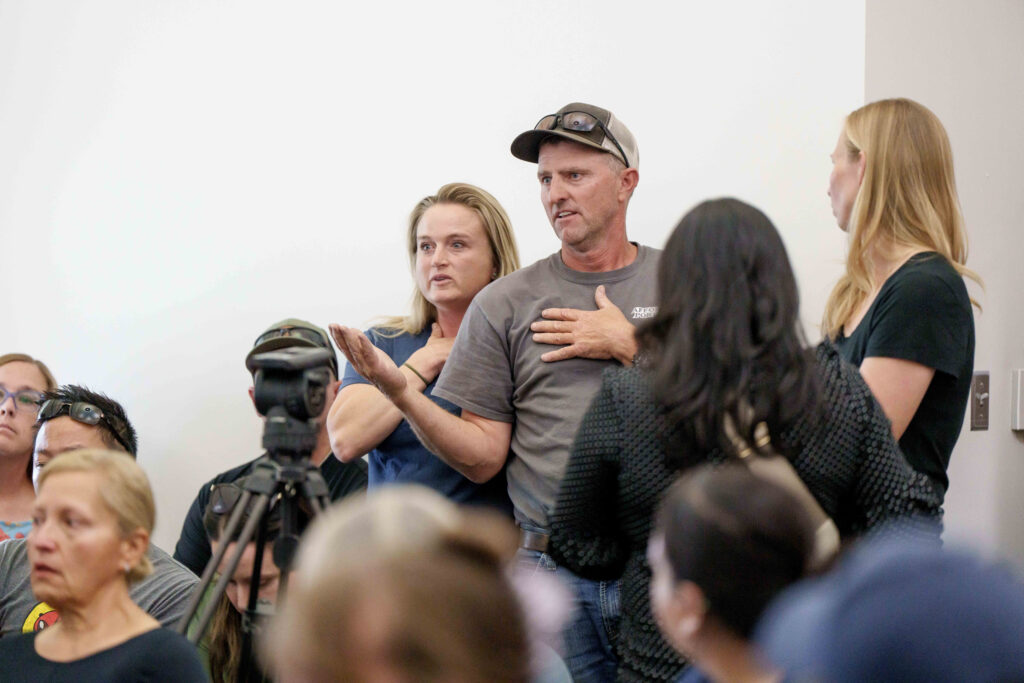


Nichole and Matt Solt, who are direct neighbors with the site of a newly announced homeless services campus, express their frustration and concern at a meeting with community members at the Day-Riverside Branch library in Salt Lake City on Wednesday, Sept. 3, 2025. (Photo by Spenser Heaps for Utah News Dispatch)
The evening after state leaders announced they had decided to build a 1,300-bed “transformative” homeless campus in northwest Salt Lake City, the community’s fear and anger was palpable.
About 100 people from west-side Salt Lake City crammed into a room at the Day-Riverside Library in Rose Park on Wednesday night, when state leaders listened to frustrations after they had already made the decision to purchase the property at 2520 N. 2200 West following a long, secretive search.
Nicole and Matt Solt — who live closest to the site of the future homeless campus on a nearly 3-acre farm directly north of the property along 2200 West — were first of the neighbors to speak out.
Utah officials unveil site for 1,300-bed homeless campus after long, secretive search
“I’ll be honest with you, if we knew this was coming, we would not have built such a beautiful barn a year ago,” Nicole Solt said, breaking down in tears while worrying that people experiencing homelessness would find it a “great location” to sleep.
Nicole said she and her kids check their horses in the dark, morning and night, before she trailed off, her voice straining with emotion, before her husband interjected angrily.
“Do you want me to send my wife out there every morning to feed my horses (with) Joe Blow laying there?” he said. “Sh-t’s going to go bad. You know it and I know it.”
‘We want to care for the vulnerable’
The Solts, along with dozens of other neighbors, grilled State Homeless Coordinator Wayne Niederhauser and the state’s Homeless Services Board Chair Randy Shumway on why they thought it was a good idea to put the campus in a fairly remote location with little to no public transportation or other services.
Niederhauser and Shumway said no location is perfect, but it was the best available parcel they could find after more than a year of searching that was the right size for the envisioned campus, which they have described as key to not only increase the state’s strained emergency shelter capacity but also transform the state’s homeless services system to be more “healing” but also “accountable.”
Shumway said it’s fair for the neighborhood to be angry, but he guessed that “a lot of your fear” and anger comes from questions around whether the campus will be “a place that’s helping people or … a place that’s permissive and allows absolute lawlessness in our community.” He said “we have got to prevent” the latter scenario.

“We want to care for the vulnerable. We need to have a place of healing and rescue. But simultaneously, we also have to be tremendous neighbors,” Shumway said.
Most of the neighbors’ concerns centered around the future homeless campus’ impact on property values and neighborhood safety.
“There’s no security out there,” said Nicole Green, who lives off of 2200 West, adding that she already fears for her 10-year-old daughter’s safety because of people speeding down the street.
Tears rolling down her face, Green urged state leaders to prioritize security “for all of us, not just them,” especially if people experiencing homelessness end up on their properties.
“We all go outside at night to check our animals,” she said. “Is that just not an option anymore?”
Niederhauser and Shumway tried repeatedly to emphasize that safety and security will be a top priority for the campus, which they envision as a facility different from any other homeless shelter so far built in Utah.
They described it as a secure, fenced off campus where people experiencing homelessness won’t want or need to leave because all of their services — including mental health, substance abuse treatment, and medical — will be provided on site.

“We have got to do it differently and better and take into account your safety over everything else,” Shumway said.
“Our priority is that they would exit and enter by shuttle,” Niederhauser said. “Our whole design is that we want to give reasons to stay on campus. That’s the whole idea.”
But for neighbors, more questions than answers — and skepticism — remained by the end of the hourlong meeting, though Niederhauser promised there would be more community meetings in coming weeks and months to field comments, questions and complaints.
‘I should have violated closed session law’
Several neighbors questioned why they learned of the decision early Wednesday only after it had already been made. Green said she found out about it while at work in the middle of the day.
“What the hell is that?” she said.
As state officials have said before while declining to reveal what properties Niederhauser and his team had been considering, Shumway cited privacy considerations for real estate transactions.
“By law there was confidentiality that all of us had to maintain until 7 a.m. this morning,” Shumway said. “By law.”
But one city leader expressed regret for not telling people sooner, even if it would have broken the law.

Her voice straining with emotion, Salt Lake City Councilmember Victoria Petro — who was in closed-door meetings regarding that real estate contract between Salt Lake City and the state — apologized to neighbors that “I didn’t violate closed session rules to get you information so that your voice could be heard.”
“I’m sorry. I should have violated closed session law. I should have taken the misdemeanor,” Petro said. “I should have told you.”
Bobby Taylor, another resident who lives off of 2200 West, called building a campus near a remote, agricultural neighborhood a “horrible idea.”
“Crime’s going to go up. The drug dealers are going to follow them. We’re all going to lose our property values,” Taylor said.
SUBSCRIBE: GET THE MORNING HEADLINES DELIVERED TO YOUR INBOX
He said the state will be putting “people that do not subscribe to the social contract we all do” with people who just “want to be left alone.”
“If we are going to endure this thing that nobody wants for obvious reasons, there ought to be some things that we can ask for, like waiving property tax within a certain radius,” he said.
Another neighbor asked if the city would consider allowing residents “the opportunity to streamline their zoning” to manufacturing — since the area has already been trending in that direction as more warehouses are being built — so they can “get out” before the campus is built.
Petro said city leaders hadn’t considered that, but it’s something she’s willing to explore.
West-side burdens
As emotions ran high at the onset of the meeting, Petro told her constituents that they were right to be angry, especially because she said west-side Salt Lake City already carries beyond its fair share of social services — like the prison and other homeless facilities — and environmental concerns from the Utah Inland Port Authority.
“It is not just this instance that’s causing you to be angry (or) me to be angry,” she said. “It is the years of disregard. It is the fact that they’re turning us into 1970s Newark, New Jersey, with smoke stacks and tenements. … We don’t have enough grocery stores and we don’t have amenities that we can walk to. And no one’s going to want to do business if we keep consolidating poverty and chasing away industry.”
“So your anger is right,” Petro added. “But the other truth I know about you is that you’re the most resilient community on the planet. I’ve literally chosen to raise my kids here among you because of who you are. … We are a community that accepts every challenge with grace and resilience.”

While Salt Lake City Mayor Erin Mendenhall — who has been urging state leaders to act quickly to expand the state’s homeless shelter capacity and other services — said in a statement she supported the homeless campus site, Petro said she will “not even come close” to supporting it until “there is a real strategy” to fully fund and operate the campus safely and effectively.
She especially took issue with Shumway for blaming Salt Lake City for “permissive” policies that he said has allowed “lawlessness” in parts of the city.
“I want real evidence-based solutions, not culture war solutions,” she said. “And when those solutions are identified, there has to be (adequate) funding.”
Top Republican leaders are supportive, but will lawmakers fully fund it?
Niederhauser told Utah News Dispatch he expects it will take roughly $75 million in one-time money to build the campus’ infrastructure, then “north of $30 million” a year to operate it.
Niederhauser’s office last year got about $24 million to purchase land and start building the campus, but he acknowledged it will be a “heavy lift” to lobby the 2026 Utah Legislature for more funding, while also engaging with other private funders. But that’s something he’ll be working on.
One of Utah’s top Republican legislative leaders, House Speaker Mike Schultz, R-Hooper, issued a statement Wednesday expressing gratitude for Niederhauser’s “exhaustive efforts to secure land” for the campus.
“To succeed, this new campus must offer more than just shelter; it must deliver real accountability through treatment, recovery, and long-term stability, or it will fail like every half-measure before it,” Schultz said. “If done correctly, this transformative campus has the opportunity to improve public safety, clean up our cities, and change lives.”
Schultz also said he plans to work with the Utah Homeless Services Board to take “full advantage” of President Donald Trump’s recent executive order that upended the federal government’s support for “Housing First” policies.
While national homelessness advocates say Housing First is a proven approach to help end homelessness by prioritizing housing as an essential need first, Schultz said Trump’s executive order “squarely aligns federal agencies with Utah’s focus on public safety, support, and accountability.”
This new campus will be a place where law enforcement, service providers, and local leaders work together to ensure safety and accountability, both inside the center and in the surrounding neighborhoods. Shelter alone is not enough; we must pair it with treatment, recovery, and a…
— Governor Cox (@GovCox) September 4, 2025
Schultz said that could also include “exploring opportunities to reprioritize existing resources to improve public safety and achieve lasting outcomes.”
Utah Gov. Spencer Cox also issued a statement Wednesday expressing support for the campus, calling it a “place where law enforcement, service providers, and local leaders will work together to ensure safety and accountability, both inside the center and in the surrounding neighborhoods.”
“Shelter alone is not enough; we must pair it with treatment, recovery, and a path to long-term stability,” Cox said. “By engaging the public throughout this process, we can build a system that improves safety, restores order, and helps people rebuild their lives.”