Utah News Dispatch
Utah and Idaho’s dispute over gas tax may fizzle with new bill to lower fuel prices


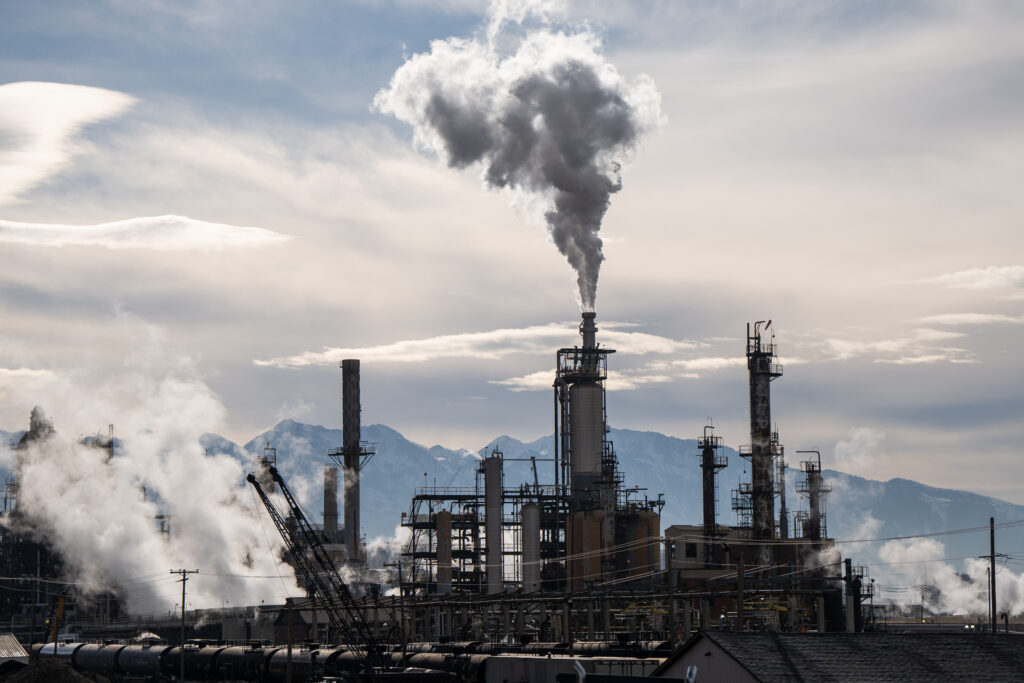


Marathon Petroleum Company’s Salt Lake City Refinery in Salt Lake City is pictured on Wednesday, Jan. 3, 2024. (Photo by Spenser Heaps for Utah News Dispatch)
The interstate dispute over a potential restructure of Utah’s gas tax may be close to an end now that the Utah Legislature has rerouted its plans. However, legislative leaders still hope Utahns will see fuel taxes decreasing by about 10% to 15% at the pump.
It was initially drafted to remove a longstanding tax exemption for refineries exporting gas out of the state, but after much controversy and public statements coming from the Idaho Legislature, the bill sponsored by Draper Republican Rep. Cal Roberts ended up becoming a proposal tackling gas supply.
“The issue in the market is that you’ve had California Democrats regulate refineries out of existence,” Roberts told reporters on Tuesday, arguing that while Utah has increased fuel production by 20%, West Coast states have lowered theirs by 10%, putting pressure on Utah prices.
SUBSCRIBE: GET THE MORNING HEADLINES DELIVERED TO YOUR INBOX
His bill, Roberts said, would help streamline processes to increase fuel supply in the state by either bringing more pipelines to Utah with fast-tracked timelines, or working with refineries to expand their manufacturing capacity. It is scheduled to be heard by the House Revenue and Taxation Committee on Wednesday.
More details on the state’s plan to lower gas prices will come through other companion bills and future announcements from industry leaders about their commitments to increasing supply, Roberts said.
Utah is proposing a gas tax restructure — Idahoans and petroleum industry aren’t having it
However, House Speaker Mike Schultz, R-Hooper, hinted at how the process may work. A Grand County pipeline from Enterprise Products, a gas and oil company, could, for example, operate to its full capacity of 50,000 barrels a day instead of keeping its current production of 18,000 barrels per day, he said.
“If we can get an additional 30,000 barrels in that pipeline over what is there today and get it right into the Wasatch Front, that has the ability to drop gas prices significantly for the state of Utah,” Schultz said.
Industry players could also look into expanding their storage space during lower-demand months in the winter.
Short-term tax cut
The bill would also establish a temporary gas tax reduction for fuel sold in the state, lowering it just for this year from the current $0.379 per gallon to $0.319 per gallon, a more than 15% reduction, beginning on July 1 and ending on Dec. 31. Schultz described it as “a temporary fix for a long-term solution.”
The state is expected to propose using $10 million to $12 million from its general fund to cover the gap until the long-term supply solutions come in.
“Think of it as like a short-term bridge, a 15% cut in the gas tax to get us to a short-term bridge, where you’ll see the gas tax level out somewhere between 10% to 15% cut for Utahns starting next year,” Roberts said.
It’s a win-win situation, Schultz said, especially after Idaho House Speaker Mike Moyle proposed a joint memorial opposing the legislation that Schultz had been promoting since last summer. Moyle went as far as to suggest southeastern Idaho could stop sending water to the ailing Great Salt Lake to put pressure on Utah, according to a report from FOX 13 and Idaho News 6.
It has become an issue where even Utah Gov. Spencer Cox has had to chime in.
“We’ve been very engaged with our legislative partners as well, and I remain very hopeful and optimistic that we will land that bill in a place where we can all be friends and do what’s good for the people of Utah and good for the people of Idaho and the western United States as well,” Cox said in a news conference last Thursday.
Increasing supply may not be an ideal scenario for oil companies, which would see lower prices for their products, Schultz said, but it was a compromise.
“Is it in the oil companies’ business model to pay a tax at the production? It’s not,” he said. “But yet, that’s what we talked about in order to force a compromise to where we can get a win-win- win solution.”
While Schultz maintains he disagrees with Idaho on whether or not the original Utah policy would raise gas prices for its neighbor, he said, “you have to get something to get people to the table.”
Ultimately, the gas tax bill debate opened up some other water conversations with Idaho. But more details will be made public next week, Schultz said.