
Utah News Dispatch
Outgoing Senate president reflects on his loss and the future — for himself and the Legislature

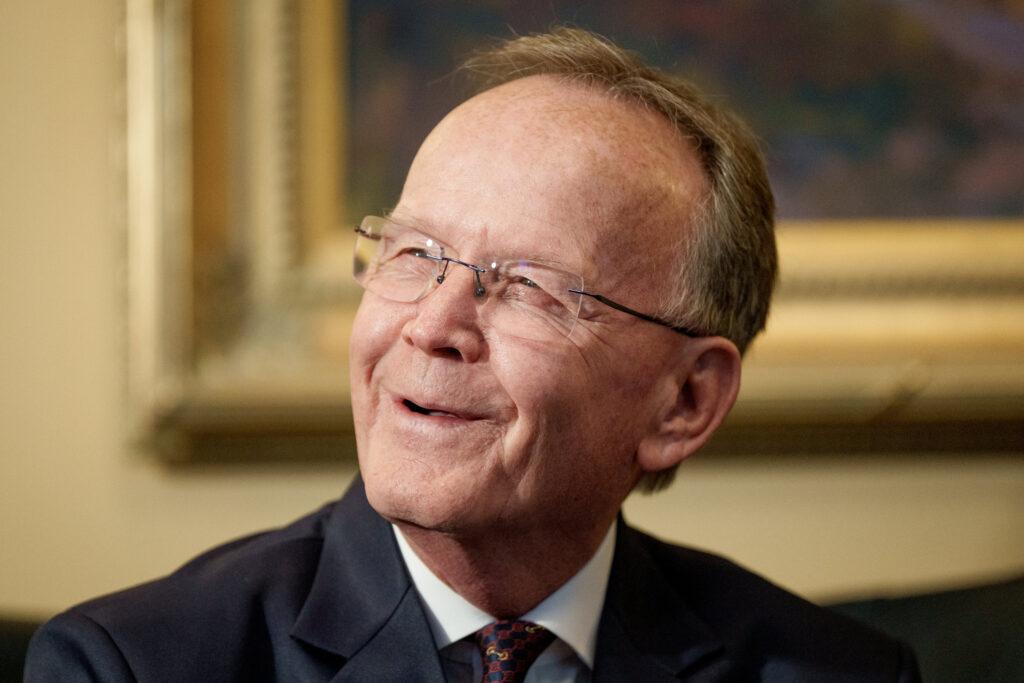

Senate President Stuart Adams, R-Layton, speaks during a media availability with senate leadership at the Capitol in Salt Lake City on the first day of the legislative session, Tuesday, Jan. 20, 2026. (Photo by Spenser Heaps for Utah News Dispatch)
After eight years as serving as one of Utah’s most powerful Republican state leaders, Utah Senate President Stuart Adams unexpectedly lost his primary.
After the upcoming November election, Utah Senate Republicans will hold a closed-door caucus meeting to vote on who will take Adams’ place.
In a recent interview with Utah News Dispatch, Adams reflected on his time as president, his primary loss and his message to Senate Republicans as he prepares to exit.
A transcript of the interview is included below, edited for length and clarity:
Q: As you reflect back on your presidency, what do you feel like were your biggest accomplishments, and is there anything you would have done differently or that you regret?
For 19th year, Utah ranks No. 1 in nation for economic outlook
Adams: “Well there’s too many to list. But one thing that I do feel good about is I’ve given it everything. There hasn’t been anything I’ve left on the playing field. I’ve given all my effort, and I’ve worked really hard to try to do the very best job that I could. And I feel extremely good about my service. It’s amazing what we’ve been able to accomplish.”
He pointed to Utah’s high economic rankings, including on household income and starting teacher pay, as evidence that he’s leaving Utah at a high point.
“I’m really proud of that service. … I’ve said it over and over again, America is the best country in the world, we’re the hope of the world. And Utah is, without any question, we’ve raised it to the best state in the nation, so I’m very happy.”
Q: Is there anything you would have done differently or that you regret?
Adams: “You know, twenty-twenty hindsight is always there, I’d do a lot of things differently as you learn new information, but in the moment, no, we gave it everything we could. We made the very best decisions. I’d go back and change a few things, but that would simply be twenty-twenty hindsight. I’ve made plenty of mistakes … but that’s what we do in the Legislature. Every year we fine-tune corrections and we keep making sure that we make the best decisions we can as we gain more information. So I’m not going to go back and second-guess mistakes.”
Q: Any examples?
Adams: “You know, back in 2015, we ran the Utah Compromise, the Fairness for All (legislation to guard against LGBTQ+ discrimination while also preserving religious freedoms). I don’t like it called ‘Utah Compromise’ because my deep-seated religious beliefs are not compromisable. But we gave protections to both the LGBTQ+ and the religious organizations. Could it have been done better? Maybe. But that I think has gone through the test of time and it’s done very well.”
Stuart Adams is out: Utah Senate president concedes to Republican challenger
Adams also pointed to other accomplishments like cutting income taxes six years in a row, increasing teacher salaries, investments in infrastructure including FrontRunner and highways, efforts to save the shrinking Great Salt Lake, and efforts to put Utah on the global map for critical mineral resources.
“So we’re solving not only the local problems, but Utah is solving world, international problems with critical minerals, with energy development. You know, I don’t think there’s another state in the nation, there may not be another spot in the world that has been so fortunate. And I’ve got to be Senate president through a lot of this. And I pinch myself sometimes at some of the situations I’ve been put in, and it’s been a real honor to serve.”
“To be elected by my colleagues for eight years in a row is a long time, and I just am so honored that they would think enough of me to elect me as their Senate president.”
Q: How are you feeling after your primary and have you been reflecting on reasons you lost?
Adams: “You know, I think there’s nothing that happens by chance and there’s always a reason. And I’m not done. I’ve got a future outside the Legislature, and I look forward to that. I don’t know what it is, and I’m not predicting anything. But when you leave at the top of your game, there’s probably not a better time to leave.”
Q: I talked with a political science professor to offer an observer’s standpoint, and he characterized you as a “strong” Senate president, both in the sense of capability and in heavy handedness. What are your thoughts on that?
Unpacking Utah’s primary upsets: The race that’s sending ‘shockwaves’ through the Legislature
Adams: “I’ve heard a little bit of that … and I would say this, OK? The process up here has been built to try to focus on issues and not on people. So when I get attacks made against me from people or when I get attacks made on other senators, my job has been to try to downplay that and make sure that people focus on the issues and don’t attack each other. So when somebody attacks someone else, sometimes there have been things that the caucus — both minority and majority caucus — have asked me to do as Senate president to try to maintain civility. And I’m really proud of that. And if it’s taken a little bit of courage to try to lead and try to maintain civility, that’s been my goal, is to try to keep civility.”
“And those that may attack me right now, I understand they’d rather attack someone than attack the issues, but my focus has been on attacking issues, and not people. And I try to make sure that anything that we’ve done to try to correct people’s actions has been to keep people from attacking each other, to make sure we focus on the issues.”
Q: This professor also made the observation that you were pretty active in asserting the Legislature’s power when it came to pushing back against other branches of government, whether it was the governor or the judiciary. When I talked with Sen. Scott Sandall, he saw it differently. He said he saw you as more of a “defender” when other branches crossed the lines. What are your thoughts on that observation?
Adams: “I have great respect. I’ve served with multiple governors. … And we’ve had great relationships. And we’ve always been respectful of one another. And I have great respect for the (Utah) Supreme Court … I want to make clear that I’m very disappointed in their alter or reform ruling (on ballot initiatives). I believe they got it wrong, OK, there’s no question about that. But I have great, deep respect for especially Chief Justice (Matthew) Durrant and all the justices. I believe they’re well-meaning. But that doesn’t mean we can’t have differences.”
End of the Adams era: A look at Utah’s outgoing Senate president and what’s next
“I would say I agree with Sen. Sandall that I’ve been trying to defend both their independence … of the executive and the legislative branch and the judicial branch. But we’re going to make sure that our founding fathers’ principles stay in place. … And I feel sorry, sometimes, for other branches of government that they don’t get to see this miraculous, difficult process of bringing 104 people together in setting policy. But I feel sorry that they’re alone sometimes and they don’t have the broad-based influence of public hearings and public input, input from other legislators. It’s really important that policy be made on a collective basis by a large group of elected officials to make sure there aren’t unintended consequences.”
“I’ve said it over and over again, that my ideas I think are really good … but I haven’t had one of my ideas, not one, that hasn’t gotten better by going through the legislative process, being beat up by both legislators, the public … and my ideas only get better. And the other branches don’t have that capacity. So I’m a big advocate of policy. … Judges should not legislate from the bench. And the governor should not do executive orders. That it’s our role to set policy.”
“I think I’ve defended the governor’s executive branch role, and I defended the judiciary’s role, but I’ve also defended the legislative role. And I think we’ve got a good balance in Utah because we seem to generally get along.”
Q: This professor also thought during your time as Senate president there are cases where you “overstepped,” like with tax reform or ballot initiatives like Proposition 4, in ways that were “problematic” for the Legislature and that could have been part of the reason you lost, because maybe you became disconnected and voters felt like you were no longer listening to them. Any thoughts about that?
Adams: “First of all, that’s part of the process, and the process works well. As we go through the process, we have representative government. We make our decisions and then they get vetted by the public. That’s certainly part of the process.”
“As for my election, I will just say this: I’ve never experienced such a broad effort of false attacks in my life, and I’m not sure where those false attacks come from. But I’ve never experienced anything like that before. And I think we need to be careful in Utah when you have dark money coming in, attacking people with inaccurate stories. I’m not sure why that happened. But I don’t think it had to do with policy decisions. I’m not sure why it came in.”
“But I stand by the policies we’ve passed, and again I think it’s been reflective of the fact that we’re the best economy and the best state in the nation. So I’m not sure why those have come in, but I believe when you see false attacks come in, they ought to be raising flags in people’s minds as to why someone would say something that’s not true about someone else. … I found very little policy debate in my election. I found a lot of personality attacks. And I was really disappointed in that. … We should have been more focused on policy than personalities, and I’m not sure why that happened.”
Q: While some lawmakers applaud your style as effective and collaborative, others have said you “stifle the process” by holding up bills or taking away committee assignments. What’s your response to your critics about your style or how you operated?
Adams: “Criticisms of me are reflective of how they treated their colleagues. The process up here is not meant to criticize each other. The process is meant to criticize the issues.”
“I would never move somebody out of their committee assignment because of how they voted. If I did that, no one would have a committee assignment. But when somebody attacks someone else or violates an ethical event, as Senate president it’s up to me to maintain decorum. And when I do things that are directed by both, sometimes the minority leader … and the caucus, to try to maintain decorum, at times you have a couple of people who are critical not only of me but other people. That is not the way we do business. … We don’t talk about each other, we talk about issues.”
Q: Sen. Evan Vickers, he’s made no secret that he wants to be the next Senate president. He said he thinks he would differ from you in the sense that he’d be more of a delegator while he characterized you as, quote, “a bit more controlling.” How would you characterize your own style as Senate president?
Why Sen. Evan Vickers, of southern Utah, wants to be the state’s next Senate president
Adams: “I’ve been very collaborative. You actually don’t function up here unless you’re a collaborative individual. I couldn’t be Senate President if I weren’t collaborative. Now, if controlling means that I try to maintain decorum or if I’ve tried to maintain civility or I’ve tried to make sure that people don’t attack one another, then yes, probably that is true. But my efforts have been trying to maintain decorum and keep people from attacking each other.”
“But nobody would pass a single piece of legislation up here if they’re not collaborative, and no one passes anything on their own. No one survives up here if they aren’t collaborative and work with other people.”
“I’ve tried my very, very best to try to represent the caucus and make sure that we maintain decorum and try to keep people from attacking one another. … I think we’ve been mostly successful with perhaps the exception of one or two people.”
Q: Do you have a preference for who should be the next Senate president?
Adams: “I’m going to let the process work. … I feel bad for anybody that tries to set policy alone. If you ever try to set policy alone, you’re going to make some big mistakes. We even make mistakes on a collective basis as a Legislature, but our policies are significantly better because we have 104 people involved, we try to involve the public, we try to involve stakeholders to set policy.”
“Now you’re going to see a new Senate president involved, and that Senate president is going to be elected, and because he’s elected, I have confidence in our caucus that they’ll pick the very, very best person. … I believe the next Senate president will continue to lead Utah and will continue to be a force around the nation and the world. Whoever the Senate president is going to be, it’s going to be a very, very capable person.”
“I have immense confidence in the process, and whoever the next Senate president is, it will be somebody that is great.”
Q: As the Senate GOP grapples with this upcoming change, what’s your message to the caucus as you exit?
Adams: “Utah is on an upwards trajectory, and just keep us going. And I have confidence that we’ll continue to lead the nation and make sure that the citizens of Utah have as much policy driven opportunities, freedoms, economic ability, economic opportunities, and socially maintain an environment where our children can thrive and have a great social experience.”
“We’re the best spot in the nation. We recreate, we have all kinds of opportunities. Everybody wants to come to Utah … let’s make sure that Utah stays the best spot to raise a family.”
Q: What’s next for you? Do you plan to serve in another capacity? Do you still plan to serve on the Military Development Installation Authority board?
Adams: “Well, you know, I like to ski with my grandkids, and I can tell you that’s what I’ll be doing. Other than that, I’m not sure. If I find out, I’ll let you know. The only thing that’s for sure for me is I’m going to go ski with my grandkids.”