Utah News Dispatch
New plan for Colorado River is still murky as states pass by early deadline


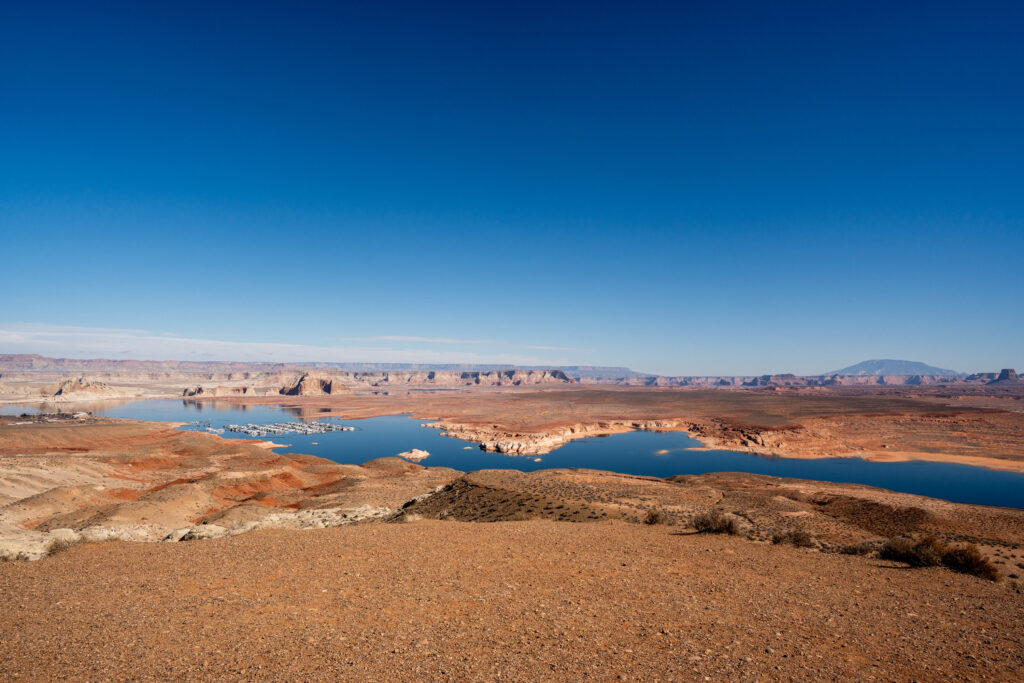


Lake Powell and the Wahweap Marina are pictured near Page, Arizona on Sunday, Feb. 2, 2025. (Photo by Spenser Heaps for Utah News Dispatch)
Utahns hoping for clarity on the government’s next move to keep the Colorado River from drying up and still supply plenty of water to the state will have to wait.
Utah and six other states along the parched river haven’t reached a deal on how they’ll share the water supply a year from now, but they agree enough to keep talking. That progress means they don’t have to turn the job over to the federal government yet, Utah’s negotiator said Wednesday.
A century-old compact governs use of the river based on flows that have dwindled during decades of overuse, drought and climate change. The river provides 27% of Utah’s water.
“The question is, how do you divide a pie that’s significantly smaller than it has been, when everybody is used to getting that big piece of the pie?” said Gene Shawcroft, Utah’s Colorado River commissioner.
The federal government set a Nov. 11 deadline for a broad agreement, but gave the states approval to keep talking as they work toward a February cutoff to reach a firm deal, Shawcroft told reporters in a brief conference call.
He reiterated the states are on the same page about ensuring the river’s “long-term sustainability and resilience.” He did not share specifics on any consensus they’ve reached for how they’ll get there.


“We have agreed on a number of things that allow us to continue to work together,” Shawcroft said. “The details, we’re still working out.”
In months of negotiations, the upstream states — Utah, Colorado and Wyoming — have stood their ground against a new system that would include mandatory cuts in dry years. Shawcroft indicated they still aren’t budging.
“In the Upper Basin, mandatory reductions are something that we don’t feel is necessary,” he said.
The Lower Basin states of Nevada, Arizona and California typically use almost all of their allocated water, while the Upper Basin does not. The downstream states have said if cuts aren’t shared across all seven in the new plan, the reductions they face may be too big to absorb.
In Shawcroft’s view, negotiators did not miss a deadline because they have enough accord to satisfy the federal government. But seven conservation and recreation groups say they wanted more from Tuesday’s milestone and they’re “deeply disappointed.”
SUPPORT: YOU MAKE OUR WORK POSSIBLE
“Without a clear operating framework, the basin remains exposed to escalating risks — from declining storage in lakes Powell and Mead to deepening uncertainty about how the system will respond to hydrologic extremes,” The Nature Conservancy, National Audubon Society and others said in a joint statement. “Every month without alignment makes it harder to stabilize the river and protect the people, economies, and ecosystems that depend on it.”
The groups called on the US. Department of the Interior and its Bureau of Reclamation, which oversees water in the West and is working with the states, to “lead with urgency and resolve.”


Negotiators are meeting every week, Shawcroft said. They’re still working out how reservoirs including Flaming Gorge on the Utah-Wyoming border will be managed.
Over the summer, they considered a new way of dividing the river based on how much water would flow in the basins if humans never dammed it or funneled it away for cities, farms and other uses. But the “natural flow” plan hit a wall.
“We couldn’t come to agreement,” Shawcroft said. “Concepts, however, of the natural flow, will likely be included in where we go from here.”
He noted the Central Utah project, which pipes Colorado River water to cities and farms on the Wasatch Front, is a junior user, meaning it’s among the first in line to absorb cuts in a shortage.
Shawcroft said the state has to be judicious when the water runs low and compensating farmers to conserve water can help.