
Utah News Dispatch
In Utah redistricting case, judge explains why she ruled against Legislature


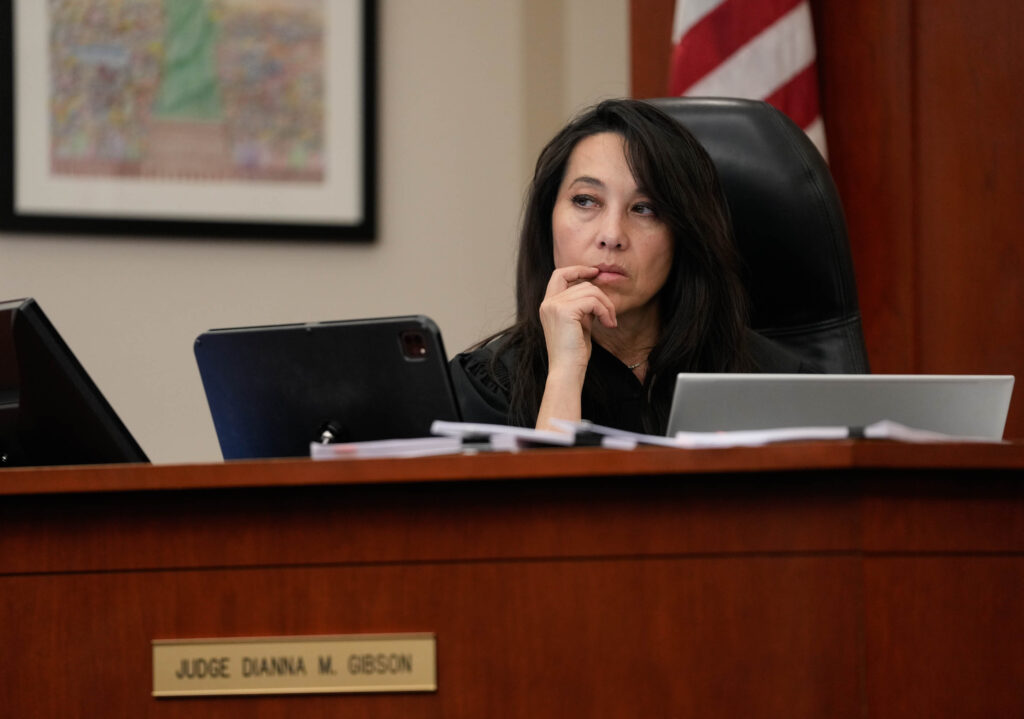


Third District Judge Dianna Gibson listens during a hearing in Utah’s court-ordered redistricting process, in Salt Lake City on Thursday, Oct. 23, 2025. (Pool photo by Francisco Kjolseth/The Salt Lake Tribune)
The Utah judge who has caught the ire of many Utah Republican lawmakers for her repeated rulings against them in the state’s yearslong redistricting legal battle issued a legal analysis Friday explaining why she has denied lawmakers’ request to push pause on the state’s new court-ordered congressional map.
In her 11-page decision, 3rd District Judge Dianna Gibson wrote she rejected the Utah Legislature’s preferred map C because it not only failed to adhere to neutral map-drawing criteria under Proposition 4 (a 2018 voter-approved ballot initiative that created an independent redistricting process) to the greatest extent practicable, but also because it was drawn with political data — which is also a violation of Proposition 4.
In redistricting fight, Utah Republican lawmakers will appeal to Utah Supreme Court
“The undisputed evidence presented in this case showed that the Legislative Defendants’ own expert, Dr. Sean Trende, exclusively used (Dave’s Redistricting Application) when he was drawing Map C and that partisan data was displayed on the screen during the map-drawing process,” Gibson wrote.
“Even by the Legislature’s own professed standards and course of conduct Map C should have been rejected by the Legislative Redistricting Committee because Dr. Trende used DRA to create it,” she continued, adding that “none of these facts were disputed during the evidentiary hearings” and that the Legislature’s attorneys “failed to show that the Court clearly erred in making these findings.”
Ultimately, Gibson found the Legislature’s map C — which would have created four safe Republican districts — was an “extreme partisan gerrymander” that violated Proposition 4 by “both unduly and purposefully favoring” the Republican party “at the expense of minority voters,” Democrats.
“The Legislative Defendants fail to address, let alone show, that the Court erred in making these findings,” she wrote.
Gibson also wrote that the Legislature’s requests — both for a stay on the new congressional map and requests for Gibson to reconsider all of her previous rulings — were “procedurally improper.”


“They argue this relief is justified because the Court’s previous rulings are unconstitutional, they have effectively been denied the opportunity to appeal, and the Court has no authority over the remedial process,” she wrote, but she rejected those arguments for multiple reasons.
Among them was that when the Legislature failed to enact a map that complied with Proposition 4, Gibson “was required to consider the only other maps submitted to the court — those submitted by the plaintiffs — and determine if they comply with Proposition 4.”
The judge ultimately decided that the plaintiffs’ Map 1, which creates a Democratic-leaning district in the northern part of Salt Lake County, best complied with Proposition 4’s criteria.
Court’s authority to pick a map ‘rooted firmly in the law’
Gibson wrote that the court’s “authority to adopt a lawful congressional map — where the Legislature’s Map C fails to comply with Proposition 4 — is rooted firmly in the law.”
After previously agreeing to participate in the court-ordered process, the Legislature “cannot now assert that the Court lacked authority to preside over the remedial proceedings.”
“Now, for the first time and despite the plain language of the stipulation that contemplates this exact possibility, the Legislative Defendants contend that this Court only had the authority to enjoin Map C, but not to adopt a remedial,” Gibson wrote.
Redistricting ruling: Utah judge picks plaintiffs’ congressional map, blocks Legislature’s
The judge asserted that the court-ordered congressional map “does not exceed the ordinary bounds of judicial review and does not violate separation of powers,” as lawmakers have repeatedly argued.
She pointed to the previous U.S. Supreme Court rulings and proceedings in other states like Florida that have selected and affirmed remedial maps proposed by plaintiffs after the state legislature’s maps were found to violate the state’s ban on partisan favoritism.
“While a state court’s role in redistricting is new to Utah, this judicial function is neither new nor novel,” Gibson wrote. “It is well settled that when the political branches fail to enact lawful electoral maps, the judiciary’s duty to provide an effective remedy is not discretionary.”
Instead, Gibson wrote the courts “have a fundamental obligation to uphold constitutional rights and to ensure a lawful electoral map is in place, including by adopting one proposed by a party in the proceedings.”
“This authority is firmly rooted in both federal and state court precedent,” she wrote. “Without the court’s remedial power, the right to vote could be rendered illusory and the constitutional guarantee of free and lawful elections would go unfulfilled.”
Allegations that timing was intentional are ‘unfounded,’ judge says
In her analysis, Gibson also addressed lawmakers’ public criticisms of her handling of the case — including allegations that the timing of her ruling (which came at 11:41 p.m. on the last possible day state elections officials had set to choose a new congressional map, Nov. 10) was intentional to undermine lawmakers’ ability to appeal.
“Any suggestion that this Court delayed issuing any ruling to force compliance with the remedial process or to preclude an appeal is unfounded,” Gibson wrote.
Utah Legislature’s special session will tackle redistricting, repeal public union bill
She added that a “simple review” of the court docket and past hearings shows she “invited discussion” and input from all of the parties involved in the lawsuit to set the court-ordered redistricting process’ schedule — which legislative attorneys agreed to.
“While no Utah court has engaged in a remedial process related to redistricting, both counsel indicated that they have litigated against each other in other states and are familiar with these types of remedial procedure,” Gibson wrote. “As a result, the Court requested the Lieutenant Governor’s office set the deadline and respectfully requested as much time as possible for the parties and the Court.”
Gibson also noted that she extended deadlines for the lawsuit’s parties “at every opportunity,” including requests for additional time made by the Legislature’s attorneys. She noted the complex case was complicated further by lawmakers’ attempts to enact a new law, HB1011 (which she ultimately blocked) that would have required Utah’s new congressional map to pass a set of prescriptive statistical tests that plaintiffs successfully argued would have resulted in a map that favored Republicans.
Ultimately, Gibson was left with only six days to finalize what turned out to be an 89-page ruling on a complex case.
“This Court did not intentionally delay any decision to foreclose the Legislative Defendants’ appeal rights or force them to participate in the remedial process,” she wrote. “Any such assertion is simply not supported by the record in this case.”
SUPPORT: YOU MAKE OUR WORK POSSIBLE
document – 2025-12-08T135113.733
SUBSCRIBE: GET THE MORNING HEADLINES DELIVERED TO YOUR INBOX