
Utah News Dispatch
Gail Miller gives another $10 million to Utah’s homeless resource centers


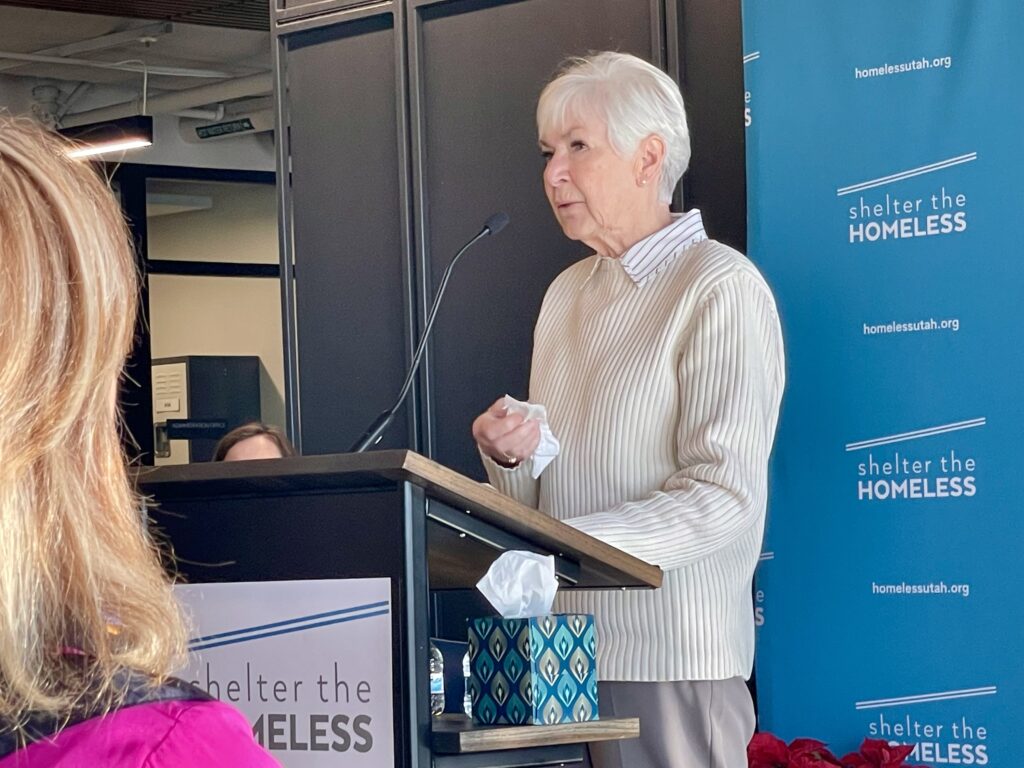


Gail Miller announces a $10 million donation to Shelter the Homeless during a news conference held at the Gail Miller Resource Center in Salt Lake City on Dec. 11, 2025. (Katie McKellar / Utah News Dispatch)
Utah’s richest woman, Gail Miller, told of how long ago, her late husband Larry H. Miller would stash money in the pocket of a suit coat that he rarely wore as a fund for “special needs.”
It was early on, when the Miller family’s business was still young.
Back then, Gail Miller said she and her husband would sometimes dip into the suit coat pocket to help people “when we saw a small need, something that could use a few hundred dollars maybe.” Then, whatever was left at the end of the year, “we’d use to support families at Christmastime,” she said.
“Now, years later, I look at that suit coat pocket,” Gail Miller said, pausing as her eyes filled with tears, “and I realize that that was a training ground for both of us. As philanthropists and as stewards.”
Larry H. Miller’s venture in car dealerships eventually grew to an empire — one of the largest and most recognizable businesses in Utah. After he died in 2009, Gail Miller took the mantle of the family company, which has since evolved into a diverse investment portfolio.
SUBSCRIBE: GET THE MORNING HEADLINES DELIVERED TO YOUR INBOX
Gail Miller told that story in front of a crowd of homeless services providers, local leaders and others during a news conference on Thursday at the Gail Miller Resource Center in Salt Lake City — a building named after her for her past charity helping improve Utah’s homeless system.
During Thursday’s event, Shelter the Homeless — the nonprofit that owns six homeless resource centers in Salt Lake County — announced the Miller family would be donating another $10 million to the shelters.
“Today’s gift probably would not fit in that suit coat pocket,” a tearful Gail Miller said. “But the spirit of giving still remains.”
$10 million for capital needs
That $10 million will be used to seed an endowment fund meant to support capital maintenance and improvements for the shelters, said Josh Romney, Shelter the Homeless’ board chair. The gift will help Shelter the Homeless to “maintain and enhance its programs, improve security, expand support services, and ensure long-term stability” for people experiencing homelessness, according to the nonprofit.
“The homeless resource centers are among the most effective tools to help individuals and families move out of crisis,” said Romney, who is a Salt Lake City-based real estate developer and is also the son of Utah’s former U.S. Sen. Mitt Romney. “This generous matching gift will provide essential capital funding to ensure the centers, which provide over 90% of the shelter beds in Salt Lake County, remain places of dignity that are safe and well maintained for many years to come.”

Gail Miller’s donation brings the total amount the Larry H. & Gail Miller Family Foundation has given Shelter the Homeless to more than $22 million.
In 2017, the family pledged to match up to $10 million of donations to help fund programs and services inside three new homeless resource centers in Salt Lake City and South Salt Lake. The shelters opened in 2019, and in 2021 Shelter the Homeless announced the Millers’ match had been met. Since then, Gail Miller has also given about $2 million along the way for various capital needs, according to Laurie Hopkins, Shelter the Homeless’ executive director.
Gail Miller and Shelter the Homeless leaders hope her latest $10 million donation will spark others to donate their time or money to Utah’s homeless system.
The goal, Romney said, is seek more donations to grow the fund to $30 million for all the resource centers. The $10 million donated by Gail Miller will be “mostly focused” at her namesake resource center in Salt Lake City’s Ballpark neighborhood to address “wear and tear” on the building.
“This money will ensure that the (Gail Miller Resource Center) continues to evolve, it will continue to improve, and it will continue to serve as a gateway for individuals who are seeking a fresh start,” Gail Miller said. “It’s not only about meeting today’s needs. It’s about building a strong foundation for tomorrow.”
Utah Gov. Cox proposes millions for homeless campus while also hoping for federal funds
Roughly $100 million in state and local government and private money has been spent on Shelter the Homeless’ resource centers.
“We (used) a huge amount of money to build these buildings,” Romney said. “We just want to make sure they’re safe and secure and clean in perpetuity.”
Ongoing funding still scarce
Although Miller’s donation helps provide stability for capital needs, Romney said, it doesn’t address the need for more ongoing funding for programs. For years, homeless services providers and local leaders have also urged state leaders to commit more ongoing money to support their operations on a yearly basis.
Miller called on everyone — including individual Utahns — to continue supporting the shelters.
“Homelessness is not a problem that one organization can solve alone,” she said. “It really requires the community, united in purpose. It needs service providers, government partners, volunteers, donors, faith, communities and neighbors, all working together.”
“It is our problem, not theirs,” she said, referring to people experiencing homelessness. “Today’s contribution is a recognition of that shared responsibility.”
Salt Lake City Mayor Erin Mendenhall, while thanking Gail Miller for her donation, said “this shared responsibility is felt.”
Although Mendenhall acknowledged the homeless resource centers opened not that long ago, in 2019, she said “the intensity of the use of these buildings is very high, and the need for capital investment, planning, and the upgrades of the infrastructure and repairs are serious.”

“This is coupled with the reality of underwhelming operational funding year after year,” Mendenhall said. “These buildings are beautiful, and they were designed to do even more than they’re doing at their peak today.”
Mendenhall said Miller’s donation comes at a “meaningful” time, not just as temperatures drop into winter, but also as state leaders “look to expand shelter options and expand needed services, mental health, behavioral health, substance use treatment, etc.”
Next month, the 2026 Utah Legislature will convene its 45-day general session, during which lawmakers set the state’s next fiscal year budget.
Homelessness funding is expected to be a topic of debate. Last week, Gov. Spencer Cox proposed as part of the state’s $30.7 billion budget, state leaders should use $25 million in one-time money and $20 million in ongoing funding to help fund a proposed 1,300-bed homeless “campus” and address “homelessness and criminal justice high utilizers.”
The governor, however, did not specifically propose ongoing funding for the homeless resource centers — and his budget recommendation, if approved by lawmakers, still wouldn’t fully fund the envisioned homeless campus, which state leaders have estimated would cost around $75 million to build, plus upwards of $34 million in ongoing funding to operate. The governor told reporters he hopes local partners, private donors, and federal funding will help fill the gaps.
Mendenhall said Miller’s donation was crucial to help sustain and improve the state’s existing shelters, which continue to face unmet needs.
“What your gift means to me is that we will not give up on these homeless resource centers that are working incredibly well for the vast majority of people who enter their doors,” Mendenhall said, calling the donation an “anchor into a system of hope and healing.”


“This is a system that is working well, and that can work even better,” the mayor said. “We know we need more beds of all different sorts. We are going to go there together with shared responsibility and with clear and open eyes about the best areas of investment.”
Asked whether he’s concerned that state leaders focusing their attention on the proposed homeless campus could crowd out funding conversations for the homeless resource centers, Romney told reporters, “I’m going to avoid that conversation because I don’t want to take away” from Miller’s donation announcement.
“We can talk about that another day,” he said. “Today’s about celebrating Gail and what she’s done here.”
Rep. Tyler Clancy, R-Provo, who in March will replace the state’s now-retired homeless coordinator, Wayne Niederhauser, said by prioritizing ongoing funding for “high utilizers” in the state’s criminal justice and homeless shelters, the goal would be to free up space to improve “flow through the system as a whole,” including in the homeless resource centers.
“We’re not going to look away from this. We’re going to double down,” he said.
This coming legislative session will be Clancy’s last as a lawmaker before he takes on his new role as state homeless coordinator. Asked whether he’s confident lawmakers will, like Miller, put their money where their mouth is, Clancy said there are “still ongoing conversations” with the governor’s office and lawmakers about future funding commitments and what the “first puzzle piece” will be to expand capacity in the state’s system.
“But the values are certainly shared there,” Clancy said, “and so that’s what makes me confident that the investment will come.”