
Utah News Dispatch
Developer of Delta data center announces ‘revolutionary’ tech to turn natural gas into water

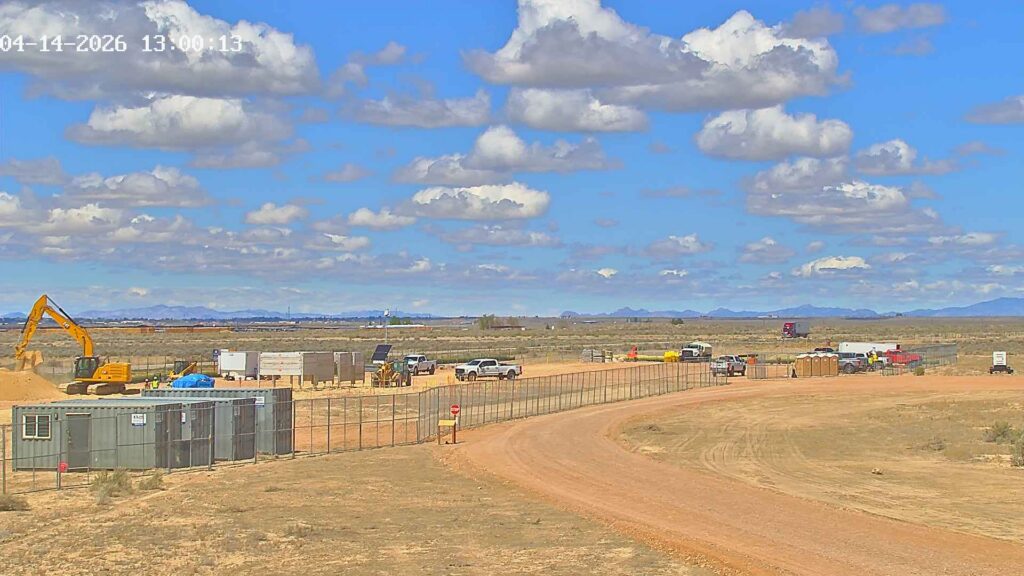

Construction crews work to build the first phase of a natural gas connection at the site of a data center project near Delta, Utah. (Photo courtesy of Creekstone Energy)
Creekstone Energy, the company behind a huge data center campus being built near Delta in Millard County, has announced that it’s in the process of patenting a “revolutionary technology” that can turn natural gas into water.
The new technology — which the developer said can capture water vapor from the exhaust of Creekstone’s own natural-gas-powered electricity generation and convert it into water — has been named GIGAWATER, which the company said is the “centerpiece” of its Project Oasis initiative at the Delta Gigasite campus.
“We at Creekstone Energy, we don’t believe Utah should have to choose between economic growth and responsible water stewardship,” the company’s founder and CEO Ray Conley told reporters in an embargoed virtual briefing last week, ahead of Wednesday’s announcement.

“Because Creekstone’s focused on building the largest data center campus in the world, that comes to the forefront very immediately,” Conley said. “We think that the data centers have to be designed for the places where they’re built. And because we’re building in Delta, in the arid West, it’s not just about minimizing local water demand from the beginning, which we’ve been focused on. But how do we innovate and how do we recognize ways to do this better?”
So Conley said Creekstone has “filed for a patent on a new technology that creates water,” designed to capture water vapor that’s created when natural gas is combusted to create electricity.
“To confirm the science holds at scale,” the company said in a news release Wednesday, Creekstone Energy has signed a research agreement with the University of Utah’s Energy & Geoscience Institute “to independently verify the technology.”
Though the company is likely several years away from generating water at a large scale, Conley said he wanted to announce it now, as the University of Utah prepares to start its research, because “I felt that it’s important for people to understand that data centers — at least some of us in the industry — are trying to push innovation forward to benefit the environment.”
“It’s something that can actually benefit Utah and not simply be a drain on resources,” he said.
As controversy over data centers have swept across the country, the majority of ire in Utah hasn’t been focused on the project near Delta, but rather on a different data center campus proposed by celebrity investor Kevin O’Leary in Box Elder County, in northern Utah. Amid intense backlash, the project area has been scaled back from 40,000 acres to 20,000 acres.
About 200 miles south of Box Elder County in a rural area, the Delta Gigasite is already under construction after five years of planning. There, Creekstone says it’s working to build the largest data center campus in the world meant to “enable leadership in the race to AI superintelligence,” according to its website.
Creekstone owns 1,143 acres near Delta, but the project’s footprint will also span across 30,000 acres owned by the Utah Trust Lands Administration that are under lease for solar, which the company says will generate the majority of the campus’ energy needs. Agreements have also already been struck to build a pipeline to bring natural gas from Wyoming to Utah.
O’Leary agrees to cut Stratos data center area in half following letter from Utah Senate president
At full build out, Creekstone says the campus will have more than 10 gigawatts of electrical capacity — more than double what the entire state of Utah currently consumes.
In April, the Utah Governor’s Office of Economic Opportunity awarded Creekstone Energy a post-performance tax incentive for its Millard County project. In exchange for the creation of 106 jobs with wages totaling $333 million over 20 years (averaging an annual salary of about $162,148 each), the company was awarded a 50% tax credit.
That post-performance refundable tax credit will save the company about $172 million in taxes over 20 years. That equates to a cost of about $1.6 million per job over the lifetime of the deal.
According to an April news release issued by the Governor’s Office of Economic Opportunity announcing the deal, Creekstone Energy is expected to invest more than $17 billion in Utah over the next two decades and generate more than $334 million in new state revenue.
Developer expects to create ‘vastly more’ water than it uses
Creekstone promises an “essentially waterless operation” with a dry cooling system that works like a car radiator, not a swamp cooler — and that it will only use water for bathrooms and drinking.
With its patent-pending technology, the company expects the data center campus to generate more water than what the Delta Gigasite “itself will ever consume.”
“Vastly more,” Conley told reporters.
With about 2.1 gigawatts expected to be generated from natural gas (compared to 6 gigawatts from solar and 1.8 gigawatts from the Intermountain Power Project, a power plant near Delta), Conley said Project Oasis is expected to generate 4,000 acre-feet of water per year. That’s equal to about 1.3 billion gallons, or enough to cover a football field one foot deep 4,000 times.

“Now, that’s just a projection,” Conley said, “based on the chemistry and the physics of what we’ve done. But we recognized early on that even though we did our own engineering analysis, which was needed to put this together for the patent and to put into operation, having independent validation was really important.”
That’s why he said they’re working with the University of Utah’s Energy & Geoscience Institute “to independently test our model, our assumptions, and help us really determine how that system can perform at scale.”
Conley, however, said he’s “pretty confident” the technology will pan out, hoping to build a working pilot program near Creekstone’s construction site “to validate that it works,” and then the University of Utah’s research will determine “what would be needed to take it to commercial scale performance.”
He expects the university’s results to come next summer. Then after about two years, he said the company will “know if it makes sense to go ahead and scale it up.”
“The science behind Project Oasis is promising,” Milind Deo, the principal investigator with the University of Utah’s Energy & Geoscience Institute, said in a prepared statement included in Wednesday’s news release.
Deo said the institute is “committed to rigorous, independent verification, moving from theory and math through computer modeling and, ultimately, to physical demonstration.”
“If the results bear out, this could change the way the data center industry thinks about water,” Deo said.

How does the new tech work?
Creekstone’s news release described the new technology as a process that turns “exhaust into water.”
“When natural gas is burned to generate power, the exhaust it produces contains water vapor,” the company said. “GIGAWATER captures that exhaust, cools it through a regenerative rock-bed system, and converts the vapor into usable water, collected on site. It doesn’t drain Utah’s water supply. It adds to it.”
Conley — who holds degrees in aeronautics and astronautics from MIT, according to his website — developed the new technology’s underlying model himself, Creekstone’s news release said.
When explaining how it works, Conley compared it to condensed water that drips out of an idling vehicle’s tailpipe.
“That’s actually condensed water in the tailpipe from the combustion process,” he said. “What we’ve done is figured out how to do that same process, only at a very large scale in the desert, to capture the water byproduct of combustion when we’re burning natural gas to make electricity.”
Conley believes the new water could potentially be used for a variety of purposes: irrigation, agriculture, geothermal energy cycles, and potentially — if it’s filtered — potable water.
“We believe that there’s a good chance the water, with at least a little bit of filtration, would be potable because there’s no bad chemicals that are in it. You know, you’re just literally precipitating the water out,” he said. “It will likely have a higher degree of acidity just because of how water interacts with rocks and that kind of thing. In which case, it would have some applications for agricultural use.”

He added the company will need to do more testing to figure out what it could be used for and “how much processing and filtering we would have to do to make it drinkable.”
“But the goal doesn’t have to be (to) make it drinkable at the end of the day, because there’s plenty of other uses you can use for it,” he said.
As for the natural gas emissions, Conley said the company is following federal standards and working with the Department of Environmental Quality on air permits.
“In our case, we are expecting to be considered a small (emissions) source,” he said.
SUBSCRIBE: GET THE MORNING HEADLINES DELIVERED TO YOUR INBOX.
He said one of the campus’ biggest emissions will be nitrous oxide. But rather than having a smokestack, he said the company is testing and evaluating whether they can put it underground and “how much of those nitrous oxides and other types of chemicals react with the rock and the other stuff we’re putting in there to minimize that emission.”
“That’s part of what Utah is looking at and what we’re trying to make sure, that it’s not only compliant with what the air quality standards are, but hopefully exceed those by a fair bit,” Conley said.
An unprecedented question for Utah lawmakers
If Creekstone’s Project Oasis works, it could pose an interesting and unprecedented issue for Utah lawmakers to grapple with: What happens when a company starts generating more water than it needs? Will it own it? Sell it? Who gets to decide the terms?
“That’s a really good question,” Conley said. “Well, we are paying for all the inputs. We pay for the gas, and we pay for the machinery that creates it.”
But he also acknowledged that water is a “unique” issue in drought-stricken Utah, noting he’s heard a joke that “the water that’s in your body, somehow Utah has a right to. Which I don’t think is actually true, but whatever.”
“I am not an expert on water law, and I’m sure people will have opinions on that,” Conley said. “But I think it’s a good problem to have because we’ll have created the resource.”
So if Project Oasis becomes flush with water it doesn’t need and could potentially sell, Conley said he doesn’t know how the discussion will play out “because there is no precedent, right?”
Bill to force data centers to publicly disclose water use advances
“It’s not like we’re doing something that’s been done before. And so it leaves an open question,” he said. “Those are things that are really matters of law. … We can follow, like, what I would think would be right. But, you know, if lawmakers have a different opinion, then they get a say in that, right?”
Conley added that if policy makers “make a decision that would deprive the economic value of it, then that would obviously impact whether or not it would be worth the effort of doing it, too.”
“So there’s always a give and take between commercial interests and how you make those decisions,” he said.
Given that Creekstone is investing money to make the project possible, however, Conley said it’s not likely that the company would give away the water it generates for free.
Utah lawmaker says project could create new standards for data centers
Rep. Jill Koford, R-Ogden, issued a prepared statement included in Creekstone’s news release Wednesday saying she hopes Project Oasis could set a new standard for how the data center industry operates as a whole.
“What Creekstone is doing with Project Oasis goes well beyond compliance,” she said. “This is exactly what it looks like when Utah businesses, our universities, and state leaders work together to meet a challenge head-on. I hope it sets the standard for how the entire industry operates.”
Koford successfully sponsored legislation earlier this year to require data centers to disclose how much water they use.
Conley said Creekstone is building GIGAWATER “because we don’t think Utah should have to choose between hosting this industry and protecting its water.”
“We hope it becomes the model for how data centers are built across every arid climate where water is precious,” he said.