
Utah News Dispatch
5 things to know about MIDA as it works to usher in a massive data center

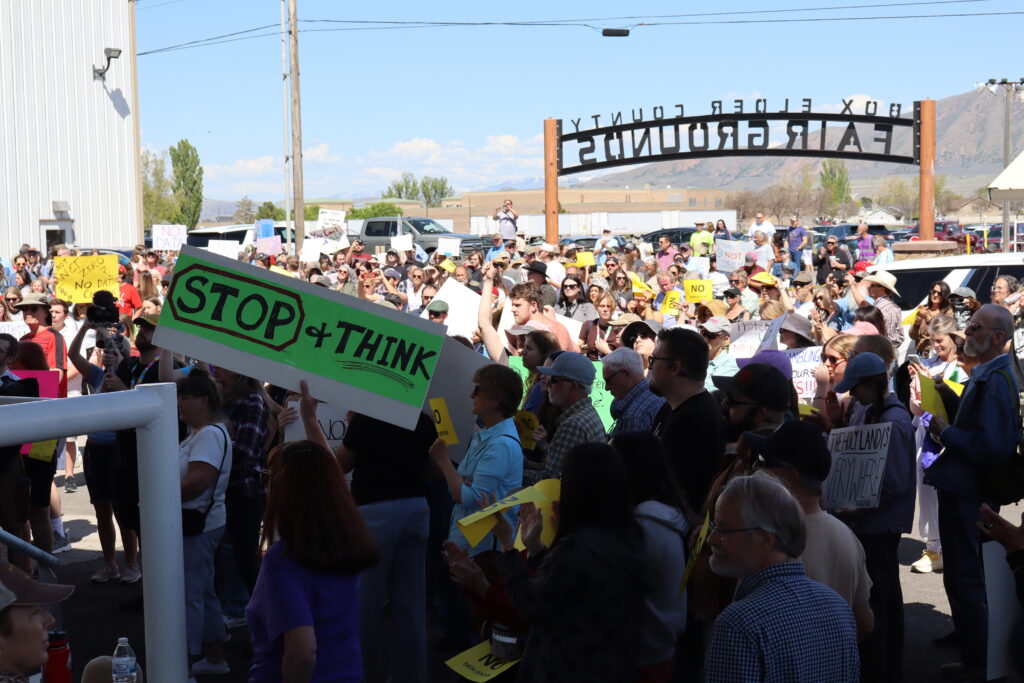

Community members protest ahead of a special Box Elder County Commission meeting to discuss the “Stratos” project, a massive data center proposed for an unincorporated area in Box Elder County on May 4, 2026 (Alixel Cabrera/Utah News Dispatch)
Utah’s plan to bring a 40,000-acre data center near the shores of the Great Salt Lake is shining a spotlight on the independent state authority working to make the Stratos development a reality. Here are five things to know about the Military Installation Development Authority, or MIDA:
What is MIDA’s role in the Stratos Project
In January the Governor’s Office of Economic Development referred the Stratos Project to MIDA after recognizing the military use of a hyperscale data center, Paul Morris, executive director of MIDA told Box Elder County commissioners in an April meeting.
It’s normal for MIDA to receive multiple proposals that are ultimately rejected because they either weren’t viable, or didn’t have a military component to them. This one, though, fulfilled a national security goal, and was especially viable in the Box Elder County site because of its proximity to the Ruby natural gas pipeline, which is expected to power the project’s energy plant, Morris said. Also because the area is near fiber networks and to a chunk of educated workforce.

Since MIDA has already approved the project, it will now work to facilitate public and private partnerships to develop it.
MIDA is also expected to create a design review committee, with representatives from Box Elder County staff and a local landowner, according to the Utah Governor’s Office.
How MIDA started
The organization was formed almost 20 years ago to work with private companies on developing military land deemed underutilized. It took shape with a 2007 act of the Utah Legislature, just a few years after Hill Air Force Base survived a national wave of military site closures. State leaders envisioned MIDA as a way to help sustain military bases and surrounding communities by generating jobs, growing the state’s tax base and bringing in money for military initiatives. To date, MIDA says it’s boosted property tax value in Utah by $1.5 billion.
Who’s in charge
MIDA functions like a local government in that it can issue bonds, levy taxes and make decisions about land use within its project areas. Sen. Jerry Stevenson, a top state lawmaker and a member of the authority’s board, told colleagues on a legislative panel in 2024 that “anything that a city can do, MIDA could do.” Unlike a city, however, its governing board is appointed, rather than elected to the job. Five of its seven voting board members are appointed by the governor, one by the Senate president and one by the House speaker.

Stevenson and fellow MIDA board member Senate President Stuart Adams have faced scrutiny for receiving campaign donations from developers of MIDA projects. The two lawmakers, both Republicans of Layton, have said the contributions do not affect their decision-making. Adams said Tuesday in a statement to Utah News Dispatch that “campaign and PAC contributions are disclosed and are entirely separate from any policy decisions.”
What one community says about a recent MIDA project
Aside from the Stratos Project, MIDA has six project areas under its belt. That includes the Deer Valley East Village, a project that also saw controversy when it was first proposed for another site. After Park City took action to preserve an open space MIDA had envisioned for a hotel, the entity moved its plans to neighboring Wasatch County, where development of a recreational project area is still in progress.
With strong concerns from Park City, Wasatch County, which had plans to develop “a mini Tahoe” approached MIDA to collaborate, Justin Grabau, Wasatch County manager, said. That agreement resulted in the Grand Hyatt Deer Valley, a 381-room hotel with 100 rooms available at special rates for active and retired service members — part of the Department of Defense’s Morale Welfare Recreation program.
Hundreds cry out as Box Elder commissioners wave in massive data center
That, alongside a “ski beach,” has represented “a pretty significant economic development” for the county, Grabau said.
The single largest impact for the community now that the project is generating revenue is more tax income, he said. There have also been more jobs and even demographic growth with people moving to the area to work in the industry. With that, the county expects more state investment for roads and transit.
The Wasatch County project is substantially different from the one proposed in Box Elder County both in size and scope. MIDA’s project occupies 14.5 acres in Wasatch County and, unlike the Stratos Project, the goal of the Deer Valley project is to provide recreational programming for the military, rather than the defense goals cited by MIDA officials on the data center project.
But, similarly to the data center campus, Wasatch County also had to sign an interlocal agreement with MIDA establishing the project area boundaries and a tax sharing agreement to move forward. Currently the county provides services in the area and contracts with MIDA to provide its buildings’ health and safety inspections.
“We have a very collaborative relationship,” Grabau said.
What taxpayers may not know
MIDA is one of hundreds of entities in the state that have the power to levy taxes, but that many Utahns may not have known about before the data center plan met public outcry. Others include the Point of the Mountain State Land Authority overseeing the redevelopment of the former prison site in Draper, and districts across the state providing services like water, sewer, fire and mosquito abatement.
“We’d like to see a way — and we’re open to all creative ideas on this — how do we broadcast that these government entities exist to the public?” said Billy Hesterman, president of the nonpartisan Utah Taxpayers Association. “We don’t necessarily think that they’re doing something nefarious or out to do something to get one past the public. We just think that people don’t know about it, and we need to find a better way for them to engage with the public, so that they know they’re there and that they’re operating.”
MIDA spokesperson Kristin Kenney Williams said in a statement the organization “operates in utmost transparency.” She noted revenue generated from the authority’s project areas gets reinvested in those same places, “supporting developments that directly benefit surrounding communities, military installations, and programs across the state.”