
Utah News Dispatch
Will stopping the Inflation Reduction Act lower Utah energy bills? Experts say no

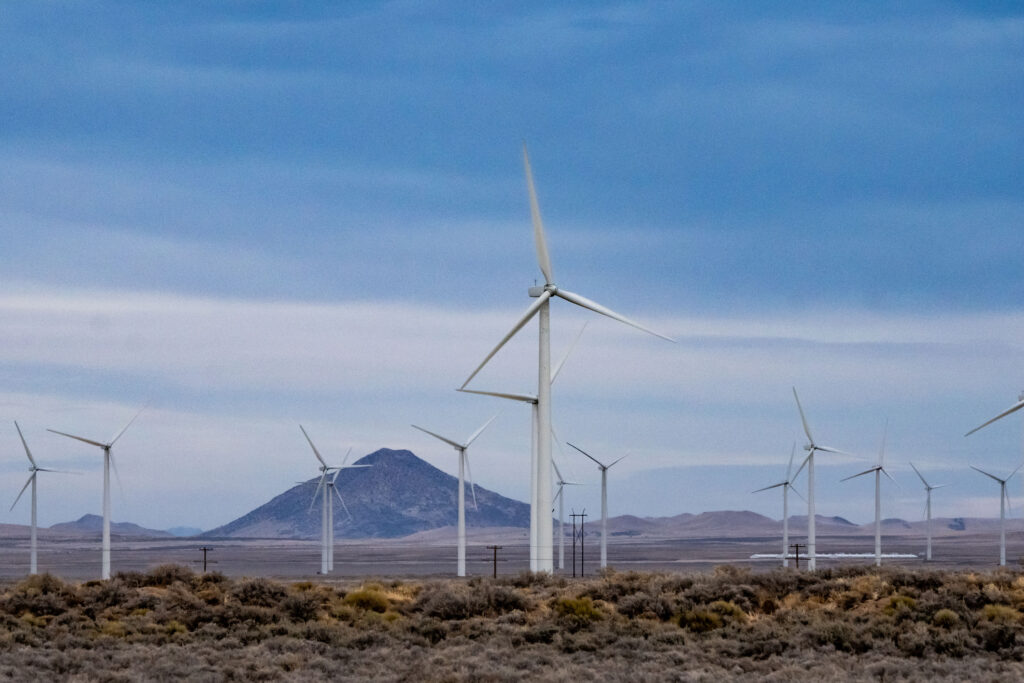

Wind turbines that are part of the Milford Wind Corridor Project near Milford spin on Sunday, Feb. 2, 2025. (Photo by Spenser Heaps for Utah News Dispatch)
A Biden administration law that propelled clean energy incentives to help address climate change was often described as a game changer for decarbonization efforts and a green energy transition. But, as President Donald Trump took office, one of his first actions was to freeze it, along with other Green New Deal efforts.
But, are the plans to eliminate the legislation in line with his goals to reduce energy prices? According to a study by clean energy experts, no.
The U.S. Congress passed the Inflation Reduction Act in 2022, opening doors for more federal tax credits and funding for clean energy technologies and manufacturing. Repealing the grants, tax credits and funding associated with the legislation would add about $50 to the average household’s energy bill a year by 2035 nationwide, according to a study by Energy Innovation, a clean energy and climate think tank.
SUBSCRIBE: GET THE MORNING HEADLINES DELIVERED TO YOUR INBOX
In Utah, annual energy bills would be $20 more expensive per household by 2030. By 2035, that number would rise to $120 per year, said Robbie Orvis, senior director for modeling and analysis at Energy Innovation.
“When you get rid of these tax credits, you get less clean energy deployed, and you get less investment in clean energy and energy technology manufacturing, like batteries and EVs and solar panels,” Orvis said. “Because wind and solar don’t have fuel costs, they’re basically free to run once you build them. And so the more wind and solar you deploy, up to a point, the more you lower energy bills, because energy bills are heavily tied to those fuel costs to run different power plants.”
Even with an expanded oil and gas production, Orvis said, energy bills are poised to rise under these federal changes.
Additionally, while big oil companies have expressed excitement about the government’s investment in fossil fuels, they are less enthusiastic about Trump’s call to “drill, baby, drill” and increase production, since doing so could mean a decrease in prices, and their profits, according to Bloomberg.
Coal, which has become a more expensive resource over time, may make a comeback under the Trump administration, but, according to The Washington Post, it may be temporary.
While Utah will undoubtedly see an economic impact from less clean energy investment, it won’t be as much as other states that have made substantial efforts to phase out fossil fuels and would have to procure energy at higher prices without the incentives, Orvis said.
Utah has heavily relied on resources like coal to produce electricity, passing legislation to protect the state’s coal-powered plants and vowing to keep a distance from blue states’ strategies to set ambitious clean energy targets.
A prime example are Colorado households, whose energy bills would see the biggest effect by 2030. According to the study, their prices would rise $180 annually. Other states would start seeing dramatic hikes by 2035. By then Missouri families would be the most affected, having to pay $640 more for their energy expenses per year.
With less investment in clean electricity and clean energy manufacturing, Utah would also lose 7,300 jobs by 2030 and 6,100 by 2035, carrying other consequences to the state’s economy, Orvis said.
“That means less GDP growth in Utah,” he said. “So we see a decrease in state GDP of $1.34 billion in 2030, and $1.29 billion in 2035.”
While Republican leaders, including Trump, have big hopes for the fossil fuel industry, citing affordability and reliability, a focus on drilling wouldn’t necessarily compensate for the job losses tied to stalling clean energy projects, Orvis said.
“You just don’t need that many hours to extract fossil fuels. Oil and gas companies have become very efficient at doing it, and so even with some increase in fossil fuel production, you still have enormous job losses,” he said.