Utah News Dispatch
Utah to receive millions through another opioid settlement


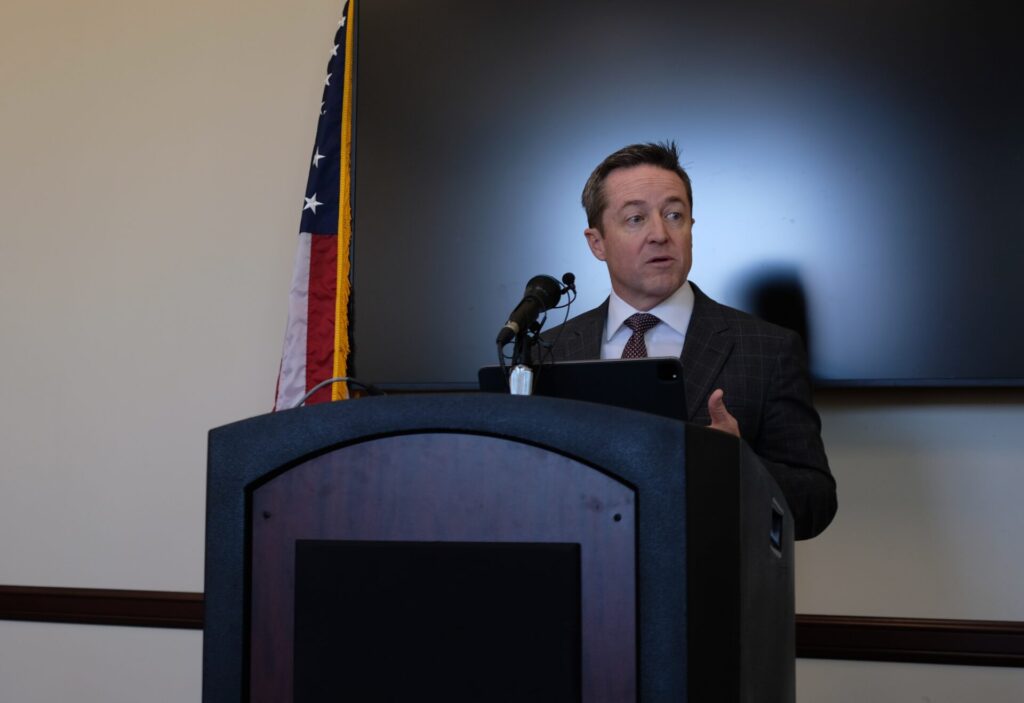


Utah Attorney General Derek Brown talks to reporters during his first press conference at the Utah State Capitol Building on Thursday, Jan. 9, 2025. (Kyle Dunphey/Utah News Dispatch)
Utah will continue to see millions more in funds secured through litigation with companies that manufactured or sold opioids, after a new settlement was announced on Monday with the global pharmaceutical company Mylan Inc.
According to the Utah Attorney General’s Office, Mylan “deceptively marketed” its opioid products — which included fentanyl patches, oxycodone, hydrocodone and buprenorphine products — to doctors as less prone to abuse. That’s particularly the case with the fentanyl patch, the office said.
As a result, the attorney general’s office claims doctors overprescribed Mylan’s products, which ultimately ended up on the illegal drug market.
SUBSCRIBE: GET THE MORNING HEADLINES DELIVERED TO YOUR INBOX
Mylan merged with Upjohn, Pfizer’s off-patent medicine business, in 2020 to form Viatris. Its brands and products include Epipen, Viagra, Xanax and Zoloft.
Viatris will join a growing list of pharmaceutical manufacturers, retailers, marketing companies and more — including UnitedHealth Group, Express Scripts, Purdue Pharma, Kroger, Johnson & Johnson, CVS, Walgreens, Walmart, and McKinsey & Company — that have either been sued by various attorneys general, or agreed to large settlements in the last several years.
Utah Attorney General Derek Brown said Mylan “was aware that its opioid products, including fentanyl patches, were especially prone to abuse, and did not inform consumers of that issue.”
Split among 15 states, including Utah, Viatris will pay about $335 million over the next nine years, money that will go toward law enforcement training and equipment, recovery programs and harm reduction efforts, including purchasing the overdose-reversing drug naloxone.
Fentanyl is the most common drug found in overdose deaths in Utah
Attorneys general from California, Illinois, Massachusetts, New York, North Carolina, Oregon, Tennessee, and Virginia negotiated alongside Brown for the settlement, while coordinating with Colorado, Delaware, Georgia, Idaho, Iowa, and Vermont.
Those annual payments will vary between $27.5 and $40 million each, and will be allocated based on each state’s “level of participation in the settlement,” according to a statement from Viatris.
In the statement, Viatris said its presence in the U.S. opioid market is “very small,” and that the settlement “is in no way an admission of wrongdoing or liability.”
Viatris said it will “further focus on its mission of empowering people worldwide to live healthier at every stage of life, advance its efforts to address unmet patient needs through an expanded innovative portfolio and continue to serve approximately 1 billion patients annually with its diverse portfolio of medicines.”
The company pointed to its manufacturing of a generic, injectible version of naloxone, and other generic buprenorphine and naloxone products used for opioid treatment and recovery.
The Viatris settlement will add to the roughly $81 million secured by Utah so far from opioid settlements. According to legislative budget records, Utah expects to see nearly $495 million from opioid settlements over the next 17 years — about $248.7 million will go to the state government, and $242.3 million will be dished out to counties.
The largest settlement is from the “Big 3 Distributors,” according to state records, which are Cardinal, McKesson, and Amerisource Bergen — industry giants that, according to The New York Times, distribute about 90% of the country’s drug and medical supplies. That settlement amounts to more than $219 million that will flow to the state and counties over the next 17 years.