
Utah News Dispatch
Utah State Board of Education to consider resolution tying DEI programs to communist goals

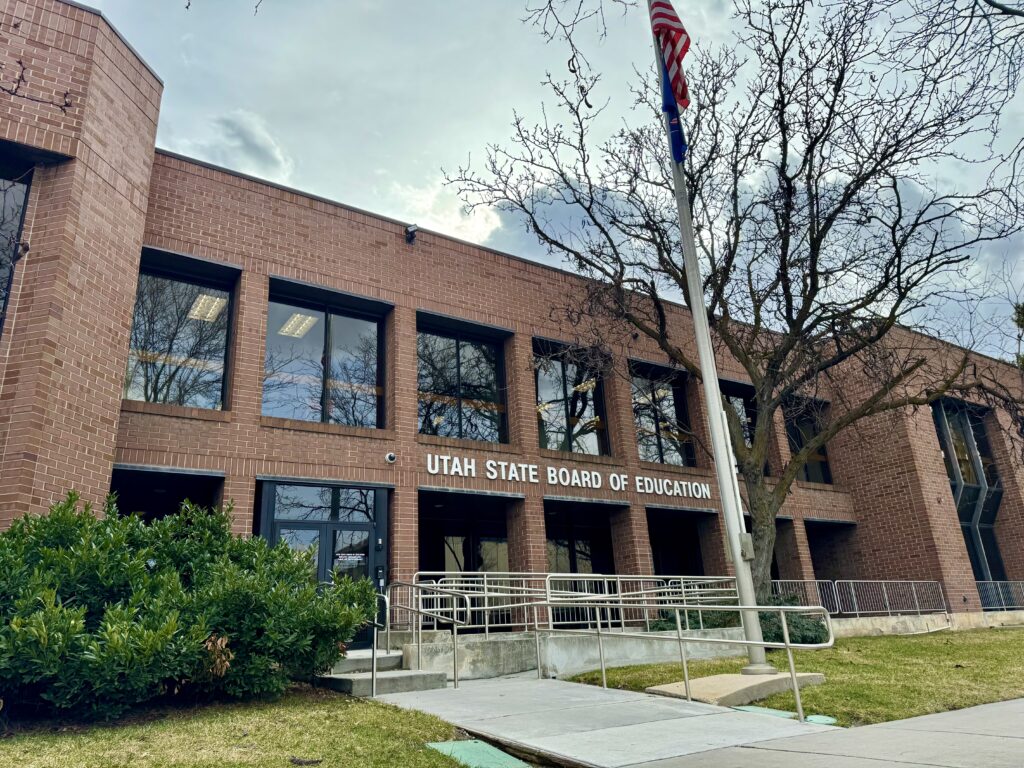

The Utah State Board of Education building is pictured on Wednesday, Feb. 14, 2024. (McKenzie Romero/Utah News Dispatch)
Are diversity, equity and inclusion programs explicitly “attempting to achieve the Soviet Communist goal of actual equality”? That will be part of a resolution the Utah State Board of Education is scheduled to discuss, and perhaps adopt, on Thursday.
Five Republican board members signed on to back a proposed resolution to remove DEI from Utah schools — Christina Boggess of Taylorsville, Cole Kelley of Vineyard, Joann Brinton of St. George, Rod Hall of Syracuse, and Emily Green of Cedar City — supporting a draft containing Trump Administration orders and a lot of Soviet Union terminology.
“The Utah State Board of Education directs its employees and subsequent staff, instructional and administrative personnel to immediately disband any and all ‘Diversity, Equity and Inclusion Practices;’” the proposal reads. “Moreover, the agency shall immediately disband and rescind all associated documents, training, programs, curriculum and policies.”
SUBSCRIBE: GET THE MORNING HEADLINES DELIVERED TO YOUR INBOX
The state school board still doesn’t have an official statement on the resolution since the board hasn’t discussed it yet, a communications person for the board said, and Boggess, who is coordinating the effort, didn’t reply to a request for comment on Tuesday.
The move stirred concerns from Utahns who oppose more DEI regulation in the state’s education system. Especially, since there’s already a Utah law in place that tightly restricts deploying DEI programs.
When HB261 became law in the summer of 2024, all public institutions in Utah banned programs that “promote differential treatment” and may exclude some based on their race, color, ethnicity, sex, sexual orientation, national origin, religion or gender identity.
As anti-DEI law takes effect, students and staffers share ‘great sense of loss’
“Of all of the anti-DEI things I’ve read in politics and in policy, this is the most far reaching and the most frightening,” Sarah Reale, one of two Democrats among the 15 state school board members, said on Tuesday.
Citing the recent implementation of that anti-DEI policy, Reale questioned the necessity of such a resolution when Utah schools have spent the last year making substantial cuts to diversity programs and are already in compliance with new federal orders prohibiting DEI.
“We have tons of work to do — helping students’ math scores improve, helping find ways to provide teachers with professional development opportunities, finding ways to support parents in the schools.” Reale said. “So to spend time on something that, to me, is blatantly just inciting fear, and that doesn’t help our teachers or students in their learning environment (…) is embarrassing. The resolution is embarrassing.”
Utah State Board of Education resolutions aren’t binding, they are just approved statements that express the opinion of the board’s majority. However, the draft resolution cites a Utah Constitution provision that gives the board control and supervision powers over public schools and programs designated by the Legislature.
However, Reale said, whether or not the resolution is enforceable isn’t the main issue.
“It’s the principle, it’s the tone, it’s the message that it sends that’s hurtful and scary,” she said. Approving these kinds of resolutions, “feels very Big Brother, very big government,” which, she added, isn’t the role of the state school board.
Soviet terms in Utah schools?
The resolution explains how a series of words and programs used in the Soviet Union may relate to DEI efforts — “коренизация (korenizatsiya), which maps to ‘inclusion,’ and разнообразие (raznoobrazsiya), which means ‘diversity,’ in the sense meant by Lenin who described it as ‘diversity in form to arrive at unity in content.’ DEI at its core is 1920s Soviet Union policy for using ethnic minorities to advance the installation of Communism,” the five board members wrote in the resolution.
The authors also criticized the terms “identity politics” and “inclusion,” which they define as “programs, processes or implemented ideas that emphasize including, affirming and protecting counter-hegemonic perspectives at the expense of universal and objective truth.”
Those correlations, Reale said, are false analogies.
“You cannot say that words in different languages mean the same thing and cross over with the same definition in English,” she said. “It feels very McCarthyism. It screams Red Scare. It’s frightening language.”
The resolution also has DEI as a synonym of Critical Race Theory, an academic discipline examining racial disparities in the country, which has existed for decades but became a hot culture war debate during Trump’s first term.
“DEI is not equal to CRT,” Reale said. “CRT is not found in any of our schools. We have looked and reviewed for anything that could be even a glimmer of CRT taught in our schools in Utah. They don’t exist.