
Utah News Dispatch
Utah Senate president and his GOP challengers debate data center, MIDA ahead of primary


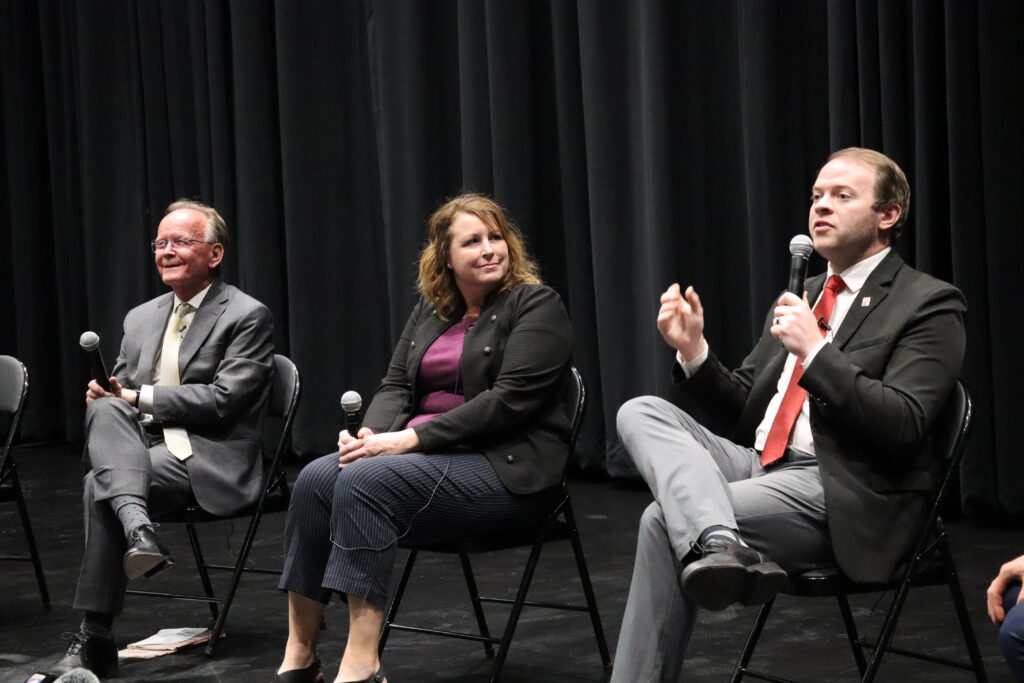


From left, candidates Senate President Stuart Adams, Stephanie Hollist and Braden Hess participate in a candidate forum at Sunset Junior High in Sunset, Utah on June 16, 2026. (Katie McKellar/Utah News Dispatch)
Utah Senate President Stuart Adams faced a tough crowd Tuesday night while defending his record on data centers, water for the Great Salt Lake and more ahead of a high-stakes primary next week, when Republican voters will decide whether he’ll stay in the running to keep his longtime District 7 seat.
If applause after each of her answers was any indicator, one of his Republican challengers, Stephanie Hollist, won the room while Adams was at times met with muttering, scoffs or silence. Adams’ other GOP challenger, Braden Hess, garnered scattered applause, but none as enthusiastic as the crowd’s responses for Hollist.
But that wasn’t unexpected for a forum attended by roughly 50 people concerned about the future of the Great Salt Lake and upset by a recent proposal to build a massive data center in Box Elder County that has drawn widespread backlash.
AI attack ads fly in contentious Republican primary for ‘vulnerable’ Utah Senate president’s seat
Hollist has latched on to that discontent, running a campaign focused on distrust and disconnect of current legislative leaders. Adams focused on showcasing his experience and Utah’s economic strengths, while Hess’ answers centered around limited government and free market principles.
The forum was hosted by the groups Grow the Flow, dedicated to saving the shrinking Great Salt Lake, Stewardship Utah, which advocates for land, air and water protections, and Box Elder Accountability Referendum (BEAR), which has filed a lawsuit in pursuit of a rejected referendum challenging the Box Elder County Commission’s votes to consent to celebrity investor Kevin O’Leary’s Stratos data center plan and approval of an interlocal agreement with the Military Installation Authority (MIDA), which is overseeing the development of the project.
MIDA
Adams chairs MIDA, which he defended as a longstanding state entity that’s helped expand Utah’s military footprint, protect Hill Air Force Base and spur the creation of thousands of jobs.
“Nobody’s done more to protect Hill Air Force Base and protect the economic validity of this area,” Adams said. “I’m proud of that record, and it’s one of the great things I’ve been able to accomplish as a legislator.”
Both of his opponents, however, criticized the powerful special district, saying it’s lost its “original” mission, grown too big, and has too much power to override local land use and taxing authority.
“It’s bloated to the point where it’s not quite recognizable to its original intent,” Hess said, adding he’d like to see MIDA and other “extragovernmental” special districts “eliminated.”
Hollist argued Utah has “lost” its separation of powers between its three branches of government, and “we’re seeing the example of it right here with MIDA.”

MIDA has “grown so big and has so many tentacles that to unravel it would be challenging,” Hollist said. She also said it has a problem with “oversight” from the Legislature, given Adams serves as both the chair of the board and as Senate president.
“There’s two hats that are being served right now, and it seems to me like it’s a little bit of a matter of a fox guarding the hen house,” Hollist said. She didn’t go as far as saying she would seek to repeal MIDA, but “there’s cleanup that needs to happen with this entity,” she said, prompting applause.
Adams, however, argued MIDA can only operate in areas where a local government gives consent and “lets them in.”
“Every city has input on everything MIDA does, so they’re really an extension of that local government, but they’re able to do more,” Adams said.
To criticisms that MIDA has “lost its way,” Adams said it’s been “wildly successful,” pointing to city and county leaders in Weber and Davis counties, saying “it’s been a great thing for us.” He also said it helped build the “finest recreation facility for the military,” located in Wasatch County.
“MIDA fulfilled that promise,” Adams said. “I’ll stand behind that because I believe those that protect our freedoms should have the very best recreation facility.”
Water, the Great Salt Lake and data centers
When moderator Ben Abbott, executive director of Grow the Flow, asked the candidates what their vision is for water management in Utah, Hollist said she “might start by not proposing the largest data center in the country,” which prompted loud applause.
“What is this really going to do to our aquifers? What is this really going to do to our environment?” she said, adding Utahns have “lost trust” with how the Stratos project was handled. “Now we actually need real information about how we would go about doing this in a way that would actually protect our resources.”
She also called for an “all hands on deck” approach to solve Utah’s water crisis, while looking to other counties and states for solutions. While she said she’s not a water expert, “I know how to bring people in who are, and I know how to listen to good, solid data.”

Hess said he’s not an expert on water or natural resources, but “from an economic standpoint, the pricing of water is distorted because of subsidies.”
“So I believe in every business, every individual paying for the use of their water. If they use it, they pay for it,” he said, opposing “use it or lose it” or tiered systems that incentivize water use. “If it’s priced correctly, as a scarce resource, people will decide accordingly.”
He also said he thinks the state needs to “utilize more reservoirs.”
Adams said the state is facing a “big problem” due to its water shortages, but he also argued he’s worked hard to search for solutions for water conservation for the Great Salt Lake, including looking to other countries including Israel to increase the state’s supply.
“When we were there, they solved their water problem with desalination,” Adams said of his trip to Israel while also describing efforts to strike deals to build desalination plants in California and trade Colorado River water shares for Utah. “Those innovative ideas are what’s going to solve our water problems.”
Adams also said it’s not just “my position, it’s a legislative position” to protect Utahns from threats to the state’s water supply, including from data centers, while also saying there’s a need for them, including for national security.
“So how are you going to deal with the need for data centers, the need for (artificial intelligence)? We know the country that controls AI is going to control the world,” Adams said, pointing to a 2025 bill that put water and power requirements on data centers.
“The data center that came into Box Elder County did say that they build more (power capacity) … than they would use,” Adams said, but he noted he also “pushed back” on the O’Leary venture after public outcry, pushing him to shrink it from 40,000 acres to 10,000 acres.

Adams also said “none” of the water on that 40,000 acres eyed for the project “goes to the Great Salt Lake because it’s just absorbed into the ground and the aquifer there doesn’t run to the Great Salt Lake.” So “we were going to take advantage” of O’Leary, he said, and require him to not only produce “more power than he consumed,” but also “he’s got to take that water that he’s not going to use for his data center and he’s got to deliver it to the Great Salt Lake.”
Adams also noted that O’Leary “has a long way to go” to obtain all the permits needed to make the data center a reality, while saying “I want to make sure the public stays engaged” on the project.
“So (I) try to listen, I think we actually … got a better project because of it,” Adams said.
Hollist, however, expressed concerns about “building the plane while we’re flying it.”
“We’re past the point of having a whole lot of trust in this particular project,” she said. “While we keep hearing a lot of promises, I am concerned about the ability to hold people accountable for those promises.”
She argued it should be a “high priority” to ensure “any data center that we build” isn’t going to impact the state’s environment and its water availability.

“I just worry a whole lot about us signing up to be the guinea pigs when we know we have limited resources,” Hollist said.
Hess said he’d expect the government to treat data centers “like any other business out there.”
“As long as they are not harming society and our resources in measurable ways, I think we should allow them to go forward,” Hess said, while also opposing using subsidies or any other types of incentives to draw projects in. “I don’t think it’s the government’s job to pick winners and losers when it comes to businesses, but it is there to protect citizens from the externalities that these businesses create.”
Hess said “as long as a business like Stratos can stand on its own two feet and absorb all of the costs associated with the increase in demand on our resources … they should be able to move forward.”
“And if they can’t, then it shouldn’t be,” he said.
Referendums and ballot initiatives
The candidates were also asked about their position on direct democracy through ballot initiatives and referendums — including whether they support the referendum on the Box Elder County data center.
Adams said he supports referendums as a “check” on government, but he said he has a “problem with initiatives.” He said during the “progressive era” in the 1900s, Utah was among 20 states that amended their constitutions to include ballot initiative power, and he disagrees with a 2024 Utah Supreme Court ruling that put ballot initiatives that reform government on equal footing with the Legislature, which he has said created “chaos” in the state’s lawmaking.

“We live in a democratic republic,” Adams said. “We don’t pledge allegiance to a democracy. We pledge allegiance to a republic. … We need to maintain and keep our republic strong.”
Hess said he’s “not a fan” of referendums or ballot initiatives, or anything that “directly” allows people to enact laws.
“The reason why is not because the people are stupid, it’s a matter of the people often don’t have the time or the resources to dive into the issues as extensively as our elected representatives,” Hess said, adding he believes in a representative government.
Hollist, however, said she supports the Utah Constitution as written, which allows both referendums and ballot initiatives.
“We need to honor that,” she said. “That is the way the Utah Constitution has been amended to be able to give the voice to the people. … But I do believe that our Legislature should be listening. That’s the breakdown that we have right here. That’s the disconnect.”
If the Legislature isn’t listening to the people, she said, “we need to be able to have a way for the people” to exercise their lawmaking power.
When Hess pressed her on whether she likes “direct democracy” or not, Hollist said, “I support the constitution.”
“Great dodge,” Hess interjected. He argued that representatives do need to listen to their constituents, but “it should not be mob rule,” and they should exercise that power through elections rather than ballot initiatives.